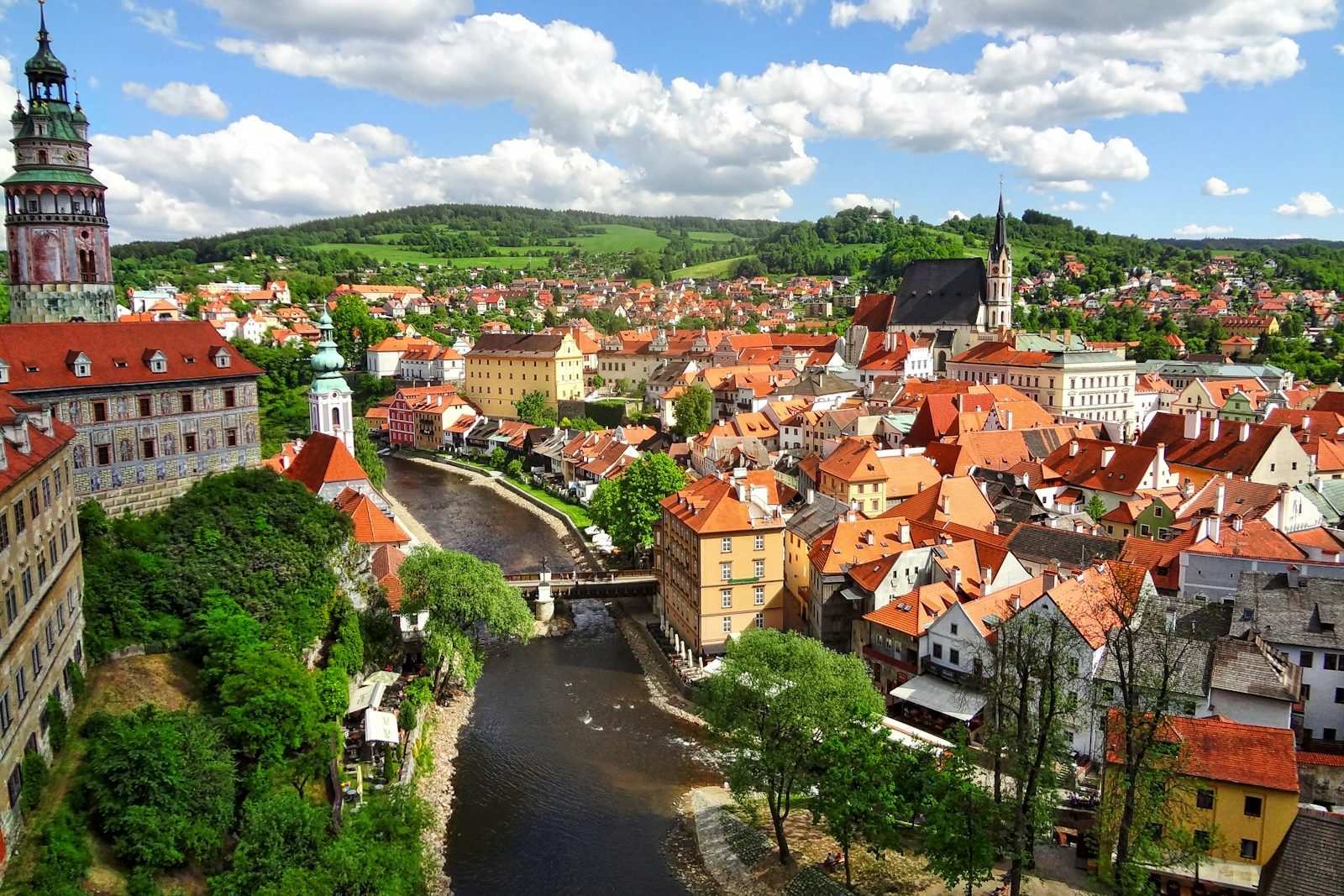


In short, here is what to see in the Czech Republic beyond Prague: medieval Cesky Krumlov, the spa town of Karlovy Vary, silver-rich Kutna Hora with its bone chapel, and functionalist Brno. All four cities are one to three hours from Prague by train or bus, so each one is doable even on a single day trip. You will not need a visa for it: Ukrainian citizens with a biometric passport can enter the Czech Republic within the Schengen 90-day allowance.
Prague pulls in the main flow of tourists, which is exactly why the rest of the country often loses on name recognition but wins on atmosphere. Krumlov has no city-length queues, Kutna Hora's Gothic cathedral stands almost crowd-free, and Karlovy Vary lives at its own spa-town pace. Below: where to go, what makes each place worth it, and where travellers most often miscalculate.
Where to go from Prague and how long it takes
Before we go through each destination, here is the big picture. Distances and travel times are approximate (a direct connection versus a transfer changes them significantly), so double-check the timetable before you travel.
Partner links: booking through them supports the blog at no extra cost to you.
| City | Why it is worth it | How much time to set aside | Distance and route from Prague |
|---|---|---|---|
| Cesky Krumlov | An entire old town under UNESCO protection, a castle above a bend in the Vltava river | A full day, ideally an overnight | about 170 km, 2.5-3 hrs by bus |
| Kutna Hora | St. Barbara's Cathedral and the ossuary in Sedlec | Half a day to a full day | about 85 km, 1-1.5 hrs by train |
| Karlovy Vary | The spa colonnade, the Vridlo geyser, Moser glass | A day | about 125 km, around 2 hrs |
| Brno | Villa Tugendhat, Spilberk fortress, the underground | One to two days | about 210 km, 2.5-3 hrs by train |
Why Cesky Krumlov deserves to be seen first
It is the most compact marvel on the list. Krumlov's historic core was added to the UNESCO list back in 1992, among the first in the country, and it still looks almost free of advertising and new construction: a curving loop of the Vltava wraps around the old town, and above it rises a castle complex whose history reaches back to the 13th century.
Krumlov's main trap is not the prices but the timing. The town is so small that day buses from Prague dump a wave of tourists here from roughly midday to five in the afternoon, and that is exactly when the main lanes get crowded. If there is any chance at all, stay overnight: once the day groups leave, the town returns to itself, and Krumlov in the evening looks nothing like the postcards.
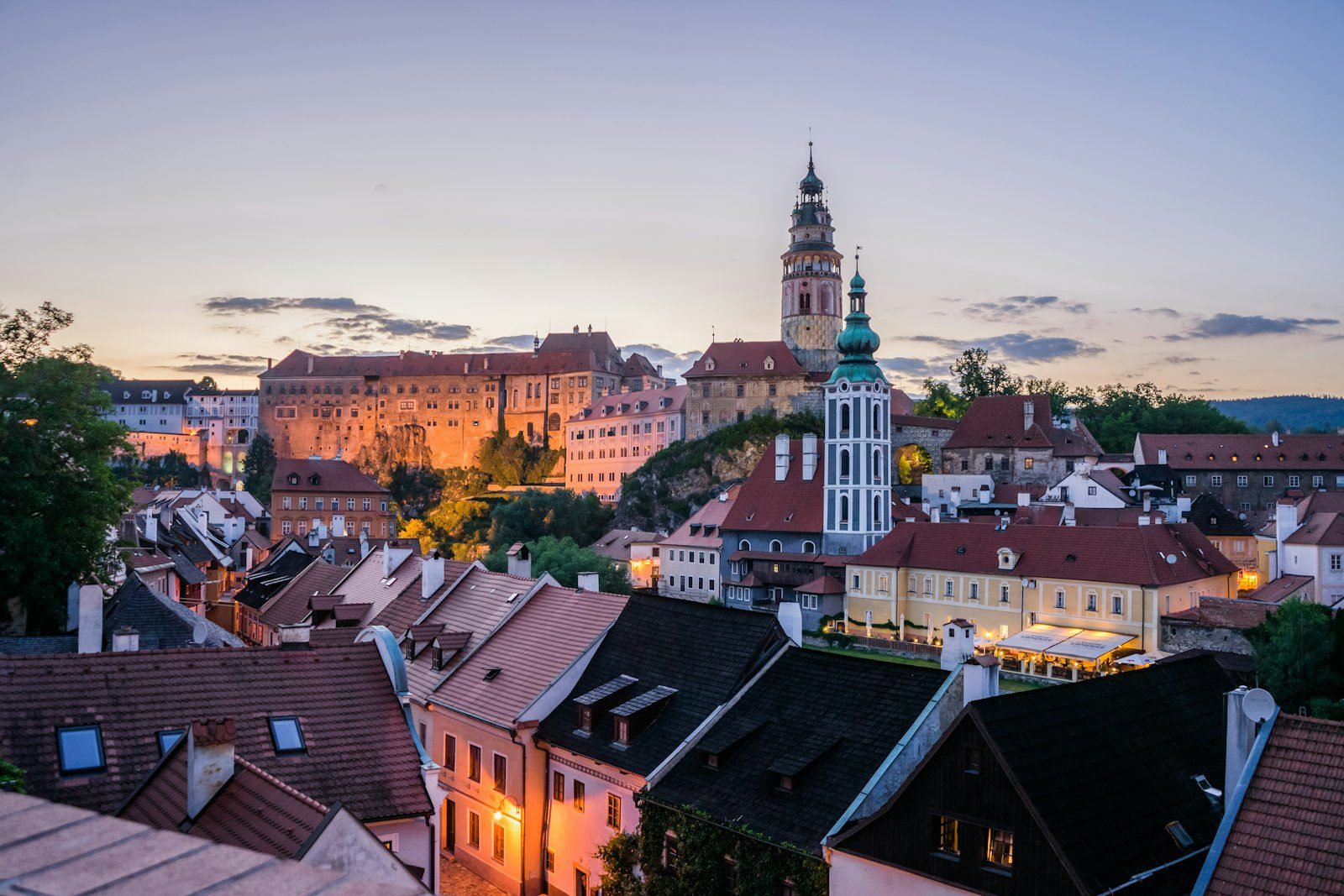
What to fit in: climb the castle tower for the view over the red roofs, walk past the unique Baroque theatre inside the castle, and go down to the river. In summer people raft and canoe down the Vltava here, and it is one of the cheapest ways to see the town from the water. Entry to the castle interiors follows a seasonal schedule with days off, so check the hours on the official website before you set out.
Kutna Hora: silver, Gothic and 40,000-70,000 skeletons
This is the easiest day trip of the four: the train from Prague takes about an hour. In the Middle Ages Kutna Hora grew wealthy on silver mines and for a time rivalled Prague in influence, and with that money it built St. Barbara's Cathedral, one of the peaks of Czech late Gothic. The historic centre, together with the cathedral and the neighbouring Sedlec Cathedral, was granted UNESCO status in 1995.
But most people come here for something else. A few kilometres from the centre, in Sedlec, stands a small cemetery chapel with a chandelier, a coat of arms and garlands made from human bones inside. By some estimates, the remains of roughly 40,000 to 70,000 people were used here, and it is not a set piece for tourists but the result of an overcrowded medieval graveyard and epidemics.
A practical point: the ossuary in Sedlec and St. Barbara's Cathedral sit at opposite ends of the town, about twenty minutes apart on foot or a short ride. Tickets are sold separately or as a combined pass, cost a few hundred crowns, and you should confirm the exact amount on site. Photography inside the ossuary is not always permitted, and the rules change from time to time.
Why go to Karlovy Vary if you are not there to be treated
You can take in the spa as a town rather than a sanatorium, and in that sense Karlovy Vary is well worth a day. In 2021 the town, together with two other Czech spas, joined the transnational UNESCO site "The Great Spa Towns of Europe". The main promenade axis runs along the Tepla river: colonnades under which hot mineral springs bubble up. The most powerful of them, Vridlo, shoots a jet up to around twelve metres high.
People drink the mineral water here from distinctive porcelain cups with a spout you sip through; the taste is peculiar, salty and metallic, and not everyone falls for it. The herbal liqueur Becherovka was born nearby, and not far away they make the famous Moser glass. Once a year, usually in early July, the town fills up for an international film festival, and that is when accommodation prices climb noticeably and free rooms are almost impossible to find.
An honest downside of Karlovy Vary: the town is stretched out and a touch prim, and in the evening, once the shops close, life here fades. Anyone chasing nightlife will be bored. Anyone who wants to stroll at ease, drink the water and browse the glass will love it.
Brno instead of a second day in Prague
Tourists skip the Czech Republic's second-largest city for no good reason. Brno is younger in spirit than Prague: universities, cafes and 20th-century architecture instead of wall-to-wall Gothic. The main draw for those in the know is Villa Tugendhat, a masterpiece of functionalism by the architect Mies van der Rohe from the late 1920s, another UNESCO site. You can only get inside with an advance booking, and tickets sell out weeks ahead, so you need to plan early.
Beyond the villa, Brno has plenty to fill a day: the Spilberk fortress on its hill, the Cathedral of Saints Peter and Paul, the tunnels beneath the old town, and one of the largest bone crypts in Europe under the Church of St. James. Fast trains from Prague get there in about two and a half hours, and it makes a logical base if you are heading further south into Moravia's wine country.
When to go and what not to do
The most comfortable months for all four destinations are late spring and early autumn, roughly May, June and September. July and August are warmer, but that is the peak of prices and crowds, especially in Krumlov. Winter is quiet and cheaper, though some of the castle interiors close for the season and daylight is short.
The most common miscalculations are gathered below. This is not an exhaustive list, but these are exactly the things that trip up anyone who plans the Czech Republic in a hurry.
| Common mistake | How to do it right |
|---|---|
| Squeezing Krumlov into half a day between other plans | Give the town a full day or an overnight: the daytime crowd eats up the whole impression |
| Showing up at Villa Tugendhat without a ticket | Book entry online a few weeks ahead, the number of places is limited |
| Planning Karlovy Vary for early July "because it is warm" | Check the film festival dates: accommodation gets pricier and sells out |
| Counting on the castle interiors in winter | Check the seasonal schedule: much of it only runs from April to October |
| Travelling on a non-biometric passport figuring "they will let me through somehow" | Without biometrics you need a visa; that is sorted out before the border, not at it |
Do Ukrainian citizens need a visa for the Czech Republic in 2026
No, you do not need a separate visa if you hold a valid biometric passport. The Czech Republic is in Schengen, so the general rule applies: a stay of up to 90 days within any 180 without a visa. The days are counted cumulatively across the entire Schengen area, not per individual country, so previous trips to other Schengen states also count toward the total.
Two details for 2026 worth keeping in mind. First, Schengen is gradually rolling out the EES entry-exit system with biometrics at the border, and the crossing procedure may take more time. Second, the ETIAS online authorisation system is being prepared (roughly a 20 euro fee valid for several years), but its launch has been postponed several times. Check the current status of both systems and the passport requirements before your trip on the official EU visa portal and the website of Ukraine's Ministry of Foreign Affairs, because this is the part that changes fastest.
A separate matter: Ukrainians with temporary protection status in the Czech Republic. That is no longer a tourist arrangement but a distinct set of residence rules, and they are worth clarifying directly with the Czech authorities rather than at the tourist sights.
Where to start your route
If it is your first time in the Czech Republic and you have only one free day outside Prague, take Kutna Hora: close, striking, and you make it back for dinner. If you have two or three days and want atmosphere rather than a sprint, Cesky Krumlov with an overnight will give you the most. And if you have already seen Prague and are looking for a different Czech Republic, a living one that is not a museum, head to Brno and further south into Moravia, where a completely different country begins: vineyards instead of castle towers.