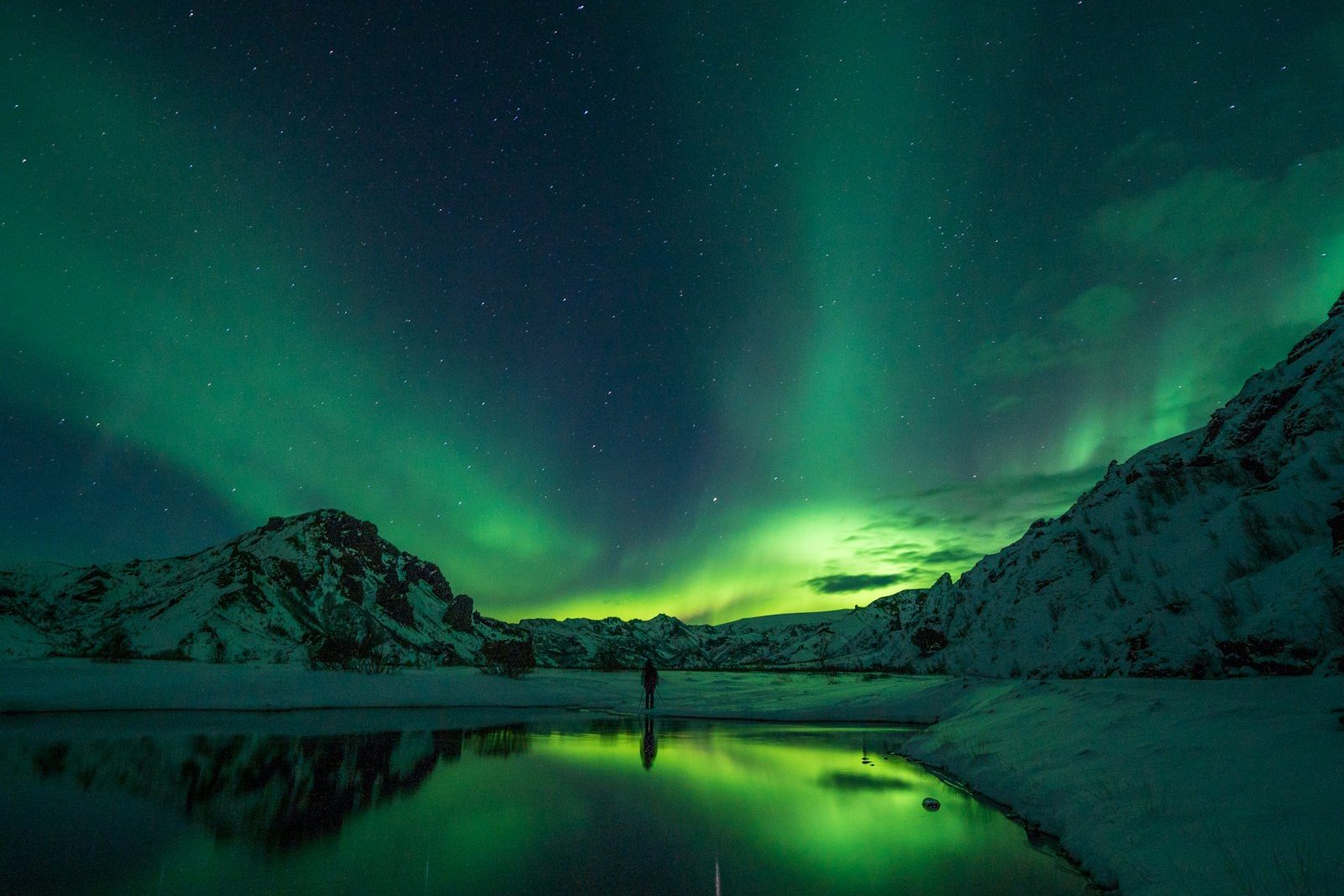


There is no single right answer to the question of the best time to visit Iceland, because it is not one trip but two completely different countries sharing the same passport of stamps. In summer you get open roads, the midnight sun and green plateaus, but not a single northern light. In winter it is the exact opposite: the aurora overhead and ice caves inside a glacier, but short daylight and half the routes buried under snow.
So the question of the best time to visit Iceland really means «what exactly did you come to see». The aurora and the midnight sun physically cannot happen in the same week.
When can you see the northern lights in Iceland, and when the midnight sun?
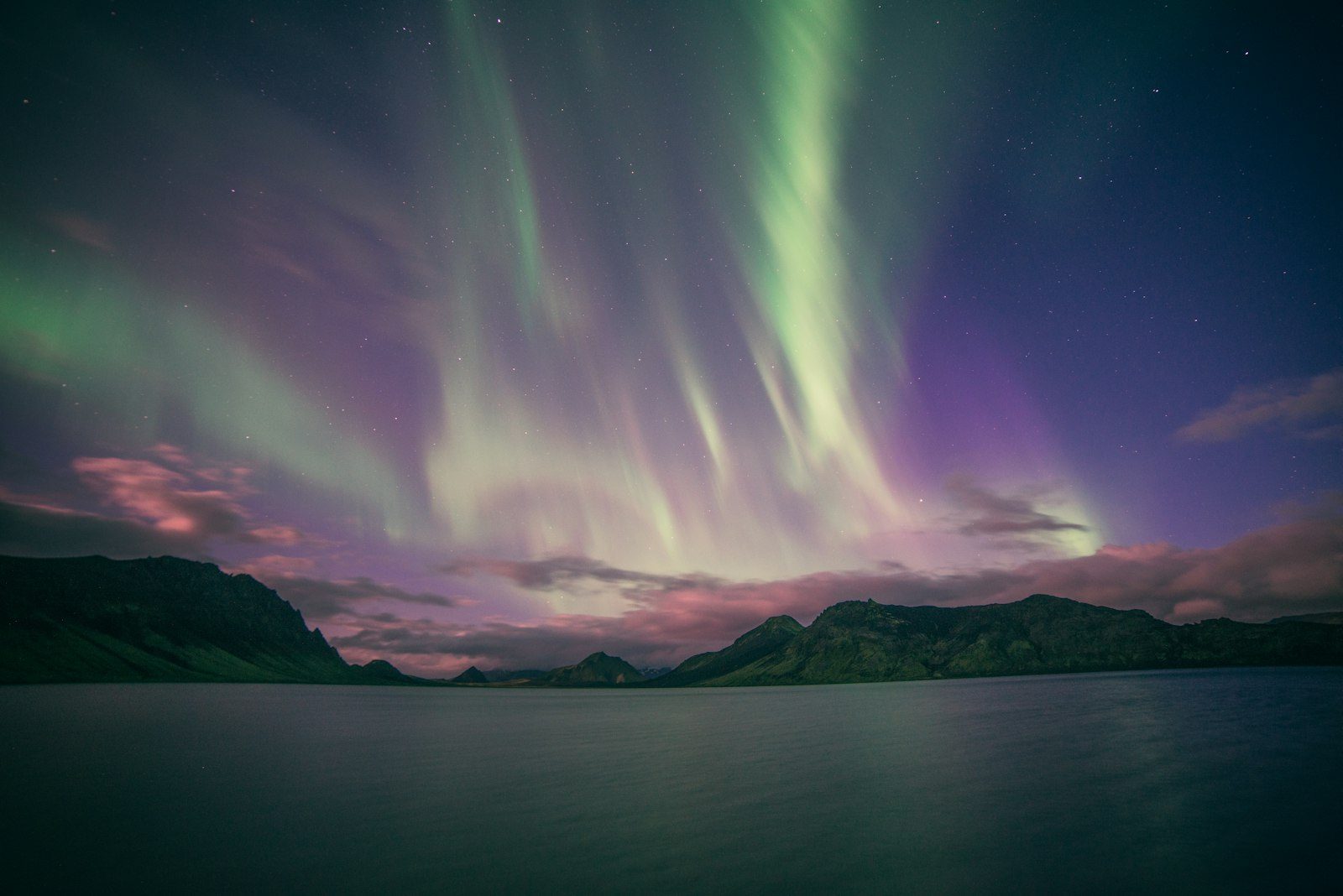
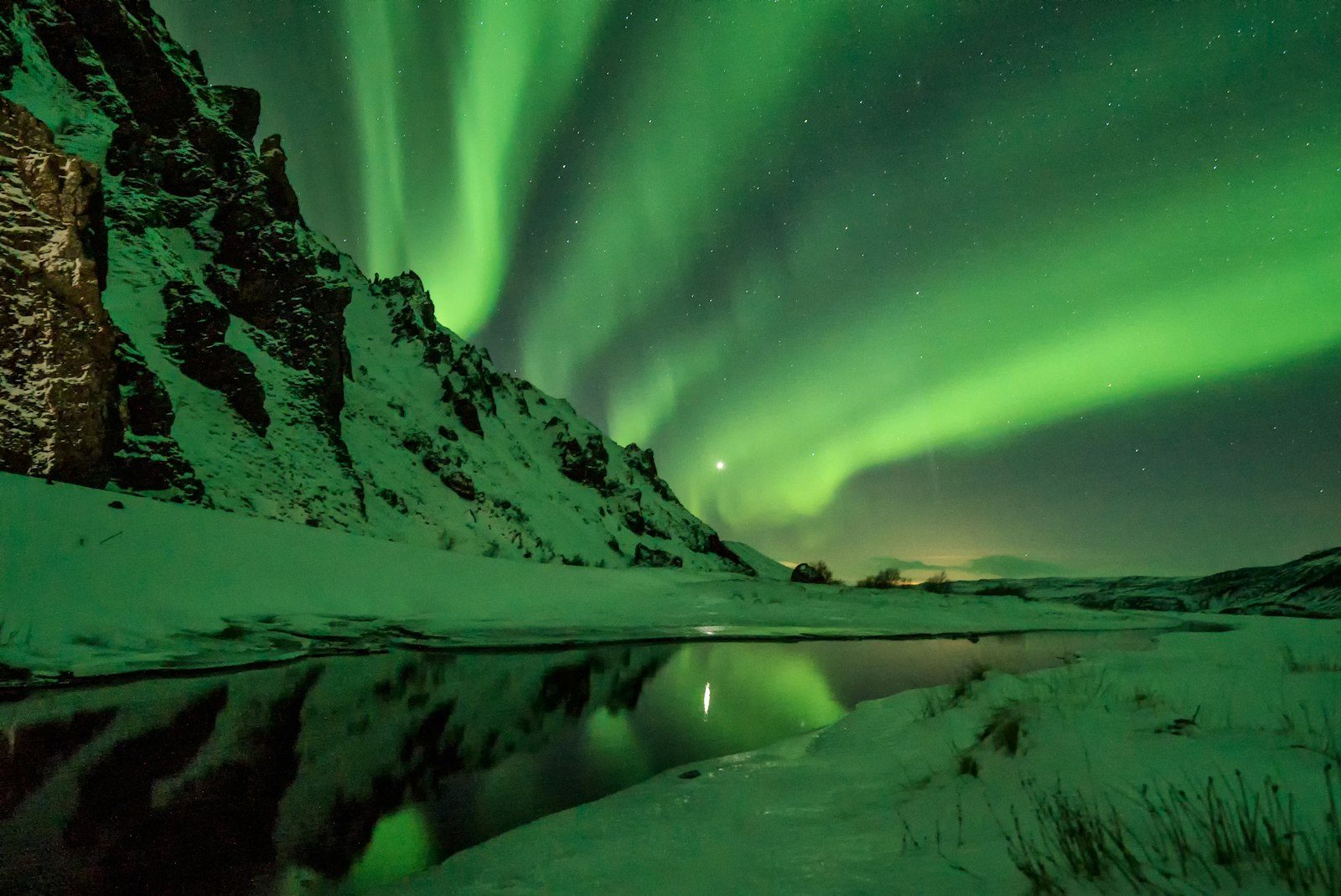
People hunt the northern lights in Iceland roughly from late August to mid-April, and the most reliable conditions come in the months from September through March. The reason is simple astronomy: the aurora is there all year, but in summer the sky is far too bright to make it out. You need darkness, and darkness only returns in autumn.
Partner links: booking through them supports the blog at no extra cost to you.
The midnight sun works on a mirror schedule. The peak falls in mid-June and early July, when around the solstice on 21 June the sun in Reykjavik sets only for a couple of minutes before midnight and immediately climbs back up. The sky never really darkens. In the north of the country and on the island of Grimsey, the sun does not set at all during these weeks.
One more detail that matters specifically for plans over the next few years: solar activity in 2026 and 2027 is in its declining phase after the 2024 maximum, but it is precisely this declining phase that brings frequent geomagnetic storms, so more flare-ups over Iceland are expected than in the quiet years of the cycle. That is not a guarantee (the aurora is always a lottery tied to the weather), but statistically the odds right now are better than average.
Month by month: a quick map of the seasons
| Month | Daylight | What is available | Weather and mood |
|---|---|---|---|
| June | around 20-21 hrs | Midnight sun, the first mountain F-roads open | Mild, around 10-13°C, start of the peak |
| July | around 20 hrs | Almost all roads open, puffins nesting, height of the season | Warmest month, the most people and the highest prices |
| August | drops to 14-15 hrs | Roads still open, the aurora returns late in the month | A transitional month, a nice compromise |
| September | around 12-13 hrs | Aurora plus accessible lowland routes, prices falling | Equinox, dark nights and bearable weather |
| October-November | shrinks to 5-8 hrs | Aurora, the first ice caves open (from mid-October) | Windy and wet, fewer tourists |
| December-January | around 4-5 hrs | Peak of the ice cave and aurora season, Christmas Reykjavik | Darkest of all, around 0°C, temperamental roads |
| February-March | rises to 8-11 hrs | Some of the best aurora conditions, ice caves still open | Steadier spring weather, the equinox in March |
| April-May | 13-17 hrs | End of the aurora, mountain roads still closed | The calm before the peak, greenery returning |
The daylight figures are approximate and apply to Reykjavik; in the north the contrast is even sharper. Check the current data before you travel, because sunrise and sunset shift week by week.
What does summer really give you besides warmth?
The main currency of an Icelandic summer is not the temperature but access. In winter a large part of the island is simply cut off: the central highlands with Landmannalaugar, Thorsmork and the Kjolur and Sprengisandur routes sit on F-roads that open gradually through June and July. F225 to Landmannalaugar and F35 (Kjolur) are often among the first to open, sometimes as early as mid-June; remote routes such as Sprengisandur usually have to wait until early July. July is effectively the only month when you can confidently say that almost everything is open.
The second currency is time. When the light holds for nearly the whole day, you are not cramming a route into 6 hours or racing to beat the dark. You can drive out to a waterfall at 11 in the evening and catch it without a single bus nearby.
Summer has its honest downsides too, and more than one. It is the most expensive and most crowded season: accommodation books out months ahead, the popular stops on the Golden Circle fill with tour groups, and you will not see the aurora at all. If the northern lights are number one on your list, you simply have to cross summer off.
Why do people come in winter for the aurora and ice caves?
Winter delivers what summer cannot offer in principle. The natural ice caves beneath Vatnajokull (the crystal caves, Katla, Skaftafell) are open roughly from late October to late March, while the ice is stable. This is a strict season: in summer these same caves melt and flood, and people simply do not go down into them.
Here is a safety detail worth taking on board before you book: you can only enter the ice caves with a guide. Conditions change every day, the route is chosen in the morning, and the gear (crampons, helmet, harness) is issued on site. Going it alone here is not about saving money, it is a risk to your life.
The price of the winter magic is light and roads. In December and January, at the depth of the darkness, only about 4-5 hours of daylight remain: the sun rises around 11:20 and sets around half past three. You plan not «the whole day» but two or three windows of activity. Add blizzards, black ice and sudden road closures, and it becomes clear why in winter it makes sense to keep a smaller radius and build in spare days.
What weather to expect in each season?
Iceland is warmer than its latitude suggests: the warm currents of the Gulf Stream soften the winter along the southern and western coasts. But «warmer» does not mean «warm».
In summer the average temperature stays in the range of 10-13°C, with July the warmest month at around 11-12°C in Reykjavik. This is sweater-and-windbreaker weather, not shorts. In winter the capital hovers around 0°C, sometimes a little higher, with rain more often than snow; January can bring cold snaps into the minus. The main enemy here is not the cold but wind with rain, so a waterproof shell and layers will save you better than a thick down jacket.
How much does the trip cost, and when is it cheaper?
Iceland is consistently one of the most expensive countries in Europe, and the season affects your budget as much as the exchange rate. The priciest stretch is July and August, along with the Christmas and New Year holidays. The best value windows are the shoulder seasons: late September, October and November before the pre-holiday surge.
The rough ranges below are meant to give you a sense of the order of magnitude, not fixed price tags. Icelandic prices move around, so check before you travel.
| Expense | Approximate range | What affects it |
|---|---|---|
| Ice cave tour (1 day) | around 120-200 USD per person | Location, transport from Reykjavik or from the glacier |
| Aurora hunting (group tour) | lower end of the day-tour range | Bus or small group, photo support |
| Car rental | noticeably pricier in summer | Four-wheel drive will not help on F-roads in winter, they are closed |
| Accommodation | peaks in July-August and over the holidays | Book months ahead for high season |
One separate budget trap: in winter it is easy to overestimate how much you can fit into a short daylight day and to book tours that physically will not fit the schedule. Fewer stops, more slack.
Do you need a visa for Iceland, and what changes in 2026?
No, you do not need a separate visa. Iceland is part of the Schengen Area, and Ukrainian citizens with a biometric international passport enter visa-free for 90 days within any 180. The conditions are standard for Schengen: a passport valid for at least a few more months after departure, medical insurance for 30,000 euros and proof of sufficient funds for the trip.
What is changing: Europe is rolling out the ETIAS system, an online entry authorization for visa-free travelers. The application costs around 20 euros (free for those under 18 and over 70) and is valid for three years or until your passport expires, but it is not a visa, it is a pre-registration. The launch date has been pushed back several times, and as of mid-2026 it is still not finally fixed, with a likely transition period before it becomes mandatory. Before you travel, be sure to check the current visa requirements from official sources: the website of Ukraine's Ministry of Foreign Affairs and the official ETIAS portal.
So when is the best time for you personally to visit Iceland?
The answer to the question of the best time to visit Iceland comes down to a single decision table.
| You came for | Season | The honest downside |
|---|---|---|
| The northern lights and ice caves | Late October to March | Short days, weather and closed roads |
| The midnight sun and the highlands | June to July | The highest prices, crowds, no aurora at all |
| A balance of price and access | Late August to September | A compromise on everything, there is no ideal |
| Quiet and savings | October and November | Changeable weather, some routes already under snow |
If it is your first time and you want the classic picture of the aurora over a black landscape, aim for the window from February to March: the lights are still active, and there is already more daylight and steadier weather than in December. If you dream of hiking the highlands and driving without fear of black ice, take July and make your peace with the price tag. And for anyone who has already been in summer and left without the aurora, the most logical move is to come back in winter for exactly what the island hides away until the dark months.