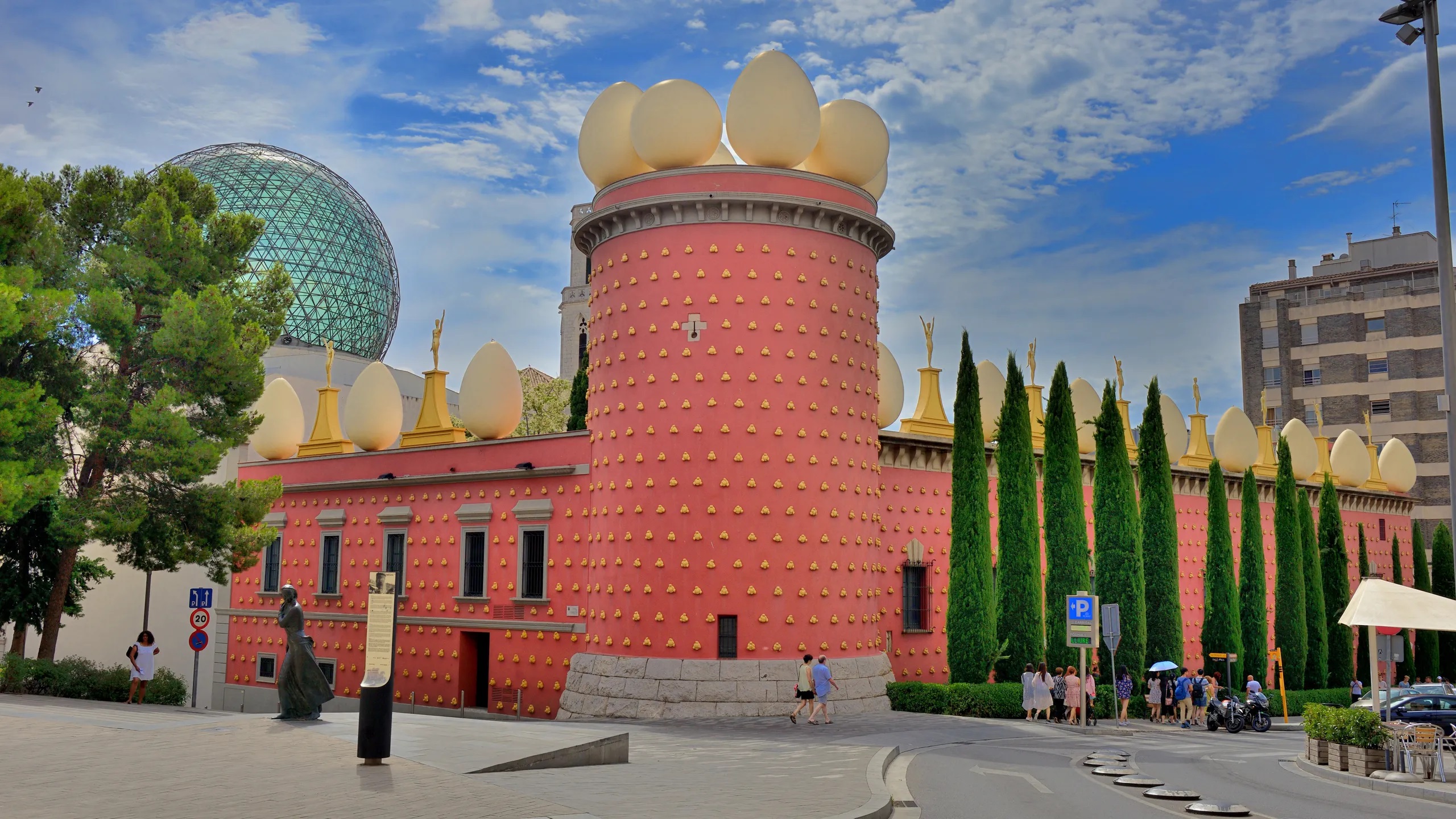


The Dali Theatre-Museum in Spain is one of the strangest museums in all of Europe.
Salvador Dali's whimsical collection, assembled by the man himself, is the ultimate statement from the famous surrealist. Best known for his uncanny paintings of melting clocks and his eccentric way of life, Dali had a grand vision, and this striking red fortress topped with giant eggs paints an intricate portrait of the celebrated artist.
The museum sits in Figueres, the eccentric Spaniard's hometown near the French border, inside a building that had been Dali's childhood cinema. After the theatre was burned to the ground during the Spanish Civil War in the late 1930s, Dali teamed up with city officials in the 1960s on a plan to rebuild it into a grand temple for showcasing his work.
Partner links: booking through them supports the blog at no extra cost to you.
By filling the former theatre with some of his most singular pieces, such as paintings that seem to transform depending on where you stand, like "Lincoln in Dalivision," and others visible only through secretly placed mirrors, Dali was able to create a museum entirely his own.
This surreal funhouse opened to the public in 1974 and remains a worthy destination for a day trip today.
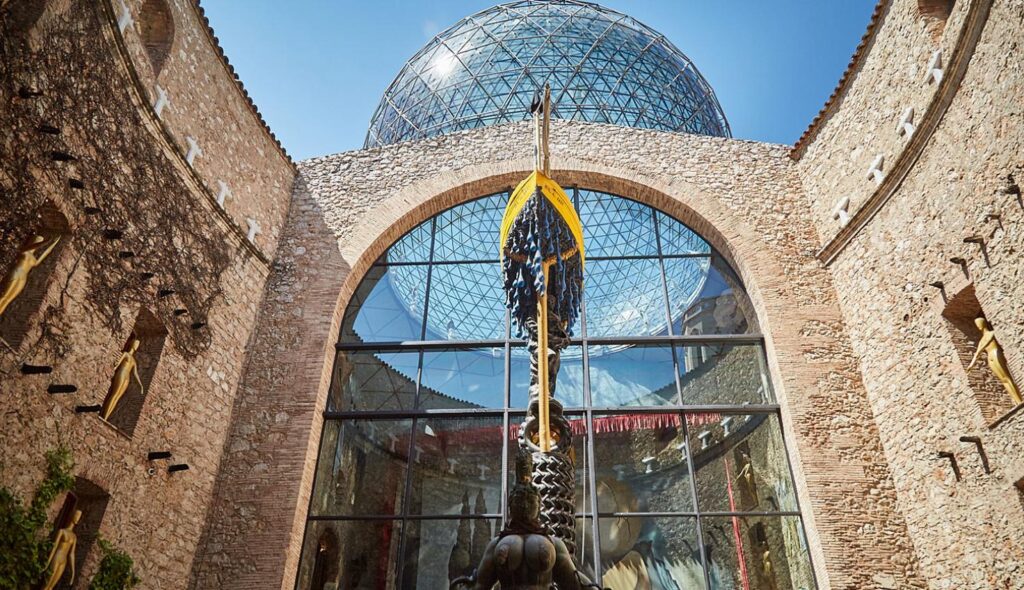
Located less than an hour by train from Barcelona, the theatre-museum in Figueres offers a break from Spain's more heavily touristed museums. It serves as the central stop on the "Dalinian Triangle," a route of three significant sites where Dali lived and made art, spread along the Costa Brava coast in Catalonia.
Also on the Dali tour: Pubol Castle, a medieval building 20 miles south of Figueres that Dali remodeled into a palace for his wife Gala, and the Salvador Dali House-Museum 20 miles east of Figueres, in Portlligat (Cadaques), where he and Gala kept a private coastal residence and studio.
It is believed that this is where, at the age of 14, he first displayed his work publicly, and the captivating theatre-museum is steeped in Dali's personal history. Even casual admirers of the artist's work should visit the main museum to get a genuine taste of Dali's surreal perspective.
Dali's Eternal Vision
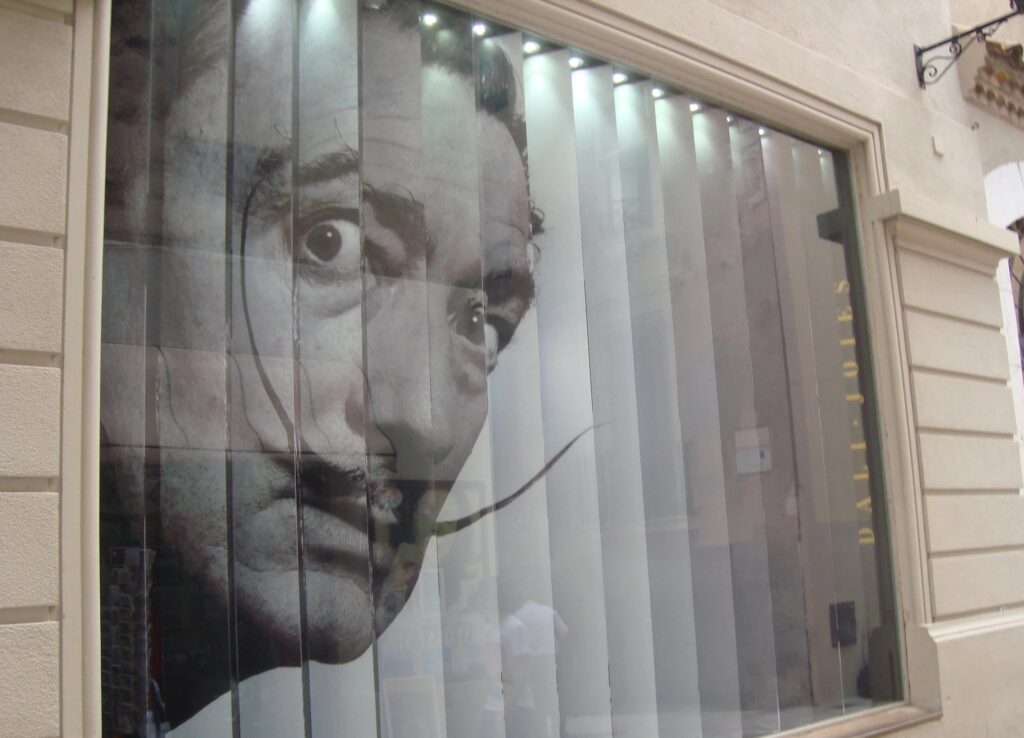
Visitors first enter the Dali Theatre-Museum through an open-air circular courtyard, which originally held the theatre seats, and in an instant they are transported into Dali's imagination.
At the center of the space sits Dali's personal black Cadillac, parked beneath "Rainy Taxi," an upside-down sailing boat painted with blue condoms that trickle downward to mimic drops of water.
Golden, Oscar-style figurines made from life-size mannequins line the walls of the rotunda. With their arms raised, they seem to be rejoicing over whatever is being created below.
A glass geodesic dome, resembling the eye of a fly, caps the former stage. Beneath it lies Dali's tomb. In fact, this is where his funeral took place in 1989, and the spot remains his (sometimes) final resting place.
In 2017, his body was exhumed from the crypt as part of a nearly decade-long, ultimately unsuccessful paternity case brought by a fortune teller named Pilar Abel, who claimed to be the master surrealist's daughter and sole heir. It was exactly the kind of spectacle Dali himself would have relished, and the bizarre episode revealed that the artist's signature mustache had survived nearly 30 years after his death.
In a 2017 radio interview, Narcis Bardalet, the embalmer who assisted with the exhumation, described the mustache as "[like the hands of a clock at ten past ten, just the way he liked it. It's a miracle," and went on to explain that "the mustache is still there and will remain there for the ages."
Watching over the main entrance is the diving suit in which he nearly suffocated while giving a lecture in England. According to author Jackie De Burca's book "Salvador Dali at Home," the artist, who had set out to "plunge into the depths of the human subconscious," had to be freed from his helmet with the help of a billiard cue that happened to be in his hands at the time.
Dali's Personal Treasury
The theatre-museum not only holds the largest collection of Dali's work in one place, but in the artist's self-titled, red-velvet "treasure room" you will find his most prized pieces, paintings chosen for a range of personal reasons.
Also on display is Dali's on-again, off-again contentious relationship with his idol Picasso. Though the two men eventually became contemporaries, they clashed over politics; scholars can see it in their art.
While Dali began spending more time in the United States, even appearing on the cover of TIME magazine in 1936, Picasso remained a committed communist from the end of World War II until his death. The mocking "Portrait of Picasso," painted in 1947, leaves little doubt about Dali's feelings on the matter. The unflattering image depicts a distorted Picasso on a pedestal with gaunt, wasted features. Dali even went so far as to call Picasso a "destroyer of art."
Daniel Johnson, a professor of art history at New York University, explains that this may have been part of "Dali's attempt to outdo [Picasso], to move beyond him and develop his own unique identity."
"In the 1940s, Picasso was still seen as the major figure to be surpassed. Dali was genuinely interested in publicity and in cultivating his own persona. This could have been part of that," Johnson explains.
Despite his public criticism of the elder Picasso, Dali's admiration never fully faded, and the two eventually reconciled later on.
And the Award Goes To...
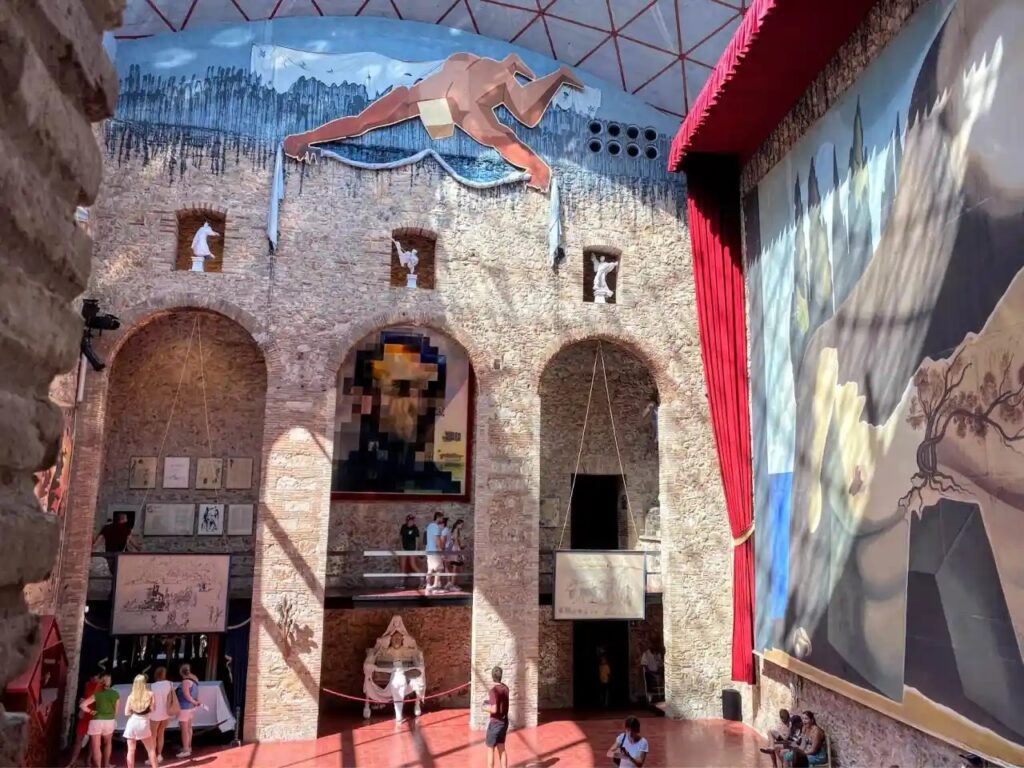
One of the main highlights of the theatre-museum is the Mae West Room, a space that transforms into the image of the legendary film star Mae West, with paintings on the wall depicting her eyes, a fireplace for a nose, a red-lipped sofa, and blond drapes for hair. From a platform raised above the living-room layout, West's famous face takes shape.
Dali's passion for cinema also came through in his collaboration with the Walt Disney studio, the animated short "Destino," which screens at the Theatre-Museum. Work on the short began in 1945, yet it was not completed and released until 58 years later, in 2003, when Disney rediscovered it and assembled a team of 25 animators using the original storyboards.
A Surreal Sistine Chapel
Another remarkable installation is the "Palace of the Wind Room," which features the stunning "Palace of the Wind Central Panel," a sweeping ceiling painting that depicts Dali and Gala seeming to float up through the roof toward a glowing crescent moon. The room also holds tapestries and a gold-painted orangutan skeleton that stares eerily into a corner.
A permanent special exhibition showcases jewels and coins that demonstrate how Dali carried surrealism into new forms of wearable art: "The Ruby Lips," with pearls in place of teeth, are made from natural rubies and 18-carat yellow gold; "The Eye of Time" is a diamond-encrusted eye-watch; and "The Royal Heart," a beating mechanical golden heart with a gem-studded crown and a pulsing ruby set at its center, was created to honor the coronation of Queen Elizabeth II.
Describing how he envisioned the collection, Dali once declared: "I want my museum to be a single block, a labyrinth, a great surrealist object. It will be a [completely] theatrical museum. The people who come to see it will leave with the feeling that they have had a theatrical dream."