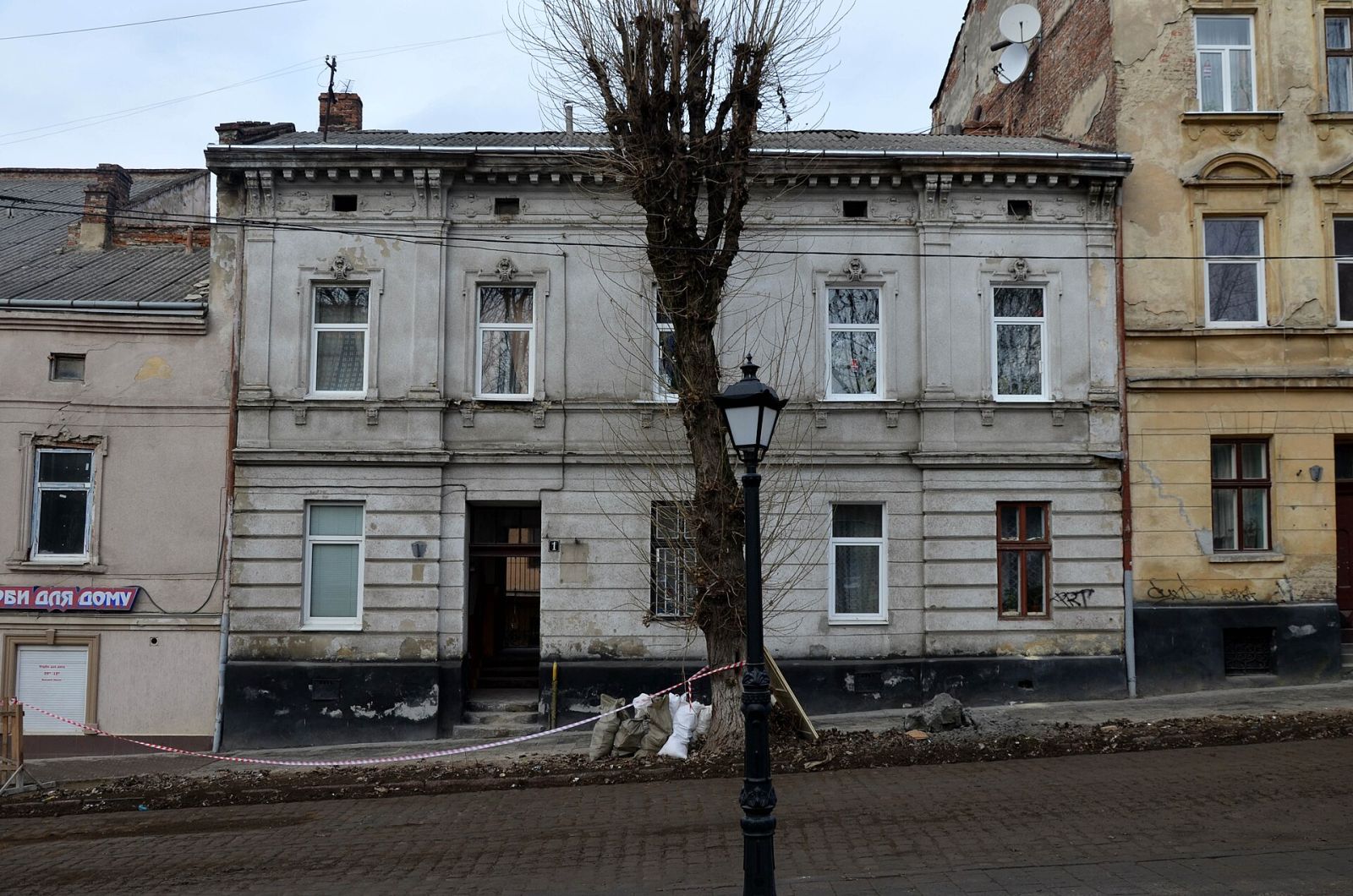


The shortest answer to the question of what to see in Ivano-Frankivsk: the historic core fits onto a handful of adjoining streets around Rynok Square, and you can walk it in half a day. The city was founded in 1662 as Stanisławów, a private fortress of the Potocki family, which is why its centre is unusually compact and symmetrical rather than sprawling like towns that grew up over centuries by accident.
There is a second reason people come: this is the main gateway to the Carpathians. Nearly every route to Bukovel, Yaremche or Vorokhta passes through Frankivsk, so a lot of travellers blow through it in transit, and that is a mistake. A full day here stands on its own. Below is the practical part: what is essential, how much time to budget, how to get here, and in what order to walk.
The Town Hall and Rynok Square: the heart of old Stanisławów
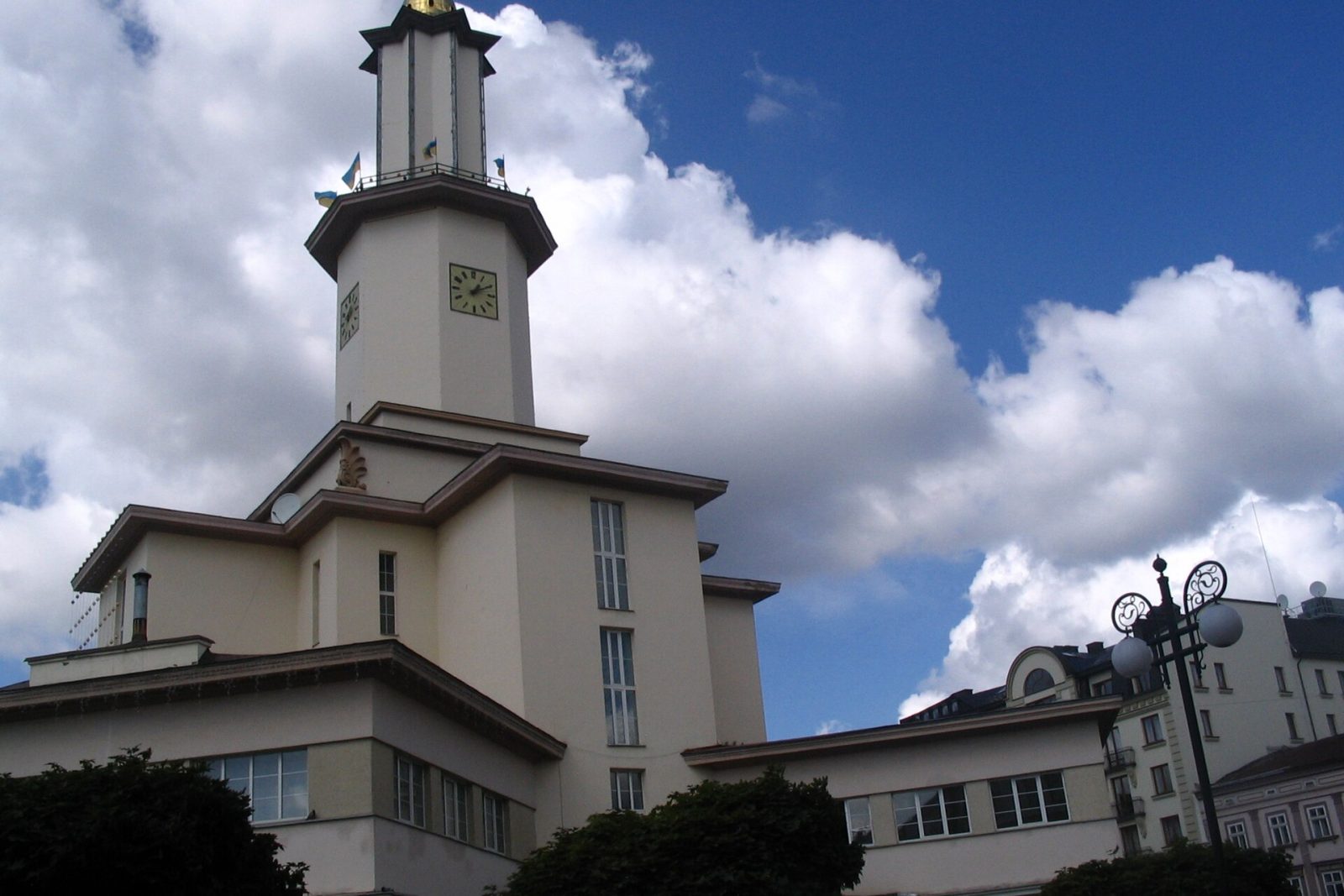
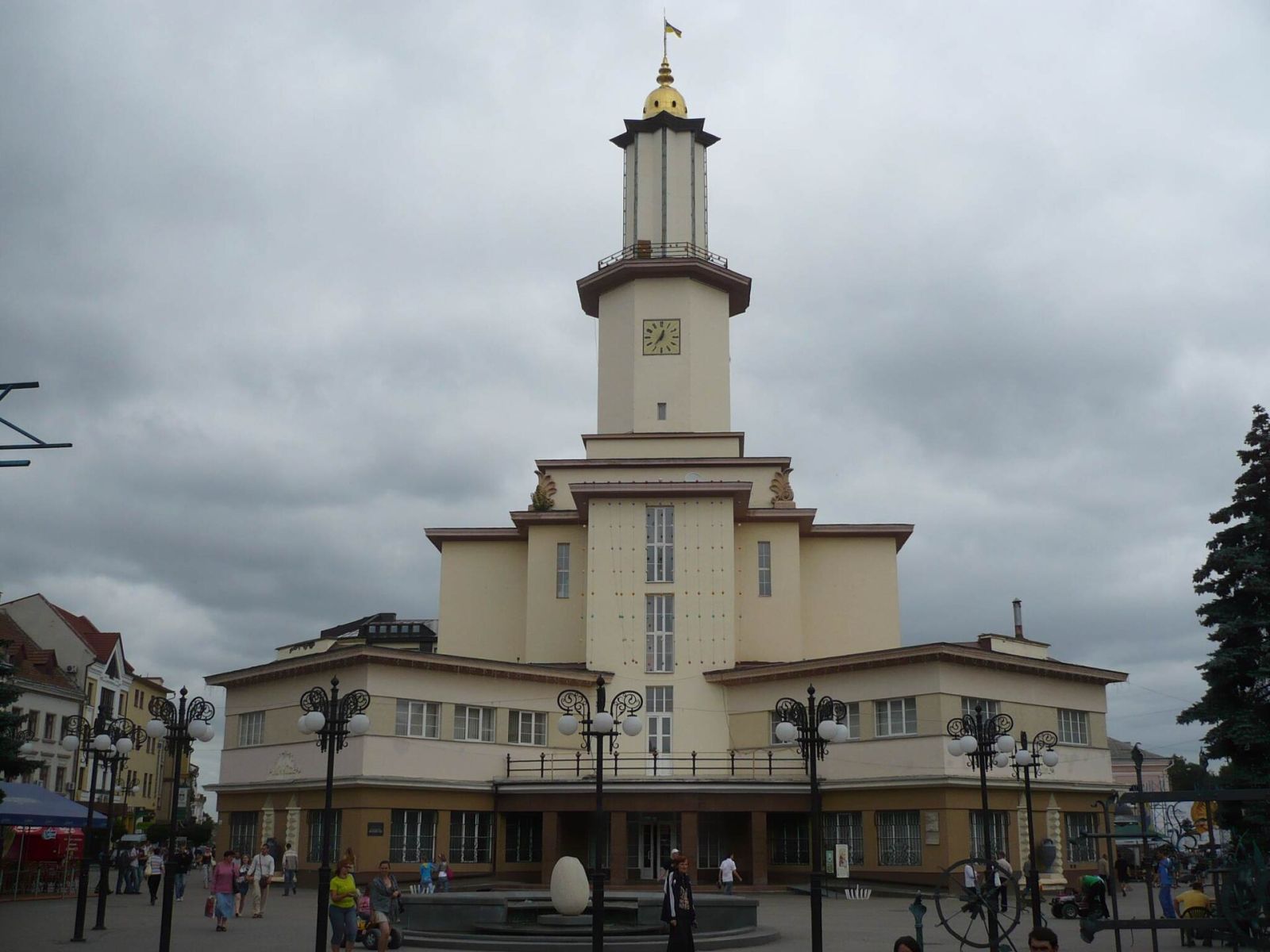
Start in the centre, and here the centre is literal: an octagonal Rynok Square with the Town Hall and its tall tower right in the middle. The present building is not ancient. It was raised in 1929–1932 in a constructivist style on the site of earlier town halls that kept burning down or collapsing. It looks unusual for the Ukrainian provinces: strict geometric volumes, no ornament, pure function. Inside sits the Ivano-Frankivsk Regional Museum, and the museum ticket also gets you up to the observation deck in the tower. The view from the top is plain but useful, because the city's layout clicks into place at once, telling you where to go next.
The octagonal shape is no accident. The plan was laid out under the Potockis on the model of ideal Renaissance towns, and that geometry has survived. Around the perimeter runs the characteristic Frankivsk town-house frontage. Budget roughly an hour for the museum and tower together, and check current opening hours before you travel, as they shift with the season.
The "hundred metres": why pedestrian Nezalezhnosti is the main street
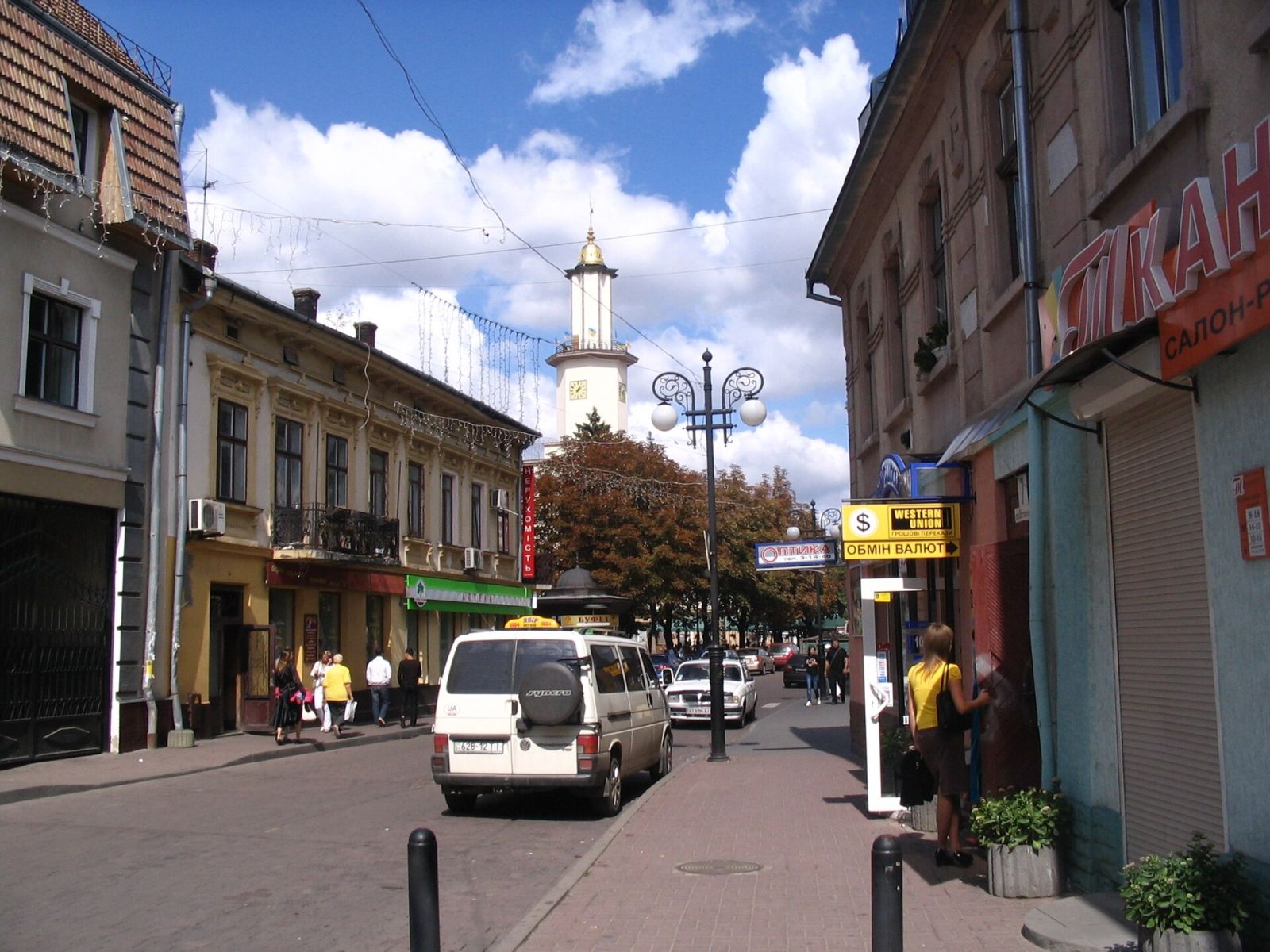
From Rynok Square it is a short step to Nezalezhnosti Street, which nobody in Frankivsk actually calls by that name. To everyone here it is the stometrivka, the "hundred metres". The nickname is local and a little tongue-in-cheek, since the pedestrian stretch is in fact longer than a hundred metres, but it stuck. This is the main promenade: café terraces, buskers in the evening, rows of late-19th and early-20th-century houses with stucco above the ground floors.
You do not need to hunt for a separate landmark here, because the street itself is the attraction. The local habit is simple: you do not walk the stometrivka, you stroll it. Sit down for coffee, look above the shop windows where tourists rarely raise their eyes, listen to the street musicians. Set aside a good half hour or an hour for this, because rushing kills the point. The stometrivka is where it is easiest to feel that Frankivsk is first of all a city to live in, not a museum behind glass.
Potocki Palace and the collegiate church: the founders' legacy
The people who founded the city left two key sites standing side by side. The first, Potocki Palace, spent a long time half-abandoned under military use, and in recent years it has been restored in stages and gradually opened to visitors. This is the residence of the family the whole of Stanisławów began with. Its condition and access schedule change as the restoration goes on, so check before you travel what is actually open at the moment.
Next to it stands the former collegiate church, also built with Potocki money as the family crypt and the town's main temple. Today its walls house the Prykarpattia Art Museum, with a collection of sacred art, icons and sculpture. The domed building reads clearly against the centre, and even if museums are not your thing, step inside for the space alone: sacred architecture from within hits harder than you expect. Together the palace and the collegiate church are the historical layer worth walking a few blocks off the stometrivka for.
The city park and its lake: where to catch your breath
Once the centre is done, the logical next move is Shevchenko Park with its lake. This is not a world-class natural wonder, just a solid, ordinary city park, and that is exactly its value: locals jog here, row on the water, walk with their kids. In summer there is boat and pedalo rental on the lake; in winter it is simply quiet and snowed under. It is the kind of spot you go to not for a specific sight but to catch your breath after the cobblestones of the centre. Half an hour here slots in nicely between the museums and coffee.
Frankivsk as a Carpathian gateway: using the city well
For a traveller, Frankivsk plays a double role. On one hand it is a standalone city good for one full day. On the other it is the most convenient base before the mountains. Minibuses and trains leave from here for Yaremche, Vorokhta and the foot of Hoverla, and transfers to Bukovel gather here too. The logic of many trips runs like this: arrive in Frankivsk, spend the night, see the city, and set off into the mountains in the morning.
If you are heading into the Carpathians for a while, it is worth booking at least one night in Frankivsk on the way in or out. The city gives you what the mountains lack: proper cafés, restaurants, pharmacies, gear shops, the chance to buy whatever you forgot. Using it as a staging post is smarter than racing through at six in the morning having seen nothing.
Cafés: why it is worth just sitting down for coffee in Frankivsk
A separate reason to linger is the coffee culture. Frankivsk is small, but cafés are dense here, and plenty of them are independent rather than chains, each with its own character. For Galicians coffee is a ritual more than a drink, and Frankivsk belongs firmly to the Lviv school in this, minus the Lviv tourist crush. Step into a place away from the busiest stretch of the stometrivka, where prices are gentler and the mood is real. This is not a stop on the route but a way to see the city from the inside, from a table rather than through a lens.
| Place | Why it matters | Time to budget |
|---|---|---|
| Rynok Square and Town Hall | Octagonal square, museum, panorama from the tower | About an hour |
| The stometrivka (Nezalezhnosti St.) | Pedestrian heart of the city, cafés, façades | An hour with coffee |
| Potocki Palace | Founders' residence, restoration in stages | 30–40 minutes |
| Collegiate church (Art Museum) | Sacred art, temple interior | An hour |
| Park with the lake | Boats in summer, quiet, a breather | 30 minutes |
| Cafés off the stometrivka | Galician coffee culture without the crowd | As long as you like |
How do you get to Ivano-Frankivsk?
The city sits in the west of the country, and getting here is straightforward. The airport is not operating at the moment because the airspace over Ukraine is closed, so the real options are train and bus. Check current timetables before you travel, as they change.
- By train. Overnight services run from Kyiv, taking roughly 10 to 13 hours depending on the route. A night on the rails saves you a whole day.
- From Lviv. The nearest major hub; a few hours by train or bus from here, and the city slots naturally into a western Ukraine itinerary.
- By bus and minibus. Frankivsk is well connected to neighbouring towns and Carpathian villages, which is exactly why it is convenient to arrive here before the mountains.
A one-day route you can actually finish
The logic is simple and runs from the centre outward. Begin at Rynok Square and the Town Hall in the morning, while it is quieter: museum, tower, panorama, so the city's layout makes sense right away. Then step onto the stometrivka and take it slowly, with a coffee break. From there loop over to Potocki Palace and the collegiate church, a few blocks aside. After the museums, head to the park and the lake to catch your breath, and save the evening for a second coffee somewhere quiet, off the tourist stretch.
What to drop if time is really tight: in half a day you can realistically manage Rynok, the Town Hall and the stometrivka, leaving the museums and the park for another time. And the other way round, if Frankivsk is your base before the mountains and you have a spare evening, just wander the central lanes with no plan, because that is where the city opens up most, not at the headline sights. For a first visit, the basic loop from Rynok to the park covers the essence without any fuss.