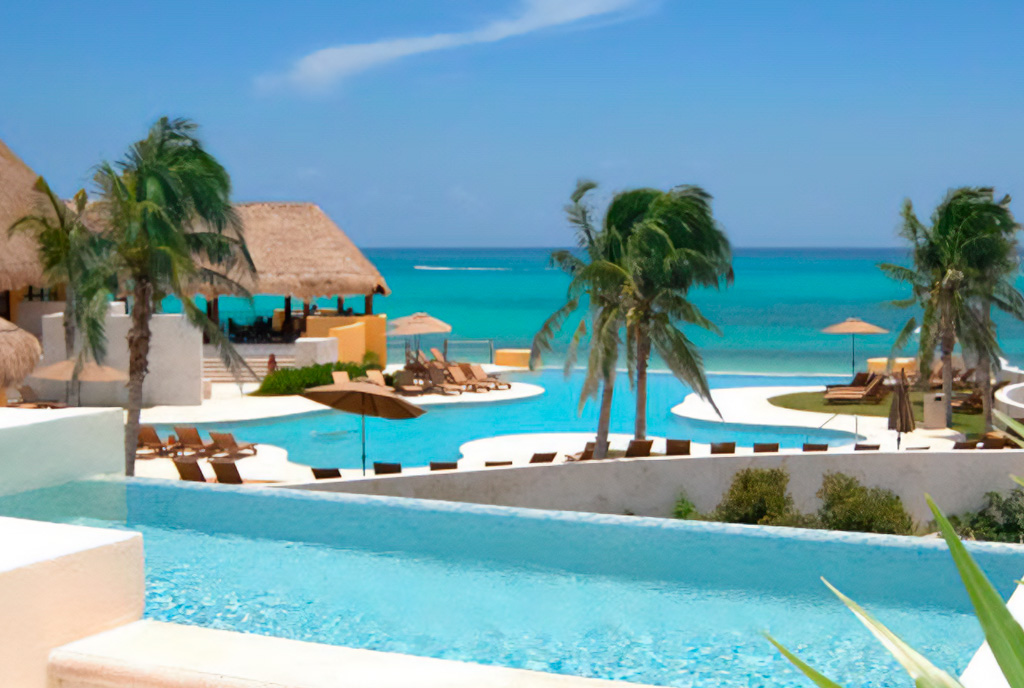


I wanted to send my family somewhere for a relaxing vacation. Notice I didn't say a thrilling vacation, or one that would broaden our horizons. I just wanted something simple.
We live in New Jersey, where it's been rainy, snowy and cold for roughly 37 years, so the perfect fix was a warm place with sun, water and alcohol.
I have a few rules when it comes to relaxing getaways. First, I only fly nonstop, on a single plane. Second, I spend no more than four hours in the air. Third, I don't cross a pile of time zones to get where I'm going.
Partner links: booking through them supports the blog at no extra cost to you.
I want to go somewhere hot, especially from October through April. Not warm, not mild, H.O.T. I don't play golf, so a lovely 21°C day does nothing for me. It needs to be at least 27°C, or I'm out. I want it hot enough that jumping into the pool or the ocean is a no-brainer.
And I want my hotel to be no more than 45 minutes from the airport. I didn't fly for hours just to spend a few more hours in the back seat of a car.
Weigh all of that up, and Mexico becomes the frontrunner. And of the many places in Mexico you could pick, you won't do any better than Mayakoba.
A Resort Paradise
Mayakoba is a 500-plus-acre property set about 35 minutes south of Cancun, in the town of Playa del Carmen. On one side of Mayakoba is the Caribbean Sea; on the other, a series of lagoons and canals threading through the mangroves.
Mayakoba got its start around 20 years ago, when a Spanish construction company bought up the undeveloped land. In the years since, an ambitious terraforming program was carried out.
With careful attention to the existing plant and animal life, underground rivers were opened up to create a canal system; trees and plants were lifted out by the roots and replanted in new spots; wildlife was reintroduced to the area; and thousands of meters of beach were restored.

And the company built four hotels there: the Andaz, Banyan Tree, Fairmont and Rosewood resorts. Each has its own grounds and style, but they all share a few things.
Every hotel has adjoining beaches; the transport links between them are easy and frequent; and guests can charge a meal at any hotel's restaurant to their room, no matter where they're staying.
Mayakoba also has an 18-hole golf course designed by Greg Norman, a dedicated venue for weddings and other events, and a traditional Mexican square, done up EPCOT-style, with extra shops and restaurants.
All four hotels have a similar layout. Thanks to the protected mangroves that sit just back from the beach, each hotel is split into two zones: a beach side and a lagoon side.

Every resort has at least one restaurant and pool right by the beach, along with rooms and suites. The lagoon side holds each hotel's entrance, more restaurants, a pool and additional rooms.
You can get from the lagoon to the beach (and back) in three ways: on foot; on one of the many bikes available at each resort (at some hotels the bikes are assigned to your room; at others there's a shared bike program); or on a five-minute golf-cart ride.
To move between resorts, you can grab a ride from your hotel's lobby, or hop on one of the boats that cruise the canal system linking the properties.
You can also take an eco-tour by boat through the canals, where you'll spot the iguanas, crocodiles and birds that call Mayakoba home. (A note on the crocodiles: once they reach about two feet long, they're removed from the grounds and taken to a nice farm with plenty of room to roam around with other crocodiles, or something like that.)
One more thing worth mentioning is the regular presence of falcons.
They're nearly always perched on the arm of one of Mayakoba's many falconer staff, and are only released to scare off other birds when the resort's winged friends get a little too curious around the many open-air dining areas. The birds seem to have wised up, since we never saw them fly too close to anyone.
Distinct Properties

The four resorts share some core architectural principles, a collection of low-slung buildings fanning out from each hotel's lobby, but the vibe is noticeably different from one to the next.
The Andaz, which opened just a year ago, is clearly the young, trendy sibling of the Mayakoba family. Its modern buildings are painted in shades of white and gray, sometimes with bold murals of local birds.
The first North American outpost of the Asian chain, the Banyan Tree, is striking and transportive, a dramatic collection of buildings that has you thinking of Southeast Asia and one of the kingdoms of Game of Thrones (Dorne, maybe) in equal measure.
The Fairmont, with its palapa-roofed beach cabanas and big oceanfront restaurant, is the more traditional hotel of the bunch, and feels closer to what you might picture as a Mexican resort.
The Rosewood looks almost Californian; its lush gardens and seaside restaurant call to mind Beverly Hills and Santa Monica as much as the Yucatan.
Each of these hotels has at least three restaurants. Since you're in Mexico, you can count on the food being good (because the taco is the perfect food in the world). But the cuisines reach well beyond the peninsula.

The fantastic breakfast buffet at Oriente, in the Banyan Tree, reminded me of those round-the-world buffets you find in Asia. You can (and honestly should) put away sushi, prosciutto, pancakes, chilaquiles and croissants in one sitting.
Banyan's Thai restaurant was impressive both for the food (get the crispy fish) and the setting, as we sat on a deck over the mangrove lagoon, listening to the calls of hooded orioles and green herons.
In the 19th century, Mexico saw an influx of Italian immigrants who blended their ancestral cooking with the ingredients on hand in their new home.
That Italian-Mexican tradition is on the menu at Casa del Lago, in the Rosewood, which sits next to Agave Azul, a sushi bar with an impressive lineup of tequila and mezcal. Down on the beach, more traditional Mexican fare is served at La Punta Bonita, which also boasts a deep list of Mexican wines.
The Fairmont's restaurants are overseen by one of Mexico's best-known chefs, Richard Sandoval. They range from the Latin-Caribbean theme of Brisas by the beach, where you'll find some terrific grilled oysters in Tabasco sauce, to the Latin-Asian fusion of El Puerco, overlooking the main lagoon.
The Andaz restaurants lean more Mexican. On the beach are Olla Taco and Olla Ceviche, which double as the bar areas for the beach pool.
A broader spread of Mexican dishes waits inland at Cocina Milagro, while Casa Amate is a great pick for a wider Latin American menu, served in a building designed to feel like the home of a globe-trotting Mexican family.
By the Water

When you're not eating, you're probably parked next to a body of water. Every hotel in Mayakoba has several pools, some with swim-up bars. The beach is fully staffed too, with umbrellas, loungers and waiter service.
In a nice nod to the modern age, the servers set out a small wireless button (a lot like the ones Amazon gives you to reorder Tide) that connects to your server's watch. When it's time for another margarita, just press it, and a staff member magically appears.
Every beach has kayaks and water bikes you can borrow. For an extra fee, you can rent catamarans (which come with a captain if you're more of a landlubber), jet skis, kitesurfing gear and lessons, plus parasailing flights off a boat anchored a few hundred feet from shore.
And when you're not taking advantage of all that, the accommodations at the Mayakoba resorts run from standard rooms to multi-room villas. They're all set in small clusters; there are none of the massive hotel towers you see in Cancun or Cozumel.
Beachfront rooms cost more, but the lagoon-side rooms have their own charm, since many of them sit over the water with outdoor spaces that float on the lagoon.
Wherever you are, you can count on excellent service at any of the Mayakoba properties. We were warmly welcomed at every hotel, from the lobby staff to the restaurant servers.
Twice-daily housekeeping kept our room spotless. Having the staff connected to one another with Secret Service-style earpieces is a nice touch.
Whoever you were talking to could pass information along to someone who might be useful. For instance, if you take a golf cart to your hotel's lobby, the driver radios ahead to make sure a car is waiting to whisk you off to one of the other resorts.
After a day or two in Mayakoba, my family settled into a delightfully gentle rhythm. The weather back in Jersey was reassuringly awful, only underscoring the fact that anything we were doing in Mexico beat anything we could have been doing at home.
The days were mostly made up of breakfast, swimming, debating where to go for lunch, lunch, lying around, debating where to go for dinner, drinks and dinner. I was after an easy, relaxing family vacation. In Mayakoba, I found it.