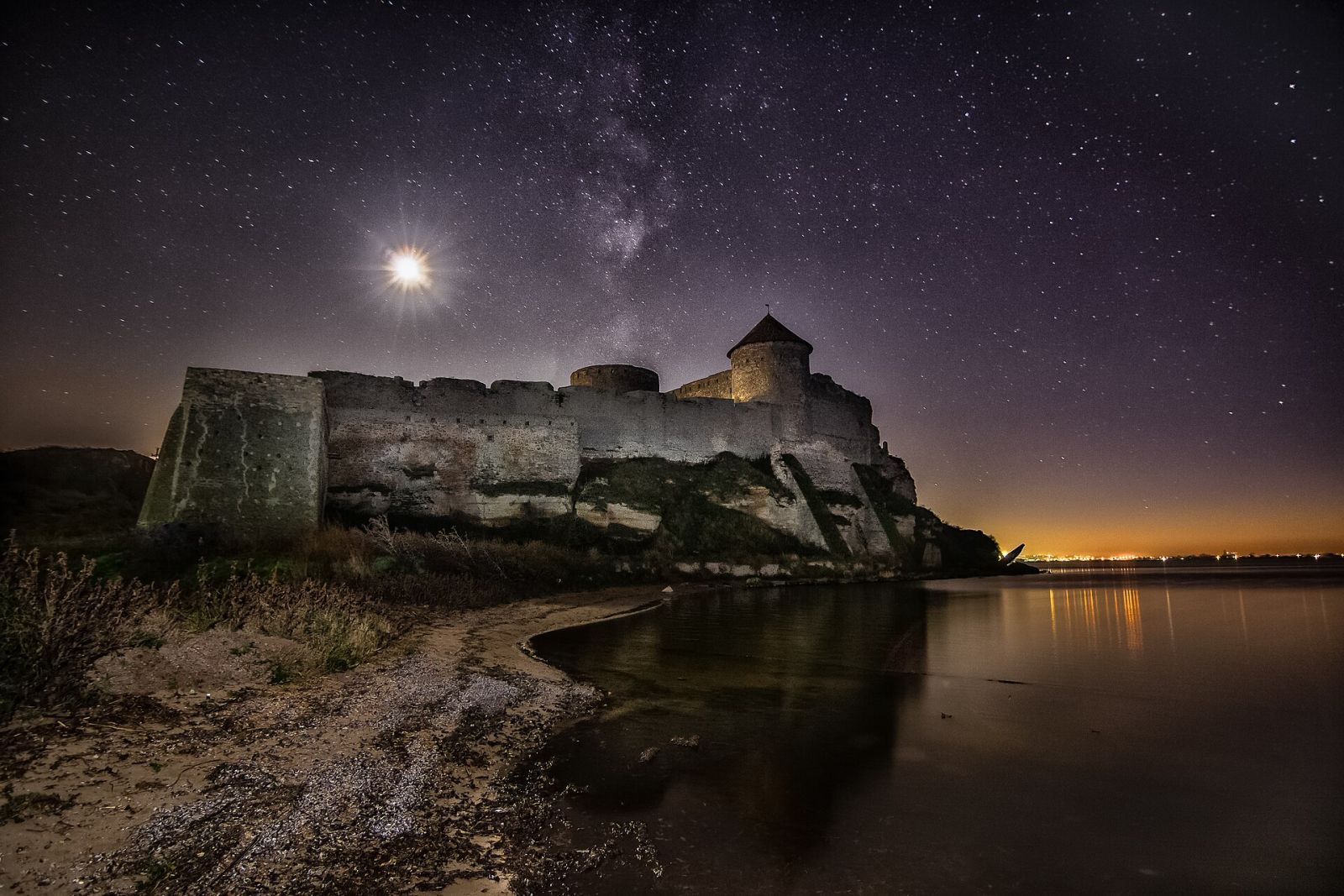
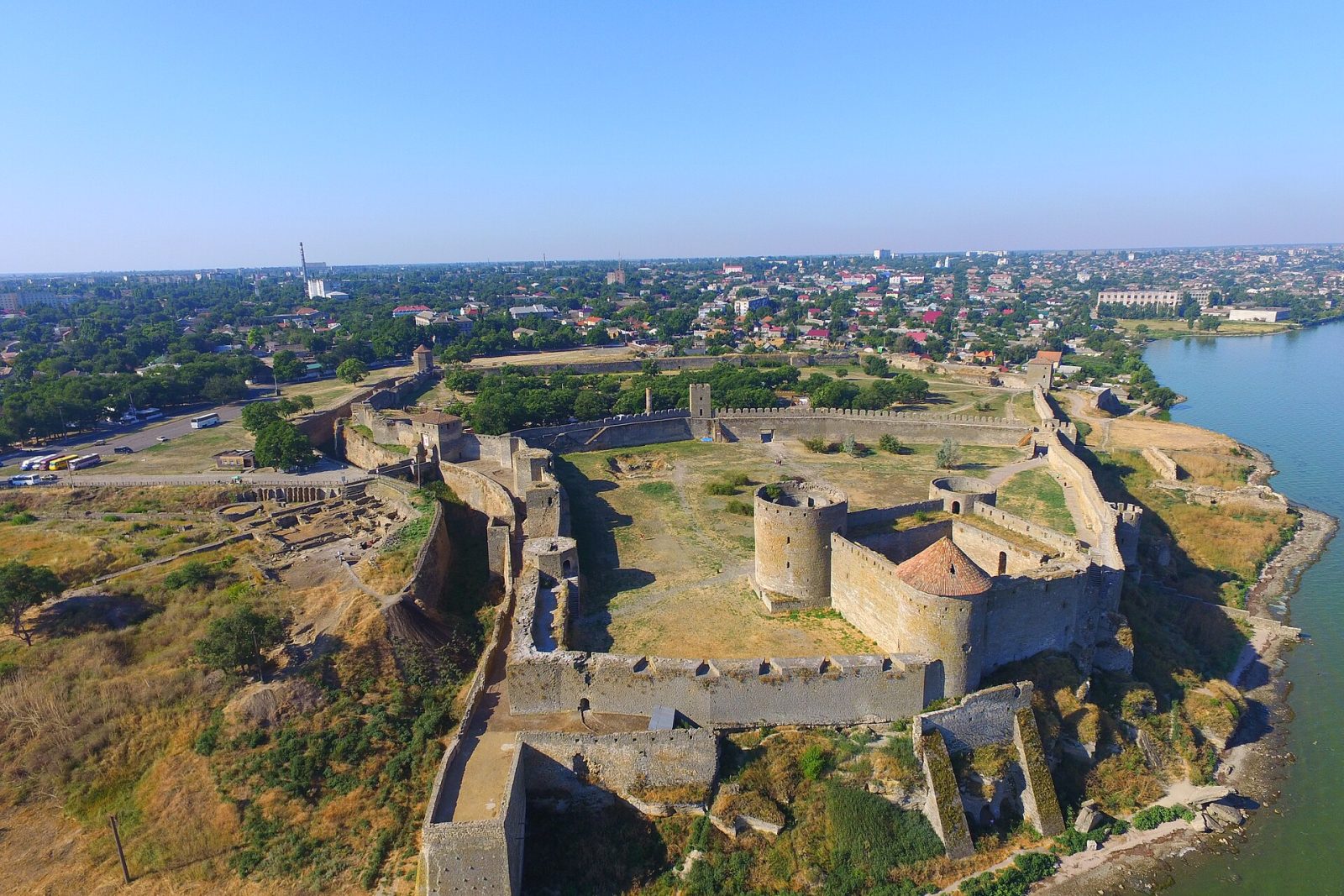
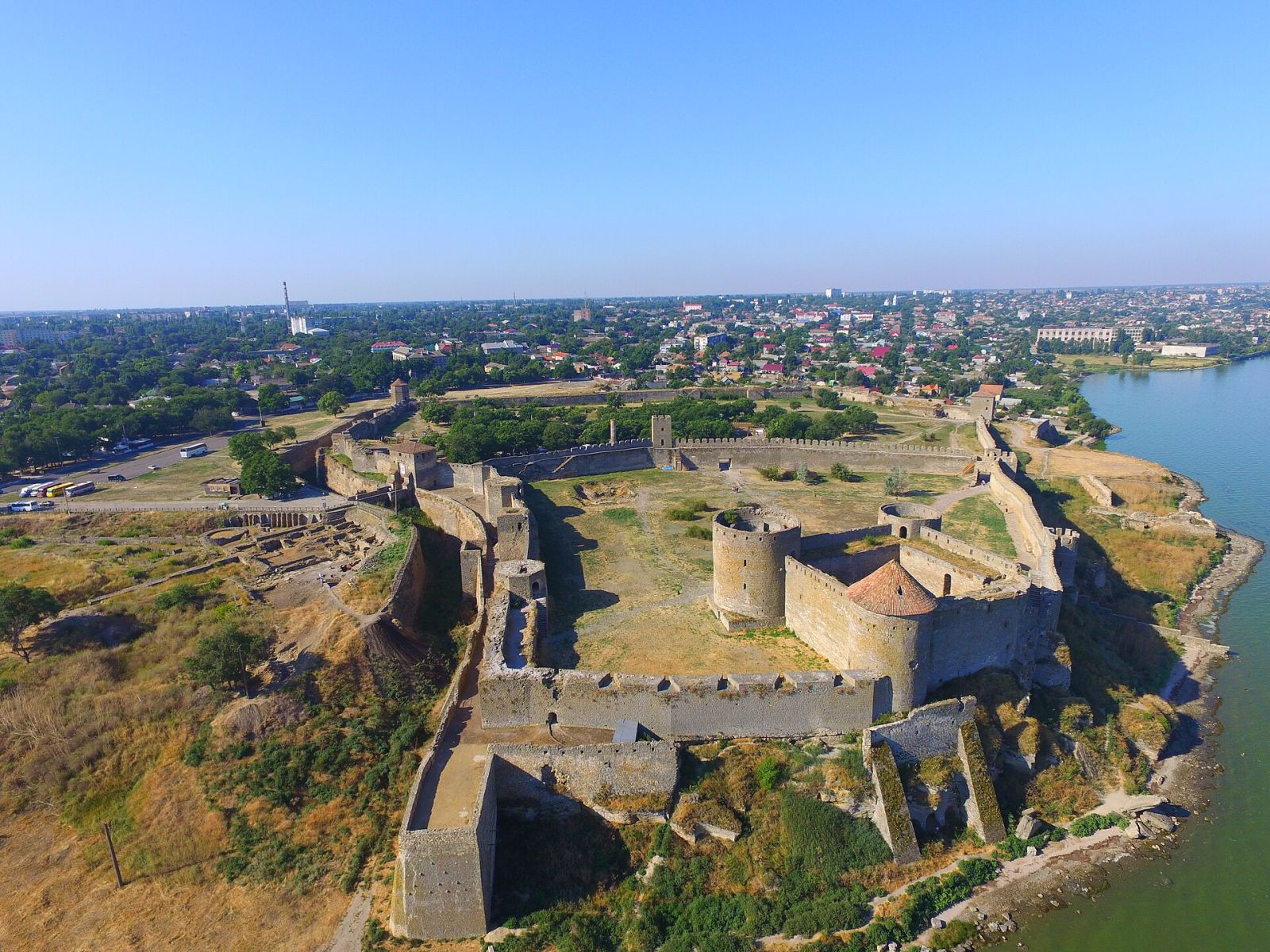
Akkerman Fortress in Bilhorod-Dnistrovskyi is one of the largest and oldest stone strongholds in Ukraine: almost two and a half kilometres of walls, more than twenty towers and four inner courtyards on the high bank of the Dniester Estuary. The scale first, so you have something to measure it against: it covers roughly nine hectares, enough to swallow more than a dozen football pitches inside. And beneath the walls lies something older still, ancient Tyras, a Greek city that predates the fortress by a good fifteen centuries.
Akkerman Fortress sits on the right bank of the estuary, where the Dniester almost reaches the sea and spreads into a wide, brackish sheet of water. The town around it changed names about ten times: the Greeks called it Tyras, the Byzantines Maurokastron, the Genoese Moncastro, the Moldavians Cetatea Albă, the Turks Akkerman, meaning "white fortress." The Ukrainian name Bilhorod is basically the same translation. None of this confusion is accidental: for centuries everyone with an interest in trade and the river crossing fought over this place.
What kind of fortress this is, and who built it
The main misunderstanding worth clearing up straight away: this stronghold was not raised by one ruler in one reign. What you see is the result of several centuries of additions. The bulk of the walls and towers went up in the 13th to 15th centuries, mostly under the Principality of Moldavia, with Genoese masters who kept a trading post here. Later, from 1484, the town passed to the Ottoman Empire for three hundred years, and the Turks rebuilt, repaired and adapted the fortress for artillery.
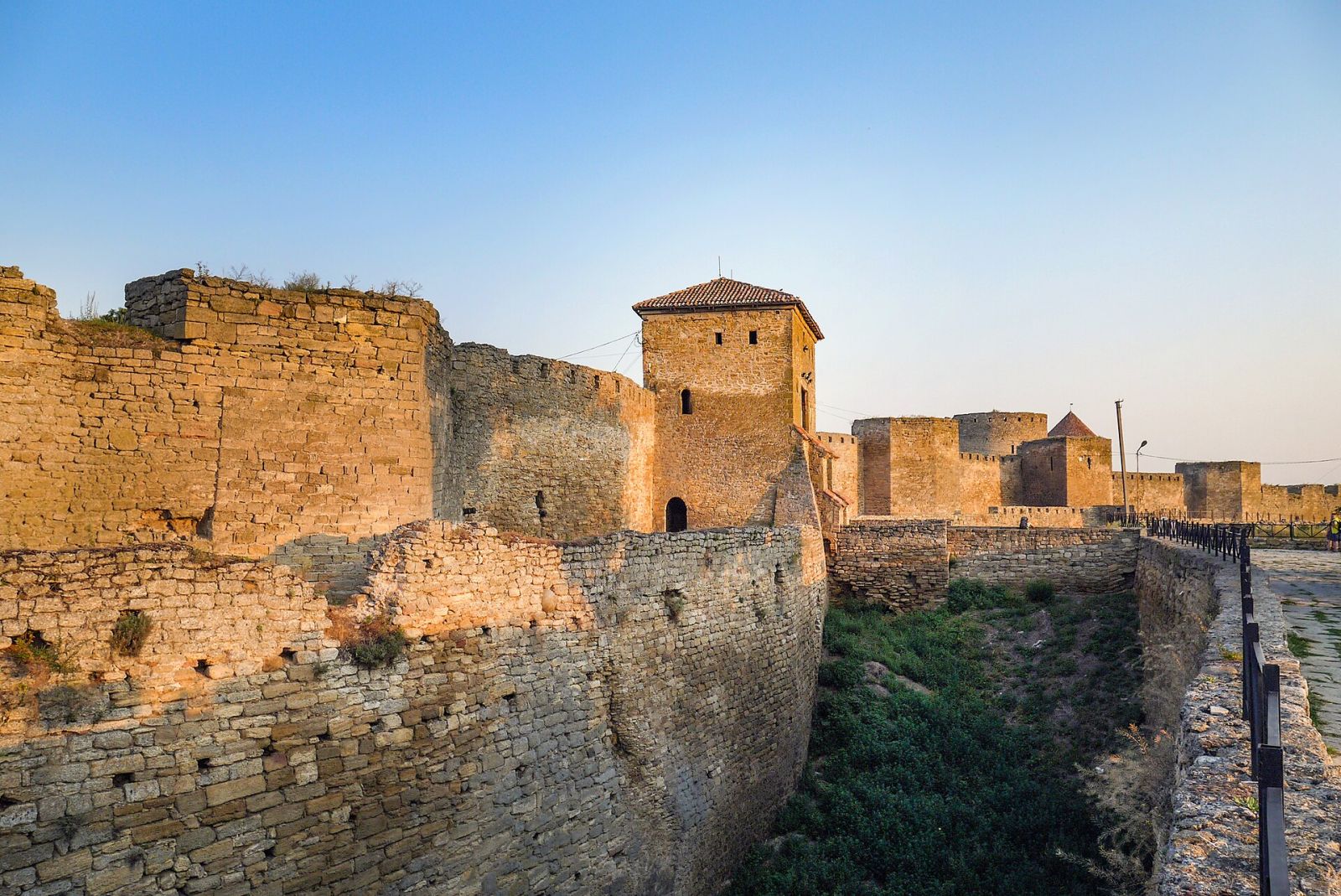
Because of this there is no single "style" inside: different stretches of wall are laid from different stone, different towers take different shapes, and the layout itself reads as a stack of eras. The walls reach over ten metres high in places and several metres thick, so even half-ruined they still press down with their weight. This is not a decorative castle for postcards but a real fighting structure built to survive sieges.
Four courtyards inside
The fortress is split into four separate courtyards, each with its own logic. This is the detail worth keeping in mind as you walk, otherwise it all blurs into one endless wall.
| Courtyard | What it was for | What to see |
|---|---|---|
| Civilian (Quarantine) | The largest, where townspeople lived | Open space, remains of buildings, the wide panorama |
| Garrison | Quarters and duty of the garrison | Inner walls, passages, loopholes |
| Port (Utility) | The way down to the estuary and the pier | Walls on the water side, the view over the water |
| Citadel (Genoese castle) | The last line of defence | Four corner towers, the strongest part |
The most striking part is the citadel, a compact inner castle with four powerful round towers at its corners. This is the section most often shot from above and put on the covers. If you are short on time, head there first, then stretch the walk out across the other courtyards.
Ancient Tyras under your feet
Here is what sets this place apart from an ordinary castle. Long before the fortress, around the 6th century BC, Greek colonists from Miletus arrived and founded the city of Tyras. It lived on trade in wine, grain and fish, minted its own coins, and later fell within the orbit of the Roman Empire. In other words, people have lived on this headland without a break for more than two and a half thousand years, and the fortress is only one of the later layers.
Excavations of Tyras are still going on, and part of the ancient foundations can be seen right by the fortress entrance, out in the open. Do not expect whole temples, it is more the outlines of streets, the bases of houses and fragments of walls. But the simple fact that you stand on the site of a Greek polis while a medieval Ottoman stronghold towers above you gives a sense of depth that no reconstructed replica can match.
Why so many films were shot here
Filmmakers took to Akkerman long ago, and the reason is simple: scale and texture. Real old stone, wide courtyards, towers and water nearby give a ready-made set for historical cinema with nothing to build. In the Soviet years dozens of films were shot here, among the well known ones a mid-1950s screen version of "Othello" and an early-1970s adventure "Robinson Crusoe." Locals still point out where the camera stood.
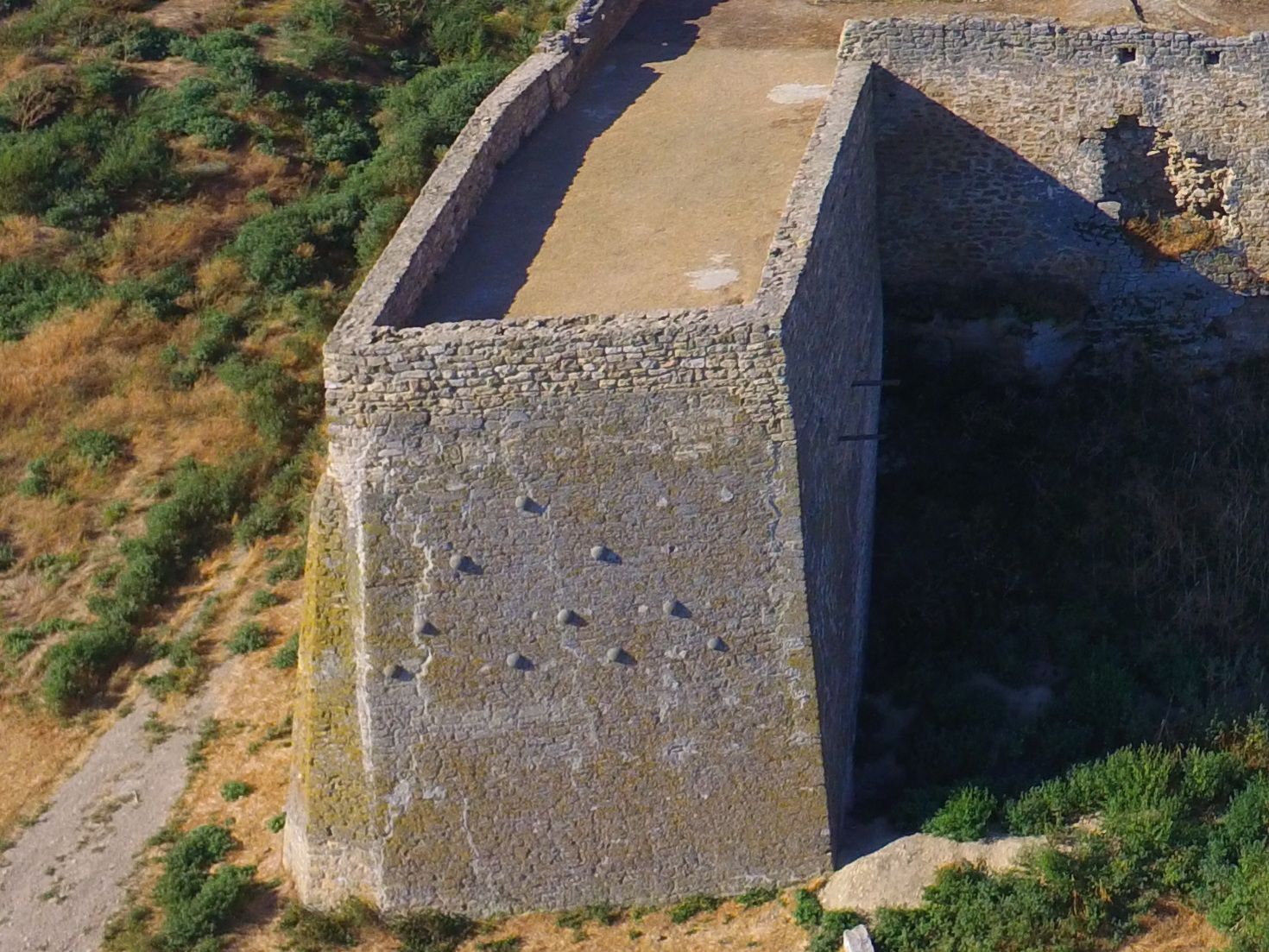
For a traveller this means one thing: the fortress "reads" well in a photo in any weather and from any angle. But that is exactly why in high season and at weekends it gets crowded, and the best viewpoints have to be shared with the crowd. If you want a shot without other people's backs in it, come early.
How to get there from Odesa
Bilhorod-Dnistrovskyi lies south of Odesa, on the far side of the estuary. Straight across the water it is about 50 kilometres, but by road you have to go around the estuary, so the real distance comes to roughly 80 kilometres and usually about an hour and a quarter to an hour and a half by car. Public transport is easy too: marshrutkas and suburban trains run regularly from Odesa and take about the same hour and a half.
| Way | Travel time | Note |
|---|---|---|
| Car from Odesa | roughly 1-1.5 hrs | Most flexible; easy to reach both the fortress and Shabo |
| Marshrutka (minibus) | about 1.5 hrs | Frequent departures; a short walk through town from the fortress |
| Suburban train | about 1.5-2 hrs | Cheap; a few kilometres from the station to the fortress |
Once in town the landmark is obvious: the fortress stands on the estuary bank, visible from a distance, and any local will point you the way. Entry is paid, and it is worth checking the price before you travel, as it changes from time to time. Inside there is little shade and a lot of open stone, so in summer bring water, a hat and shoes you are happy to walk uneven stairs and walls in.
What to pair it with: the estuary and Shabo wine
Making the fortress a separate half-day trip is a bit wasteful, since the visit itself takes an hour and a half to two hours. It makes more sense to build a full day around it. The most logical neighbour is Shabo, an old wine-making village some ten to fifteen kilometres away, founded back in the 1820s by Swiss colonists. It has a wine centre with tours and tastings, and it is a fine way to round off the day: first stone and history, then the estuary, the terraces and a glass of the local vintage.
The Dniester Estuary is a draw in its own right. Wide, calm water, fishing boats, sunsets over the sheet of it, and nearby the region's unusual sand spit and salt lakes. A workable day looks like this: the fortress in the morning while it is cool and quiet, a midday stroll through the old town and along the shore, then the drive to Shabo for a tasting. If you are staying the night, keep the evening for the sunset over the water, which is especially good here.
When to go?
The most comfortable time is late spring and early autumn. May, June and September bring warmth without the draining heat, greenery around the walls and the soft light in which the stone looks its best. July and August work too, but then the open courtyards can turn genuinely scorching, and there are noticeably more tourists. Winter suits those who like empty frames and do not mind the wind off the estuary: the views are stark, but the stronghold is almost yours alone.
As for time of day, morning wins on every count: cooler, fewer people and even light on the walls. The second good window is the early evening, when the sun drops over the estuary and lights the towers in a warm colour. Midday in summer is the worst, the open stone heats up, there is almost no shade, and the water nearby only adds to the closeness of the air.
A few honest warnings
The fortress is a genuine ruin, not a polished museum with a handrail at every step. Walls and towers are crumbling in places, the stairs are uneven, and railings are not always enough, so watch every step with children and at height. Wear closed, sturdy shoes; heels are entirely out of place here. Infrastructure is modest: cafes and toilets are near the entrance rather than inside, so plan to be self-sufficient.
And the main thing, about the mood. Akkerman Fortress is valuable not for a single tower or a striking frame but for the sense of compressed time: Greek Tyras under your feet, Moldavian and Ottoman walls around you, the quiet estuary alongside that has seen it all. Come not to tick a box but to walk the courtyards slowly and picture how many peoples passed through here. That is when the fortress opens up in a way it never does on a quick dash for a photo.