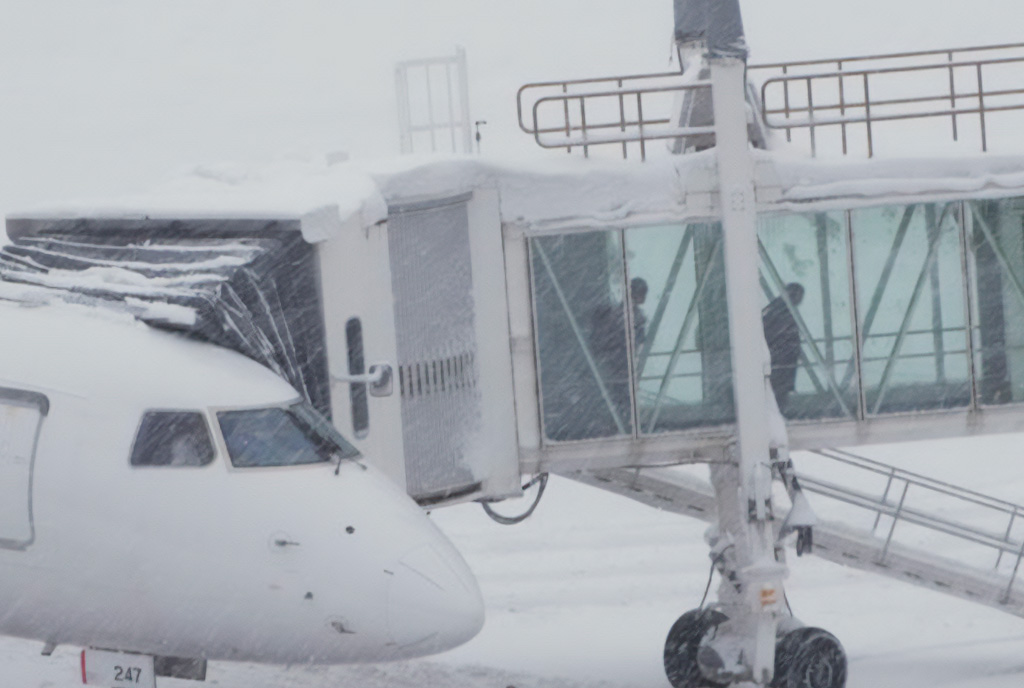


Twenty one feet of snow is enough to bury a two story house completely. And then some.
That's how much snow fell last year in the city of Aomori, in Japan's northern Tohoku region. But for this coastal city of nearly 300,000 people, it was just an ordinary winter.
Every year, this northern prefectural capital is battered by heavy blizzards and ice storms, making Aomori one of the snowiest large cities on the planet and an intriguing choice for a trip.
Partner links: booking through them supports the blog at no extra cost to you.
The extreme snowfall is driven by cold Siberian winds that blow into Japan from the northwest every November. As the cold air passes over the warmer waters off Japan's mountainous coast, it picks up moisture, then rises and turns into snow.
And there is a lot of it. The city of Aomori has already seen more than eight feet of snowfall in the first months of this year.

Sea Effect Snow
Japan's so called "sea effect snow" leaves most of the city of Aomori and its surroundings blanketed in a thick layer of powder throughout the winter.
The ground stays almost entirely white until April. Rooftops are covered. Sidewalks are blocked. Many streets in the city center are defined by walls of packed ice that grow taller every time the snowplows try to clear the road.
Julia Minatoya grew up on the outskirts of the city of Aomori. The drifts in her yard get so big each winter that her family can't use most of the doors and windows on the ground floor of their home.
"It's a constant battle for everyone here, every single day," she says, shovel in hand, as fresh flakes once again bury the driveway she has just cleared.

A Winter Wonderland
Despite the constant blizzards, the city of Aomori doesn't shut down in winter.
On the contrary, it transforms into a winter wonderland for skiers and other tourists eager to play in the snow.
Many visitors come to try some of the freshest and finest seafood in Japan. Vendors sell it wholesale or by the piece at Furukawa, the city's central fish market.
The local specialty is nokke don, a rice bowl with a variety of toppings such as raw tuna, octopus or sea urchin, which you pick out from the different stalls.

"The best season for fish in Aomori is winter, especially for cod, since so many of them come into these waters to spawn," says Ene Natsume, a fishmonger at Furukawa.
For powder lovers, the nearby Hakkoda Mountains offer some of the wildest backcountry runs in the world.
American Tim Roberts recently traveled here from the United States with a few friends. The group spent several days snowboarding both groomed and ungroomed trails on Hakkoda.
"This place is a little different, because there aren't many marked trails on the mountain. It's really a kind of 'choose your own adventure, find your own way,'" he says.
After a long day on the slopes, many skiers unwind in one of Hakkoda's onsen, hot sulfur springs scattered across these volcanic peaks.

'White Impulse'
Getting to the city of Aomori is easy, even when it's snowing. It's a three hour ride from Tokyo on Japan's high speed bullet train.
Or you can fly into the city's main international airport, perched on a mountain above town. Aomori Airport handles around 20 flights a day.
The ability to land and take off there even in winter is made possible by the airport's massive snow clearing crew, which calls itself "White Impulse."
The 120 person team runs dozens of heavy snowplows several times a day to keep the airport's single runway free of ice in the worst winter weather.
In more than two decades of the Aomori Airport's operation, not a single flight has ever been delayed or canceled because of snow on the runway, says Daisuke Saito, a snow remover with "White Impulse."
"When I see planes land and take off safely thanks to what we do, it makes me happy. It's a real sense of accomplishment," he says.
A $35 Million Snow Removal Operation

Of course, removing snow from the runway and the roads around the city of Aomori only solves part of the problem: it has to go somewhere.
To prevent buildup, flatbed trucks haul the excess snow to the port along the northern coast of the city's Mutsu Bay. There, it is dumped into the sea.
The trucks run all day, every day.
Last winter season, the snow removal operation in the city of Aomori cost $35 million, according to local officials.