

Its founder calls it Italy’s “biggest shake-up” in a decade, it has been hailed as a “vital way to combat overtourism,” and now it is ready: the region of Tuscany has taken its first step toward becoming one giant gallery.
The Uffizi Galleries in Florence, Italy’s most visited museum and home to arguably the world’s greatest collection of Renaissance art, have launched Uffizi Diffusi, or the “Scattered Uffizi,” a project that will see artworks taken from the gallery and displayed across the Tuscany region.
Over the next five years, up to 100 regional galleries will be created with the aim of halting the overtourism that has all but swamped Florence in recent years.
Partner links: booking through them supports the blog at no extra cost to you.
The artworks will be placed in small towns and villages to spread tourists (along with their spending and their environmental impact) throughout the region, rather than concentrating them around the Florentine draw.
In the future, ancient palazzi, monasteries, and crumbling turn-of-the-century spa resorts will be turned into permanent exhibition spaces, but the project kicks off this summer with five temporary shows staged in the area surrounding Florence.
An Italian “magical mystery tour”

The project, called “Terre degli Uffizi” (“Lands of the Uffizi”), will mark the 700th anniversary of Dante’s death by drawing connections between the region and the poet, who was exiled from Florence for political reasons.
San Godenzo, a village in the mountains near the border with Emilia-Romagna, was the birthplace of Renaissance painter Andrea del Castagno, and also the place where Dante stayed when he was sentenced to death in absentia in Florence in 1302. He left San Godenzo never to return home, and died in Emilia-Romagna. The exhibition will link the two men through a fresco of Dante painted by Andrea del Castagno, which has been restored and will be returned to his homeland from July 26 to September 5.
Anghiari, famous for the Renaissance battle depicted in a lost painting by Leonardo da Vinci, will host an exhibition about the culture of combat and the self-made soldiers who went from mercenaries to founders of their own art-filled courts, men like Federico da Montefeltro, whose portrait by Piero della Francesca is one of the most famous works in the Uffizi.
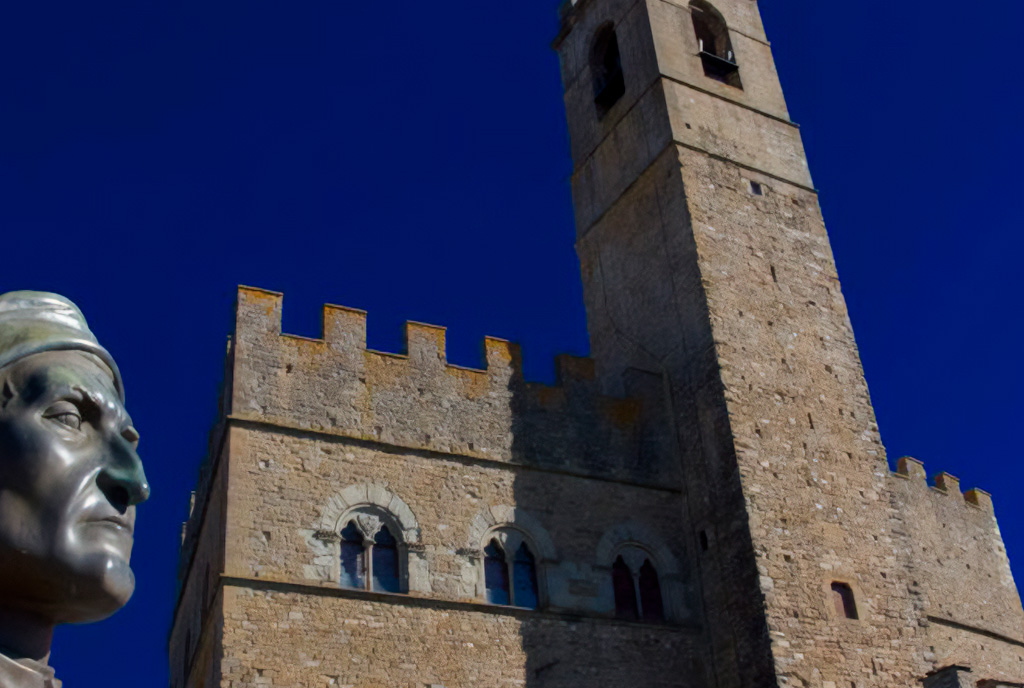
Poppi, a lovely hilltop village in the foothills of the Apennines east of Florence, where Dante wrote part of the “Divine Comedy,” will host a Dante exhibition centered on a painting of Paolo and Francesca, the poem’s most famous tale of forbidden love (the pair are imprisoned in the second circle of hell). Painted by Nicola Monti, it is a recent Uffizi acquisition. The exhibition will take place in the hilltop castle of the Guidi counts, political allies of Dante himself.
In the Valdelsa region, in Montespertoli, a tiny hilltop village 40 minutes southwest of Florence, there will be an exhibition of “giottesca” paintings. The painter Giotto, one of the best-known masters of the early Renaissance, influenced local artists whose works will be shown in the rectory of the local church.
And the town of Castiglion Fiorentino will hold an artwork exchange with the Uffizi on the theme of Saint Francis. Officials will send their star painting by Bartolomeo della Gatta to the Uffizi, where it will take pride of place in the 15th-century rooms. In return, the Uffizi will send its painting “Saint Francis Receiving the Stigmata” by the early Baroque painter Cigoli to the town.
A landscape that inspired a thousand paintings

Although the exhibitions feature no superstar artworks (the gallery has previously lent works by masters such as Leonardo da Vinci to neighboring towns), Uffizi Galleries director Eike Schmidt said the project would offer something no less valuable: an all-encompassing art experience.
“You don’t look at a work of art in isolation; you see it on a screen, in a book, or in a museum,” he said.
“The physical context and the context of the landscape matter enormously, and this will make it possible to experience these artworks in a completely different way.
“Seeing a work by Andrea del Castagno in the landscape Andrea del Castagno came from, I think that’s worth a trip from California, Warsaw, Australia, or Barcelona.”
Schmidt, however, has bigger plans for the wider project. Among other things, he has earmarked a villa in Montelupo Fiorentino, half an hour’s drive west of Florence and once owned by the ruling Medici family, as a space for an exhibition of works by Botticelli. The villa will be restored and become the heart of the project.
For now he calls the launch projects a “magical mystery tour” of northern Tuscany. The towns are developing cycling routes and driving routes between them to create mini art trails.
Schmidt said the urgency of the project, which was largely planned during lockdown, was an attempt to avoid a return to the overtourism that has plagued Florence in recent years.
“At the height of the season it was no pleasure for the visitor, let alone for the resident, so now, at the moment the city and the country are reopening, we have to send a signal for a new kind of tourism,” he said.
“That means encouraging a blend of landscape tourism, family tourism, food tourism, sports tourism, and cultural and artistic tourism too.
“The reason to do it now is that we need to turn tourism into something more environmentally and socially sustainable, and something that will be more fun too. And that means relieving hot spots like Florence by spreading visitors around.
“Returning artworks to the hills where they were painted will help strike a balance.”
“A vital way to combat overtourism”

Those working in the sustainable tourism industry applauded Schmidt’s idea. Justin Francis, co-founder and CEO of Responsible Travel, called it a “beautifully simple idea.”
“Essentially, everyone wins. Tourists and residents get the chance to see wonderful art far from the crowds, businesses across the region will see revenues grow, and the people of Florence may get a little respite from the pressure of tourism at the center of gravity,” he said.
He suggested the concept could go global, calling it a “vital way to combat overtourism worldwide. It will be interesting to see how far the ‘scattering’ concept can go.”
The mayor of Castiglion Fiorentino, Mario Agnelli, said the Uffizi project would put the towns on the global map.
“I wanted to hold exhibitions before, but you need insurance and transport for that, and the costs were impossible for us as a small town,” he said. “Even if he [Schmidt] had given me a Botticelli, I could never have managed it.” The Uffizi umbrella provided the funding needed to help individual towns, he said.
For his part, Schmidt says: “The numbers suggest this will be the biggest [cultural] shake-up in Italy in the last 10 to 12 years,” and says he “firmly believes” the model could be rolled out in other regions and countries, including Lombardy and parts of Spain.
He added that now, after the forced pause of the pandemic, is exactly the right time to do it.
“Data from companies like Airbnb shows us that beautiful little hill towns were actually sold out long before the cities, and in fact many hotels in the big cities like Florence, Rome, Milan, and Venice have not yet reopened.”
Asked whether this is a race against time before mass tourism returns to its former levels, he agreed: “That’s why I put so much energy into starting now rather than in 2022.
“It’s important to have a new offering, one that is more compelling and higher quality, before we simply slip back into the old mechanisms.
“I’ve been saying for a year and a half that if we don’t change our offerings, there’s a risk that people will just fall back into their old habits.”
The Uffizi Diffusi project is also behind a Napoleon exhibition on the island of Elba, where the French emperor was once exiled, this summer.