

As tourists return to Italy, one of the cities hit hardest by tourism is fighting back.
In a bid to avoid crowds during the pandemic, Florence's authorities announced that people would be barred from lingering in the city's most popular nightlife districts unless they had eaten or drunk in the area.
And in an effort to tackle the side effects of tourism, one of the city's most influential voices has called for a tax on street-food stalls.
Partner links: booking through them supports the blog at no extra cost to you.
Florence's mayor, Dario Nardella, has signed a decree banning people from wandering through popular districts on Thursday, Friday and Saturday evenings until further notice.
Access to six areas of the city's historic center, including the popular Santo Spirito nightlife district, is off limits from 9pm to 6am unless people are using the bars and restaurants located there.

Other bans cover the central areas of Piazza Strozzi, Santa Croce and Piazza S.S. Annunziata. These are all spots where people love to gather in the evenings on the steps of famous churches and palaces.
Eating or drinking on the steps of the Basilica of Santo Spirito is also banned around the clock.
Anyone who breaks the rules will be fined between 400 and 1,000 euros (475 to 1,185 dollars).
The rules will stay in force until the end of the pandemic.
Locals reacted to the news with anger. Veronica Grechi, owner of the Velona's Jungle B&B in Florence, said the decision was "wrong."
"The squares are public. If people behave badly, you should make them leave, not say you can only access these places with a receipt from a bar. That means you can only get in if you pay," she said.
"You can say you cannot bring beer and throw it on the ground, but restricting access, no, that is wrong."
A call for a 'sandwich tax'
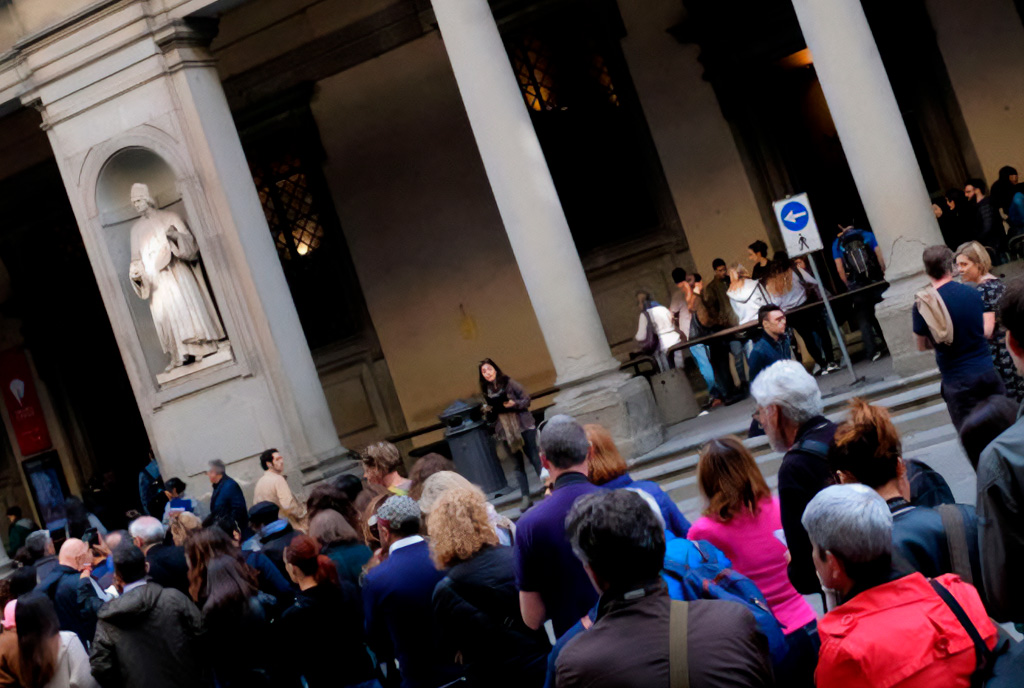
But while the city authorities declare war on nightlife, the director of the Uffizi Gallery, home to one of the world's most famous collections of Renaissance art, has come down on tourists, demanding a "sandwich tax" on the street-food stalls that supply visitors with takeaway meals and, in the process, litter the city center.
"Bans [on food] and fines [for litter] have proved largely inadequate to fight this phenomenon," said Schmidt. The open courtyard around the Uffizi is lined with built-in benches of highly absorbent "pietra serena" stone, so the problem is not just the litter, he says. Food and drinks damage the stone that has stood there since the Renaissance.
"Even now, the benches and steps of the Uffizi and the Loggia dei Lanzi [which overlooks the main square] are full of people eating and drinking. The result is oil and sauce on the stone, scraps of paper, food leftovers and soft-drink stains everywhere."
"The stone absorbs all of this and is damaged over time, so to protect it we have to clean it constantly."
"Making stall owners accountable through a small contribution could be a concrete way to fight this."
Street-food vendors are different from restaurateurs, Schmidt said, because the latter have premises where customers can eat, which they then clean up. With street food, on the other hand, "of course it is a legitimate business, but they take money for selling a product while essentially washing the consequences, the litter, the oil, the ketchup, the sauce dripping onto the ground or the stone, onto the citizens. So we need to balance the situation."
An 'absurd' idea
His proposal was met with delight by some locals. "The situation is terrible and needs to be managed," said Grechi, who would like either to ban eating and drinking in the area or to change the city planning to prevent clusters of street-food stalls: "It means that anyone who does not want to sit down for a meal ends up in the same few spots," she said.
But those in the business reacted with fury.
Paolo Gori, president of the business and services sector at Confartigianato Imprese Firenze, a trade association for small and medium-sized businesses with 8,000 members in the area, called it "absurd."
"Now is not the time to be thinking about new taxes after 18 months of pandemic," he said, adding that about a third of his members had either closed during the pandemic or were close to closing.
"The hospitality sector is one of the hardest hit industries. They are only just starting to see the light at the end of the tunnel, and then along comes this idea of a sandwich tax."
What is more, he said, "Florence was born on street food. We have a street-food culture," referring to lampredotto, a local delicacy made from the cow's fourth stomach and usually served in a sandwich.
Instead, he said, the city should put the responsibility on the tourists who make the mess.
"We need to fine the people who behave badly, who litter, who make the city dirty," he said.
"We want tourists, but the behavior has to be civilized. Florence is everyone's heritage, but tourists should respect it enough to leave it clean."
A question of quality
Alessandro Frassica, owner of the high-quality sandwich bar Ino, agrees that it is too much, too soon.
"The problem definitely exists, so we need to take measures that can better hit the 'hit and run' side of tourism, but I have not understood how the tax would be applied and to whom," he said.
The problem is not just sandwiches, he said.
"Ice cream, pizza, everything has gotten out of hand now, especially if you talk about the quality of what is on offer."
"To make something of good quality, there are costs, from the product itself to staff, hygiene and cleaning the point of sale. So when something costs so little, we have to ask questions."
"And let's not forget that people often bring their own food in a backpack and leave the waste everywhere."
But Schmidt insisted: "The situation that is coming back is already punishing various kinds of business, but most of all it damages the image of the whole city, and that hurts everyone."