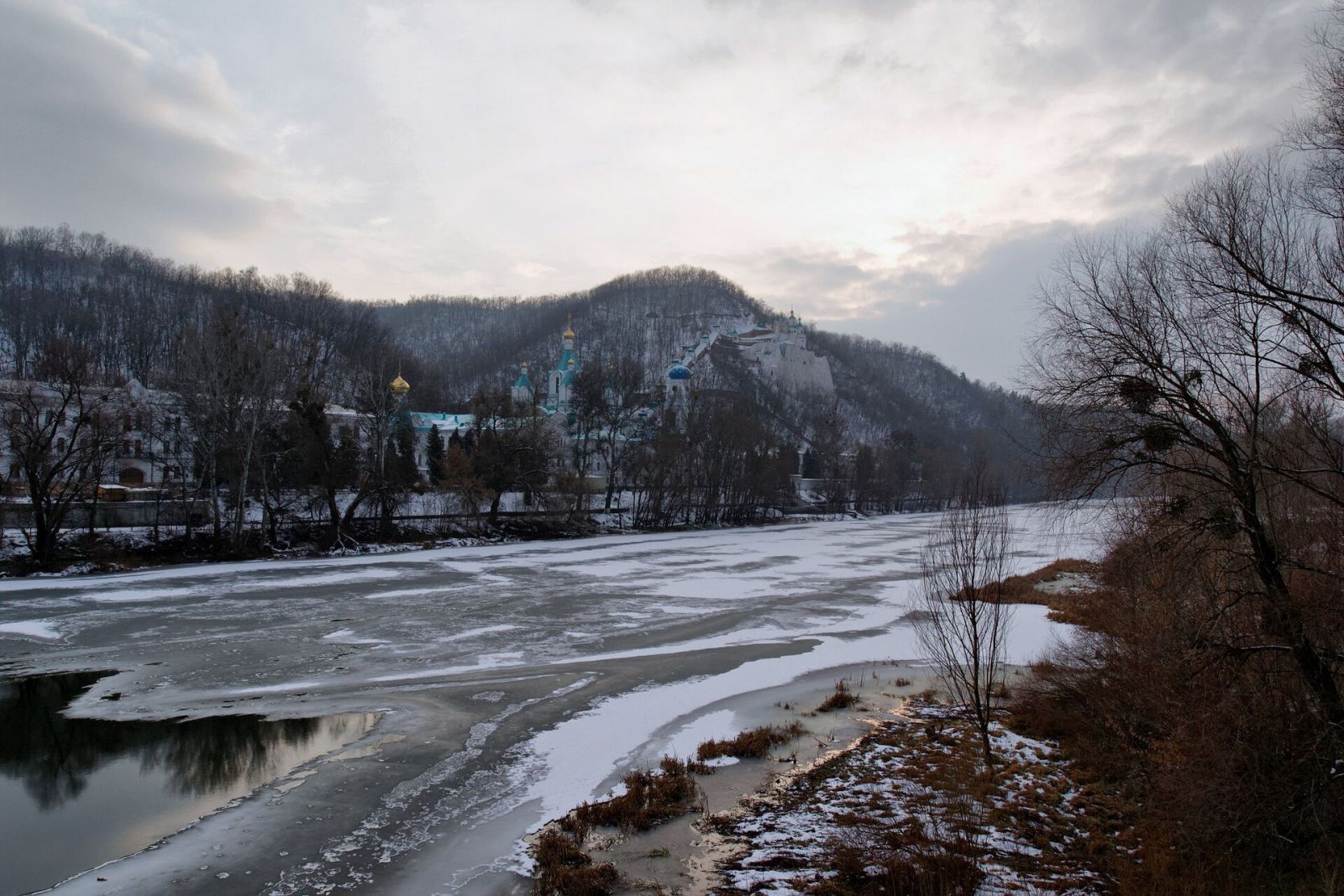
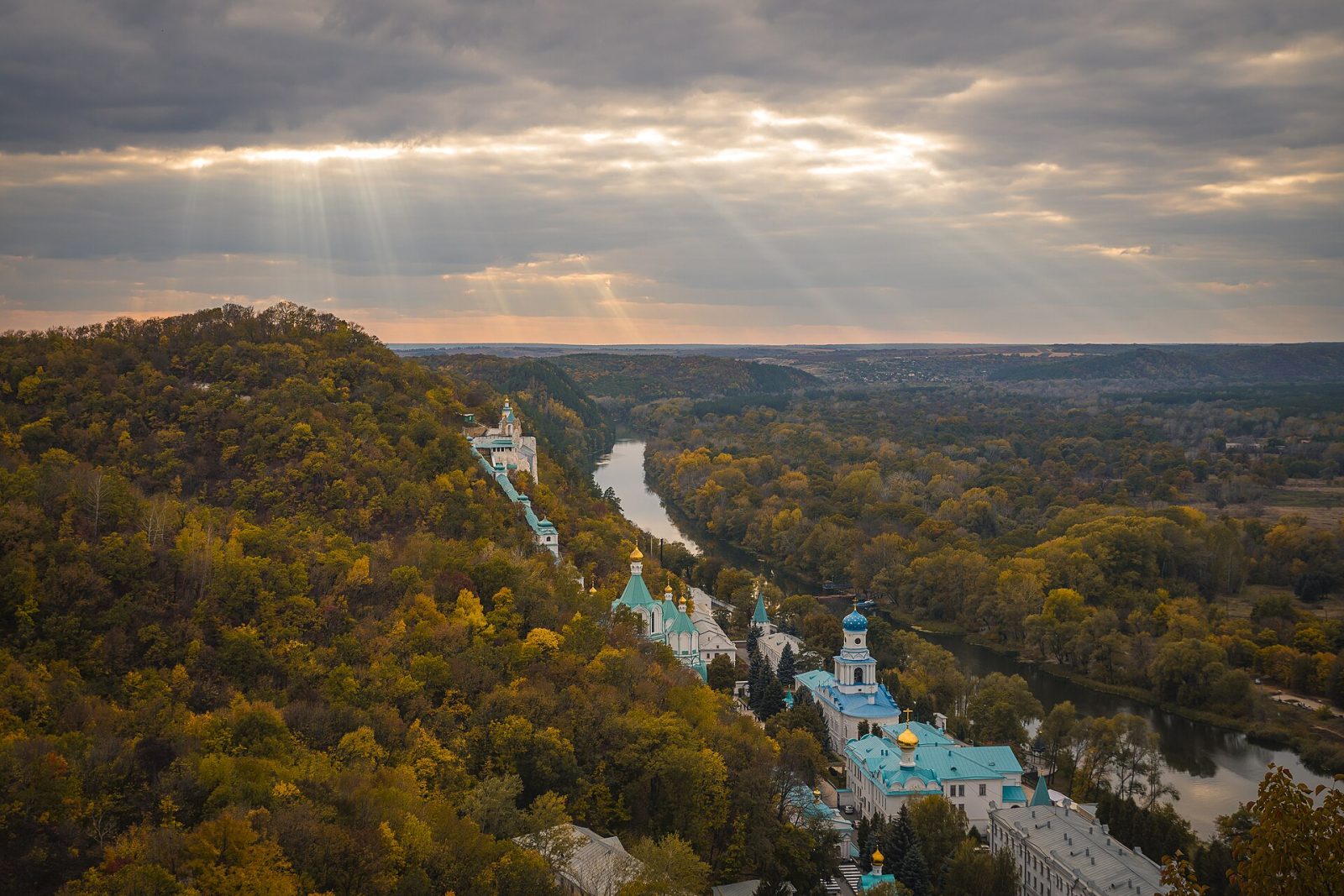
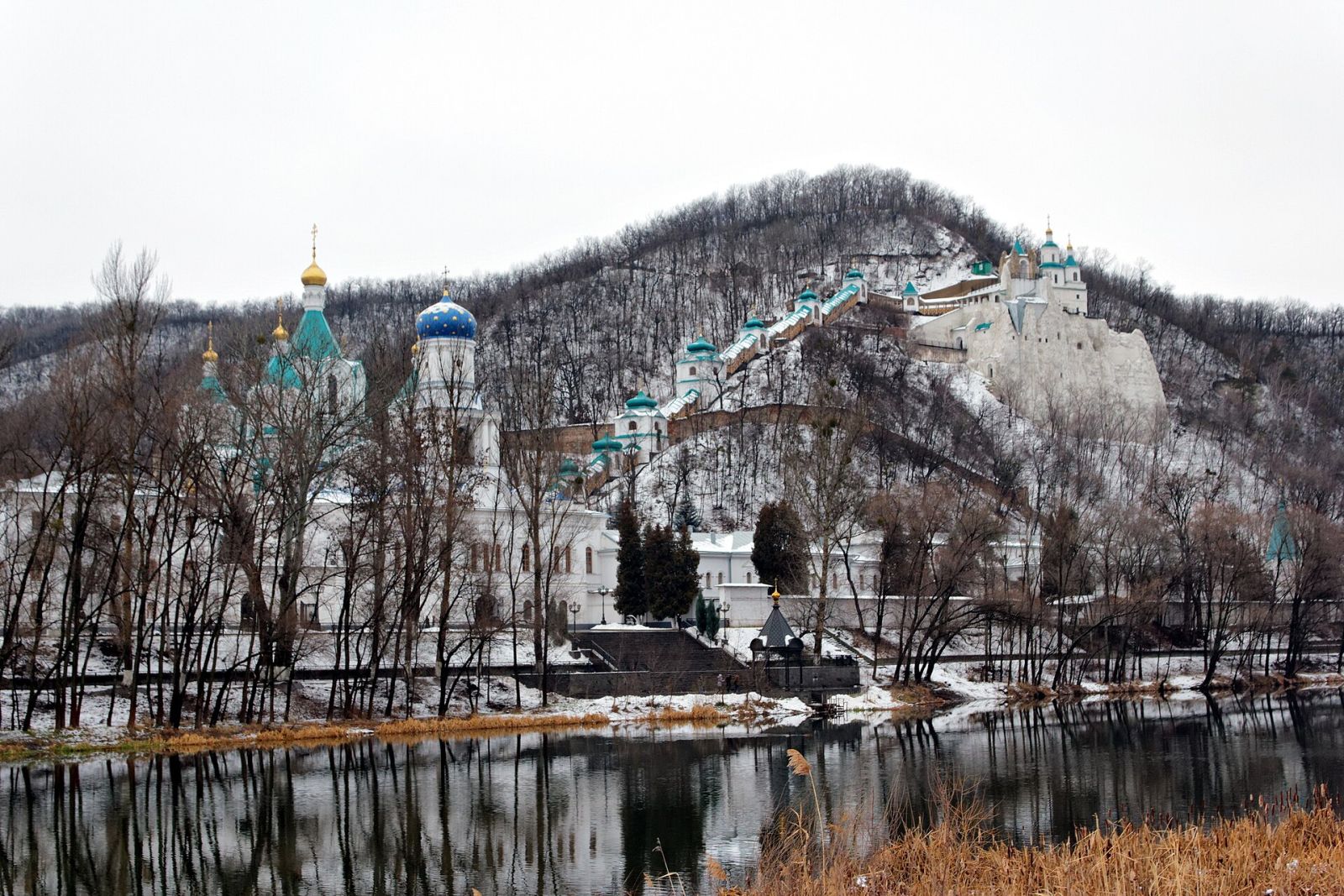
The Sviatohirsk Lavra above the Siverskyi Donets river in the Donetsk region is one of only three lavras in Ukraine, sharing that rank with the Kyiv Pechersk and Pochaiv monasteries. It does not sit on a plain. It bites straight into white chalk hills, and its great marvel is a cave monastery carved into the soft chalk back in the Middle Ages. War now surrounds it, so the first thing any traveller should do is not pack a bag but check whether the region is even reachable right now.
Why chalk, and not ordinary stone?
The banks of the Siverskyi Donets here are made of chalk, and that is geology rather than poetry. Chalk is soft enough to cut with a knife, which is exactly why the earliest monks were able to hollow out a whole network of tunnels, cells and churches inside the hill. Scholars still argue over the founding date, most often pointing to the turn of the fifteenth and sixteenth centuries, though some caves may be older. The monastery appears in documents from the 1620s, when it was already a working community.
White slopes above dark water, this is the view that drew painters here as far back as the nineteenth century. The best known image of the lavra came from Ilya Repin, born nearby in Chuhuiv. Hill, river and monastery, three things holding that picture together.
What are the main things to see?
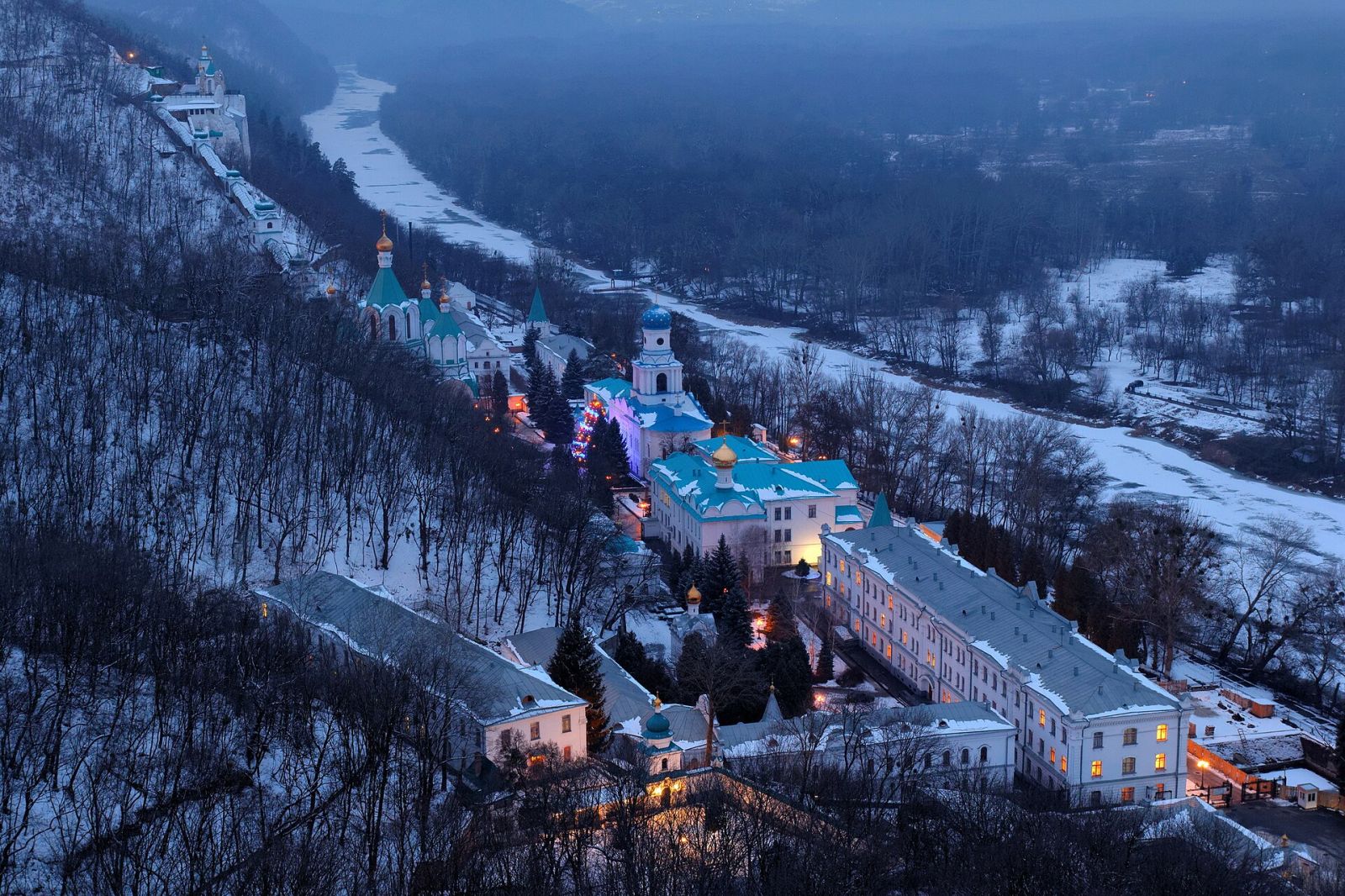
The complex is large, and one short walk will not cover it. Here are the anchor points to build your visit around.
| Site | Why it matters | The catch |
|---|---|---|
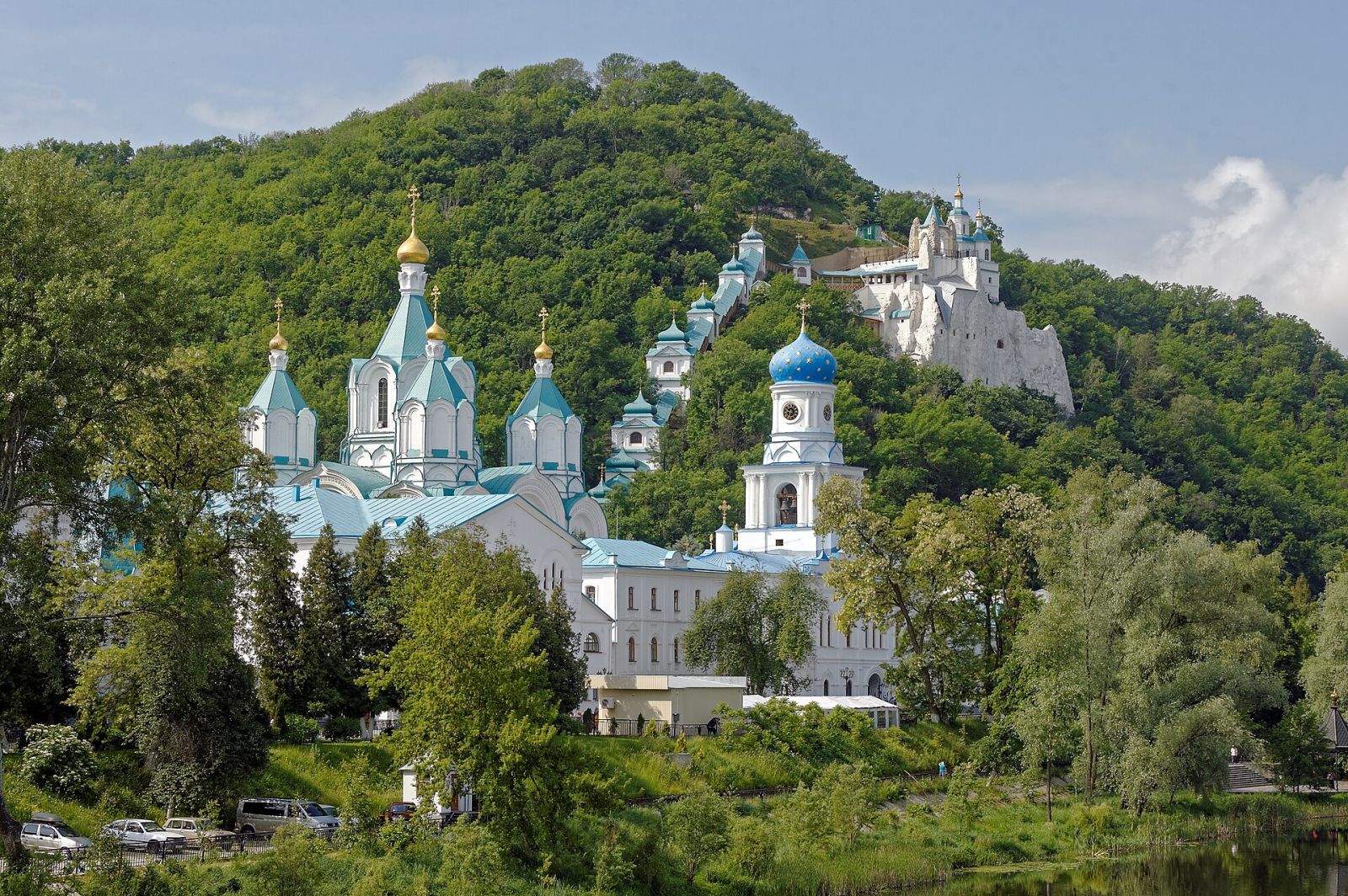
| St Nicholas Church | Perched on the very top of a chalk cliff, visible for miles | The symbol of the lavra, printed on every postcard |
| Cave monastery | Underground passages and cells cut into the chalk | Access to the caves is often limited, ask on site |
| Dormition Cathedral | The main above-ground church, massive, nineteenth century | The heart of the community's worship |
| Artem statue | A giant Soviet-era concrete monument on the next hill | A sharp contrast with the monastery, more on it below |
St Nicholas Church on the cliff
This is the building people recognise even when they have never heard the monastery's name. The small white church has fused with the rock as if it grew out of it rather than being built. From below it looks like it is hanging in the air. You reach it by paths and stairs, and from up there you get the finest view over the river and the floodplain forests.
Caves inside the hill
The oldest part of the community is hidden underground. Narrow passages, low vaults, coolness even in a heatwave, this is where monks lived, prayed and hid from raids. The chalk around you is pale grey, almost white, and by candlelight these corridors look much as they did three centuries ago. Because the rock is fragile and safety is a concern, cave tours do not always run, so do not count on them in advance.
So why is there a giant Artem next door?
It is one of the strangest neighbouring pairs in Ukraine. On the hill facing the monastery stands a twenty-two-metre concrete statue of the Bolshevik figure Artem, made by the sculptor Ivan Kavaleridze and raised in 1927 in a cubo-futurist style. The intention was blunt, to crush the spiritual symbol of the place under a monument to the new power. History decided otherwise, and now both structures stand side by side as memorials of different eras. The monastery is a living shrine, the statue a silent witness to the attempt to fight it.
A little of the hard history
The fate of the Sviatohirsk Lavra has never been calm. In the eighteenth century Catherine II ordered the monastery closed and its lands handed out, and it revived only in the mid nineteenth century. Under Soviet rule the community was shut down again and its grounds turned into a sanatorium. Monastic life returned here only at the end of the twentieth century. The monastery received lavra status in 2004, becoming the third in Ukraine.
The heaviest pages are the newest. During the fighting of 2022 the complex was damaged, the wooden All Saints skete burned down, and people sheltering on the grounds were killed. This is no longer distant textbook history but a wound only a few years old. That is why any account of the place should keep a restrained tone.
Dress code and conduct
This is a working men's monastery, not an open-air museum, and the rules match.
- Women need a skirt or dress below the knee and a covered head, a headscarf can usually be borrowed at the entrance.
- Men may not enter in shorts and need long trousers, while any hat comes off instead.
- Bare shoulders, deep necklines and revealing clothing are out of place for everyone.
- Photography and video inside the churches are often restricted, watch for signs and never film during services.
- Speak quietly and behave with restraint, for many this is a place of grief, not just a spot for a photo.
How do you get there?
In peacetime the route was simple. The nearest large town is Sloviansk, and from there it is about 30 kilometres to Sviatohirsk by bus or minibus. Direct services and trains ran from Kharkiv and Kyiv to Sloviansk, then local transport took over. The town of Sviatohirsk itself is small, and from it the monastery is a few minutes on foot across the bridge over the Donets.
But right now all of that is theory. The Donetsk region is an active war zone, some routes no longer function, and access to certain areas is closed or dangerous. No guidebook, this one included, can promise that the road is open today. The real situation must be checked immediately before any trip.
An honest word on safety
No sugar-coating here. Sviatohirsk and the surrounding area lie close to the front line, and the situation shifts fast. There have been periods of shelling and damage to the community itself. A pilgrimage or a tourist trip here should be planned only after you have checked official warnings, entry restrictions and the current conditions in the region. If there is even the slightest doubt about safety, the trip should be postponed. The Sviatohirsk Lavra is not going anywhere, while your health and life are worth more than any view over the Siverskyi Donets.
For those who cannot reach it in person now, there is another way, to read about it, look at archive photographs and keep the place in mind. One day the white hills above the river will be calm to visit again. For the moment the wisest choice is to wait and not take the risk.