

Winemakers in France's Burgundy region agree on one thing: 2021 was about as disastrous a year as any of them can remember.
The catastrophe struck in April.
Just as the tender buds on their vines were opening, the weather forecasts warned of a sudden, out-of-season drop in temperature.
Partner links: booking through them supports the blog at no extra cost to you.
For three nights, growers stayed up in their vineyards, lighting candles in a desperate attempt to save their harvests, some of the most prized in the world, from frost damage.
It was no use. Temperatures fell so low that in some areas half the crop was lost, and France declared an "agricultural disaster."

Alberic Bichot, president of the Federation of Great Burgundy Wines, says the three nights of frost cost the region 1 billion euros ($1.1 billion). As for his own harvest, he says 70% of his white grapes and 40% of his red were lost.
"It's a kind of drama for all of us," Bichot says. "Burgundy is small, and for our little region this is something very, very hard. But that's life.
"The good news is that we'll pick more grapes. The next harvest is 10 months away, so we have to be optimistic!"
Fierce Bidding

Beyond Bichot's half-full-glass assessment, there was also some tangible good news for the region's winemakers at Sunday's Hospices de Beaune charity auction, an annual event seen as a barometer of what the year's harvest might bring.
The auction, held in the beautifully preserved Hospices de Beaune, honors centuries-old traditions in which a medieval almshouse received donated plots of vineyards in famous regional wine villages such as Gevrey-Chambertin, Vougeot and Meursault.
Every year, on the third Sunday in November, the Hospices sells the year's harvest in barrels, to be aged and bottled by local winemakers, giving a closely watched early indication of how the market rates the potential of a good wine.
This year's event, run by the auction house Sotheby's, drew hundreds of bidders, both in person and remotely, competing to buy barrels filled with some of the finest wines in the world.

Although the Hospices cellars may have held fewer barrels this year than usual, roughly half, according to the auction's organizers, the sale still brought hope and cheer to the region.
With so few barrels up for sale, the bidding was fierce from the very start, and wallets were loosened even further by the charitable nature of the sale.
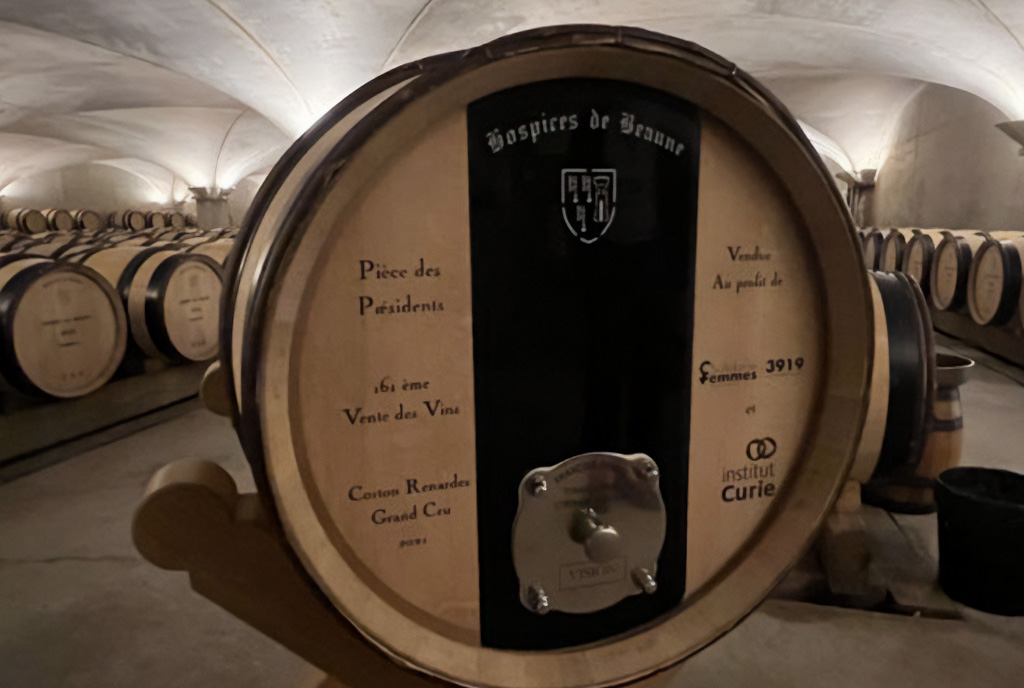
All eyes were on the main event, which took place late in the evening: the sale of the Piece du President, a 228-liter barrel of Corton-Renardes Grand Cru, which sold for a record 800,000 euros ($900,000).
Juicy Prospects

Beyond the immediate benefit to charity, the sale offered some hope that although this year's harvest was smaller, the prices it fetches might make up for it a little.
Bichot insists that even higher prices won't offset the shortfall, but says traditional French winemakers work with the long term in mind.
"When we plant a vineyard, it's not for next year, it's for the next generation," he says. "We plant a vineyard for the next 50 to 60 years. We're simply trying to bring out the soil, the terroir, the climate of Burgundy over the long term for future generations. It's our life, the life of our parents and grandparents... and for our children too."
But Bichot sees a silver lining where few have found one. A small harvest means, he says, a "high concentration of juice," potentially producing a better wine.
"So it's still early to know," he says. "But what we're tasting so far makes us very optimistic."
And, as he points out, the fact that the fate of one of the world's finest luxury goods rests in the hands of the gods keeps local growers humble.
"We know how small we are," he says. "And how much we owe to nature."