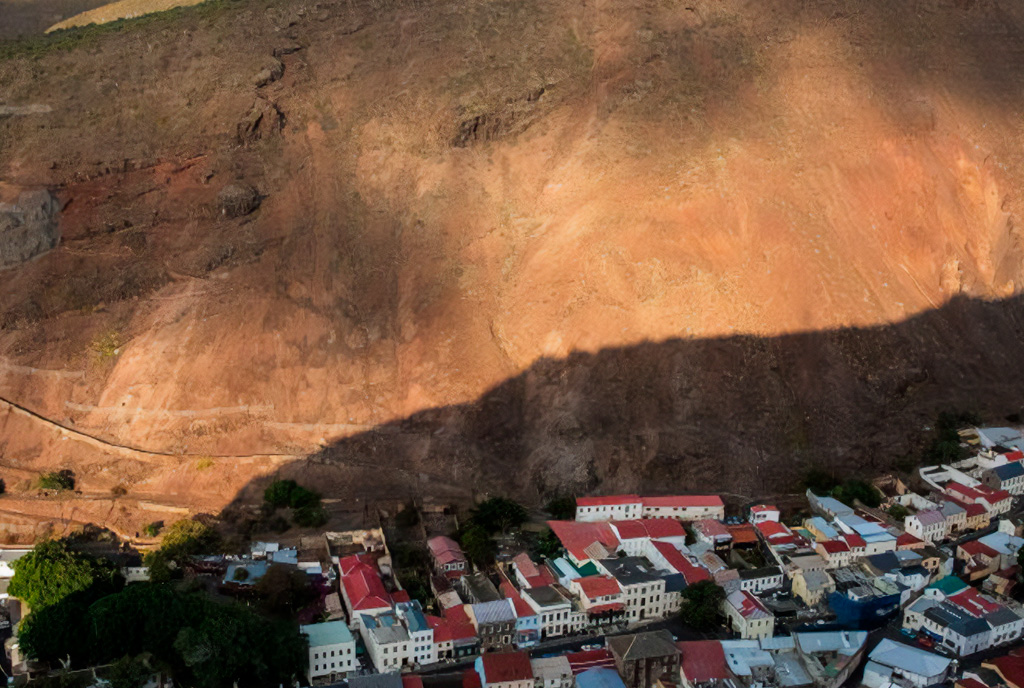


Halfway across the Atlantic Ocean, between South America and Africa, lies the island of St Helena.
Sitting 1,200 miles west of Windhoek in Namibia, it's one of the most isolated places on Earth: a 46-square-mile island of breathtaking rocky trails, dizzying roads and flax plants swaying in the ocean breeze.
With a population of fewer than 5,000, it can sometimes feel as though there are more dolphins in the surrounding ocean than there are Saints, as the islanders are known.
Partner links: booking through them supports the blog at no extra cost to you.
Yet for all its remoteness, St Helena is famous around the world thanks to its most celebrated visitor, who died there 200 years ago.
Napoleon Bonaparte, the first Emperor of France and conqueror of much of Europe, died at his home, Longwood House, on 5 May 1821.
It wasn't a home he had chosen, though. Napoleon was exiled to St Helena after the British defeated him at the Battle of Waterloo in 1815. Having already escaped a previous exile on Elba, off the coast of Italy, the French emperor was a flight risk to the European rulers who wanted him gone. Enter St Helena: a British colony 5,000 miles and 10 weeks' sail from Europe.
Related article: Remote islands: the world's 7 hardest-to-reach outposts
Napoleon spent more than five years on the island, arriving in October 1815. It was here that he built his own myth, dictated his memoirs and battled chronic pain from old battle wounds, and, quite possibly, a fatal stomach cancer.
And two centuries on, his myth still lives on the island, carefully tended by a single man: Michel Dancoisne-Martineau.
The 55-year-old, a native of Picardy, France, first came here at the age of 18 and has rarely left the island since.
He has adapted to a way of life very different from most people's. He leaves the island once a year; if he orders something from Europe, in 2021 the delivery takes longer than it took Napoleon to get there in 1815.
And if you think he does all this out of reverence for Napoleon, think again.
A different kind of legacy

Bought from the British by Napoleon III, nephew of the first emperor, the Napoleonic sites on St Helena stand in stark contrast to their counterparts in Paris.
Instead of the Tuileries Gardens of the French capital, St Helena has the gardens of Longwood House, his long-term home, which form an ocean of colour on this rugged island.
Instead of the Château de Malmaison, St Helena has the Briars, a sunny little cottage where he began his exile.
And instead of the extravagance of his tomb at Les Invalides, St Helena is home to Napoleon's original burial site. The emperor was buried on a lush hillside until France reclaimed his body 19 years after his death. Today, only a stone slab remains, ringed by black-painted railings.
Michel Dancoisne-Martineau looks after all of it. As director of the French domains on St Helena and honorary French consul, his job is to preserve these three small Gallic corners on an island that remains a British overseas territory.
That preservation has also meant serious restoration. When he arrived, the previous curator had left everything at the mercy of the elements.
"The old presentation was more about how it was at the start of Napoleon's stay, when he let the trees grow very close to the house to make it even darker than it really was," says Dancoisne-Martineau. "It was a choice, but it wasn't subjective. I suggested trying to make the house look the way it did when Napoleon died on 5 May 1821, both the house and its garden."
So over the years he reworked the woodwork and paint inside the house, and restored the gardens Napoleon had enjoyed outside. "You can see the aviary, the Chinese pavilion, the ponds, the grottoes and the sunken paths; it's a pleasure in itself," he says. Indeed, the garden brimming with colour, which Napoleon planned himself once he realised he would never leave the island, has turned one of St Helena's bleakest spots into one of its loveliest.
The myth of the martyr

Not everyone, however, is thrilled with Dancoisne-Martineau's efforts to beautify these places. For one thing, much of the Napoleonic myth rests on the idea that the emperor lived in appalling conditions on the island.
"Napoleon used the wretched, filthy conditions at Longwood and the bad weather to his own advantage, to cast himself as a martyr," says Dancoisne-Martineau, adding that the emperor deliberately reached for Christ-like connotations in the memoirs he dictated while on the island.
In truth, that wasn't far off. Longwood, the house assigned to Napoleon, was "the worst place on the island," says Dancoisne-Martineau. At 500 metres above sea level, it was constantly wrapped in cloud and buffeted by the trade winds. (Not that the English assigned him the house for that reason; they put him there because, on a high plateau reached by a winding ridge, it was almost impossible to escape from.)
His exile was arranged in such haste that nothing was ready for him when he arrived, even the administration of the island had to be handed from the East India Company to the British Crown. For the first two days Napoleon was confined to the boat that had brought him to St Helena, moored in the harbour.

And after two happy months at the Briars, a pretty cottage perched above the island's only sizeable settlement, Jamestown, Longwood came as a shock.
"Slowly but surely he realised the appalling conditions, both of the weather and of the house, which was falling apart," says Dancoisne-Martineau.
"The wooden floors had rotted, the roof leaked, water ran down the walls, rats scurried across the boards, there was the smell of stagnant water underfoot; it was a dreadful place."

On top of that, the year-long building works to raise a residential block for his entourage next door created "noise pollution" on this most remote of islands.
And although the British had promised to build him a new house, it was finished a week after his death.
Today, though, Longwood is an absolutely lovely place. Too lovely, in fact, for those who leave comments in the guest book complaining that it's simply too nice.
"Some are disappointed that it isn't in ruins, since that would match the legend of a very bad house; they'd rather see it derelict than well preserved," he says.
"But my job is to show you the house of a man who died yesterday. I have nothing to prove."
A legendary arrival

Dancoisne-Martineau's own story is almost as captivating as that of the man whose legend he polishes.
Born in rural Picardy in northern France, his journey to St Helena reads like a novel. In 1985, as an 18-year-old student, he fell in love with the works of the English poet Byron. He then read a biography of Byron so good that he wrote to its author on the spot.
The author was one Gilbert Martineau, a former curator of the Napoleonic sites on St Helena.
"He invited me to come for the summer holidays, and I was 18, and I thought it was perfect," he says.
Martineau was getting old. He had already retired but still looked after the sites, since his post had been advertised some time earlier but no one had applied: "They couldn't find anyone crazy enough."
Enter the young Michel.
Related article: New flights open Napoleon's hidden Atlantic island to international visitors
"I fell in love with the island and decided to apply," he says. At the time he was studying agriculture, but this way he could carry on the course by correspondence while being paid to maintain the Napoleonic landmarks. In short: "It was the perfect situation, because I was broke." He returned to France to do his compulsory military service, then signed a three-year contract in December 1987.
Dancoisne-Martineau wasn't happy in France: "I had been rejected by my own family, so there was a big void in my life."
At the same time, Gilbert Martineau felt discontented. Traumatised by his experience in the French navy during the Second World War, he had "lost faith in humanity," Michel says, and had withdrawn to St Helena, which he hated, and took pleasure in hating.
But he was also an old-fashioned man. "He had this notion that a man without children is one who has wasted his life," says Dancoisne-Martineau. So, two years after their first meeting, he made the young man an offer: he wanted to adopt him.
"He needed a child to give meaning to his legacy and his name, and I needed a father figure, so we combined our interests and he adopted me," he says simply.
"He was the father I never had. I'm very proud to be his son; we had a normal father-son relationship for 10 years."
And so Michel Dancoisne, an agriculture student, became Michel Dancoisne-Martineau, director of the French domains of St Helena and honorary French consul.
His three-year term kept renewing, again and again, as he bought land, built his own house, and then married a Saint.
He cared for Gilbert Martineau until the old man fell ill with cancer, and then they moved to La Rochelle in France for treatment. But as soon as his adoptive father died in 1995, Dancoisne-Martineau went straight back to St Helena.
He never left again.
"The French man"

Today the "French man," as the islanders call him, is one of the best-known residents of St Helena. For curious visitors, a glimpse of Michel Dancoisne-Martineau, the man who gave up Europe to hide away on this remote island and tend Napoleon's memory, ranks alongside climbing the near-vertical 900-foot Jacob's Ladder in Jamestown or meeting Jonathan, the 189-year-old giant tortoise believed to be the oldest living land animal in the world, who resides at the Governor's (British) residence.
"It irritates me," he says of the attention, adding that while the islanders want to know all your business at once and then leave you in peace, visitors have an insatiable need to see him.
"I'm just doing my job, but for some reason people want to see me in the flesh. Once I went along to a group because they were so insistent, but when I met them they had absolutely nothing to say to me; they just wanted a photo. It's almost as if they want to see the whale sharks, Jonathan and me."
Related article: New flights open Napoleon's hidden Atlantic island to international visitors
And yet the life he has chosen is, for most of us, an unusual one. In 2017 the island's long-awaited airport finally opened; before that St Helena was five days' sail from Cape Town aboard a British royal mail ship, the RMS St Helena.
He normally leaves the island only once a year, but because of the pandemic he hadn't left the rock for two years.
He buys only food on the island, stocking up on clothes and everything else during his annual trips to South Africa and France.
"If you want something extra, like coffee or other things, you have to import them from Britain," he says. Forget Amazon Prime; the delivery time is three months.
And still he never wants to leave.
"I lived in a tiny village in Picardy, so I'm used to a small community," he says. "It's not a challenge at all; it's what I'm used to. And I like the communal side of it. There's a very strong sense that everyone here is here for everyone else. That's why I love this place so much.
"I built my house and married a local woman, so I have no reason to leave. And now, with Brexit, I feel more St Helenian than ever."
Myth and magic

So what about the man his life has revolved around for the past 34 years? Was he a legend or a monster? A great ruler or a cruel one? And, most importantly, was he murdered by the British or did he die of stomach cancer?
Dancoisne-Martineau refuses to be drawn.
"You can think of Napoleon as a militarist, a monster, a hero, a superhero; whatever you think of him, I really don't care," he says.
"I have no strong opinion either way. My job isn't to steer visitors; my job is to preserve and present to you the house of a man who died yesterday. If you hate him, you'll be surprised that I don't try to change your mind at Longwood; I simply put the place in perspective."
Familiarity has bred, if not contempt, then a certain detachment from the subject.
"This is my everyday life, so I lose the perspective, the objectivity, everything, by focusing on such a narrow angle on the man. Every blade of grass has its purpose for me."
Not everyone is so relaxed. While most visitors to the island come for its marine life and remote location, some are Napoleon devotees, who are outraged by Longwood's good condition. Others try to steal the emperor's belongings, which Dancoisne-Martineau has spent decades gradually recovering, after much of it was taken back to France or scattered around the island.
And then there's the empty tomb, a 1-kilometre (0.6-mile) walk down a romantic, verdant hillside.

"At first I didn't understand it," he admits. "I found it strange to become the keeper of an empty tomb. But precisely because it's an empty tomb, everyone has their own interpretation of the man.
"He's no longer an individual; when an identity loses its physical substance, it becomes a myth. And, of course, a magical place [like the Valley of the Tomb] perfectly illustrates the myth, and then nature does its work to heighten it. This is where your imagination goes to work. I love it.
"And it becomes very hard to place Napoleon or define him, because everyone has their own approach. It's astonishing how many people are curious about, hate, dislike, love or feel passion for this man. It's almost as if there are as many readings as there are people."
This sweet island life

St Helena is known as one of the 14 British overseas territories and was declared part of the British Empire in 1875. Although Britain's old Colonial Office was abolished in 1966, Dancoisne-Martineau says that when he arrived 19 years later, the place still had a "very strong" colonial feel, with many civil servants on the island who were part of the old system.
"Slowly it faded, and colonialism disappeared," he says, pointing to the 1982 Falklands War as one of the turning points for change.
"Then St Helena slowly but surely took control of its own destiny. It's difficult, because the island has no resources, so they depend on Britain. It isn't easy, but they have a strong will to assert their identity, which is very beautiful."
But even in those early days, he said, he never felt any hostility because of his nationality, despite generations of Franco-British antagonism.
"That was all a very, very long time ago," he says. "The only times I've been attacked, and they're so rare as to be almost marginal, were by intellectuals in London who still dictate to the island what they should think or do; postcolonialism.
"The locals just call me 'the Frenchman'."
Although, having spent more time on St Helena than he ever did in France, he's no longer a typical "Frenchman".
"I'm somewhere in between," he says when asked whether he feels more Saint than French.
"The French have an expression, 'citoyen d'autre mer' [citizen from across the sea], or 'citoyen ultra-marin', which is even more romantic."
While he insists he neither likes nor dislikes Napoleon, he admits he's "fascinated" by the man who "never gave up".
"Most people in his position would have been depressed and bitter, but he was resilient, a fighter, a man who never, ever gave up," he says.
But it's St Helena itself, rather than its most famous inhabitant, that he feels closest to.
"I'm in love with the island and its people," he says.
"It's the home I searched for all my life."