

Many destinations lean on a handful of well known beauty spots to keep their reputation as a popular getaway alive.
When it comes to Greece, those postcard landscapes of blue skies, even bluer seas and whitewashed villages are simply everywhere.
This sun soaked Mediterranean country has enough picture perfect places to fill a lifetime of holidays.
Partner links: booking through them supports the blog at no extra cost to you.
Here are 36 beautiful (and delicious) reasons to travel to Greece:
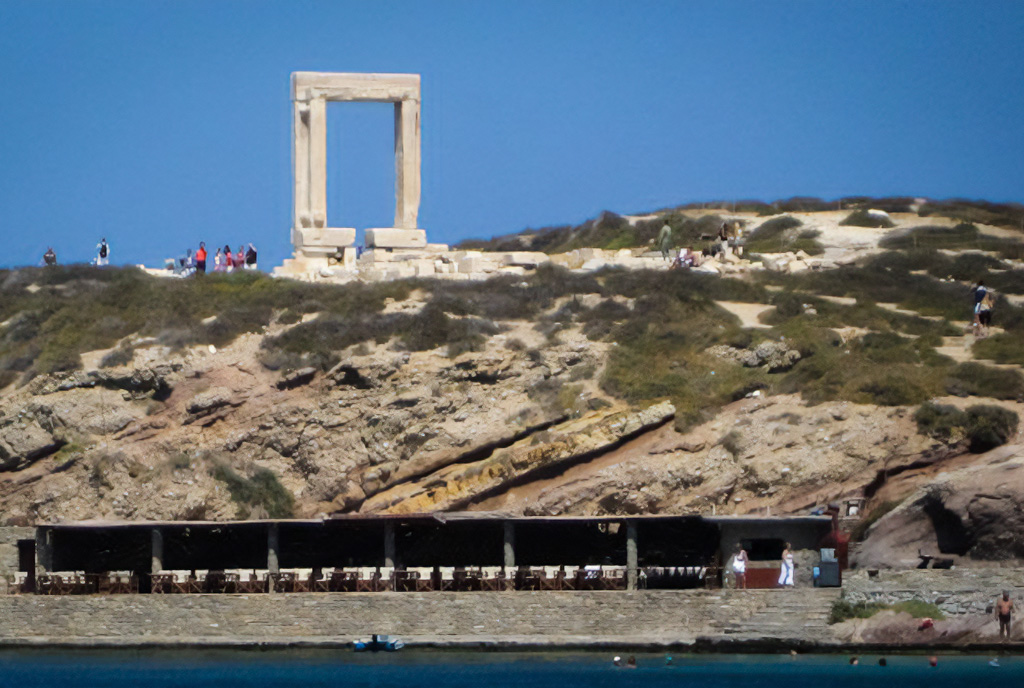
The Portara of Naxos

The largest of the Cyclades islands, Naxos pairs Caribbean style white sand beaches for sun lovers with a 3,000 foot mountain for hikers.
The Portara is the setting of the cruelest betrayal in all of mythology. It was here that Theseus abandoned Ariadne, daughter of King Minos, despite his promises to marry her and despite her help in slaying the Minotaur.
Not all was lost, though: the god Dionysus fell in love with her, and the composer Richard Strauss wrote a popular opera about her plight.
Karpathos

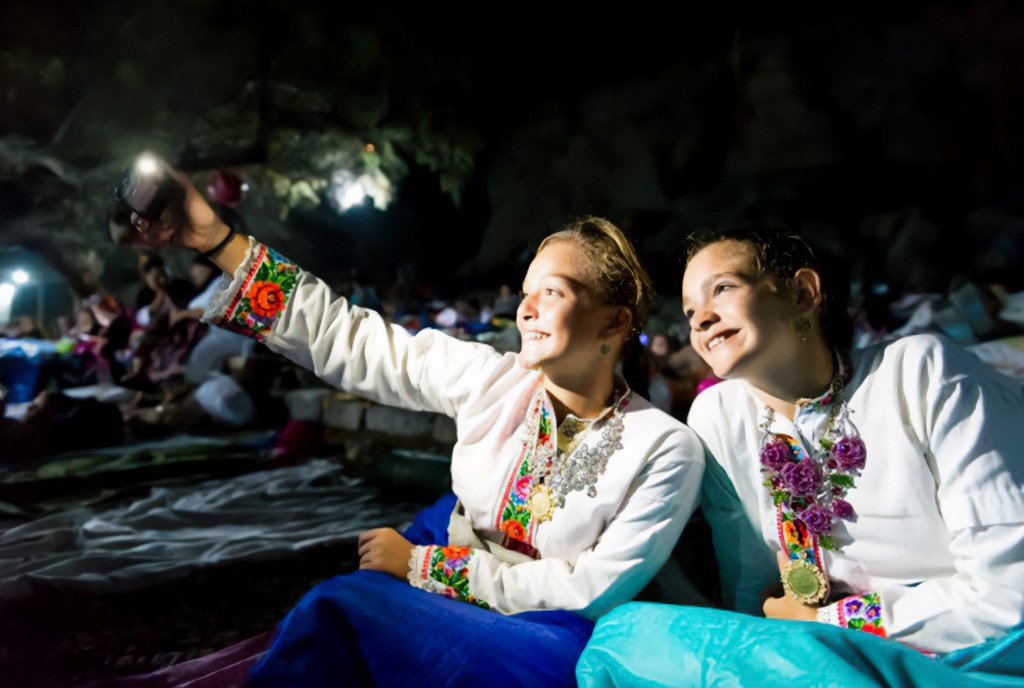
One of the most mysterious islands in the Aegean, Karpathos is almost never mentioned in historical texts, leaving archaeologists baffled as they try to decipher its ancient underground chambers and strangely built shrines.
Its wild landscapes are matched only by its unique ethnic culture. The village of Olympos (NOT Mount Olympus) is so cut off from the rest of the island that women still wear traditional embroidered dresses, even in the early 21st century.
Ios

No Greek island captures the carefree, sun drenched summer holiday better than Ios.
It has some of the finest beaches in the Mediterranean.
Its nightlife is famous for open air clubs that only get going after midnight and keep the party running until dawn.
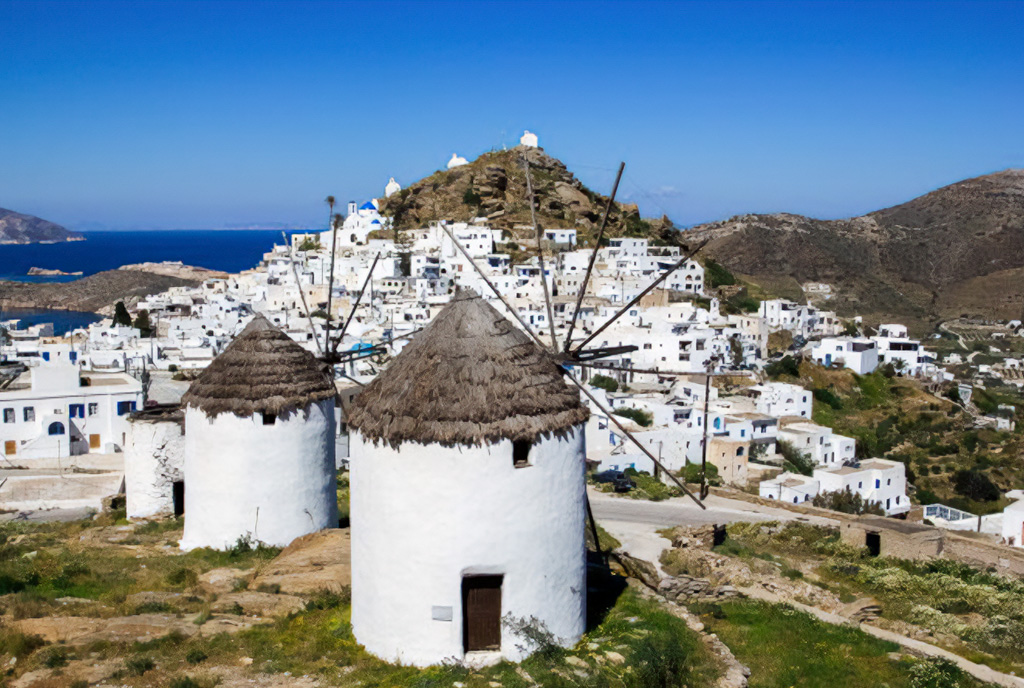
Finally, its capital, Chora, is a whitewashed zigzag of narrow alleys whose iconic windmills are a reminder that, in spite of the heat and the sun, the island is also swept by a seasonal summer wind, the meltemi, which acts as a natural air conditioner.
Fresh Seafood

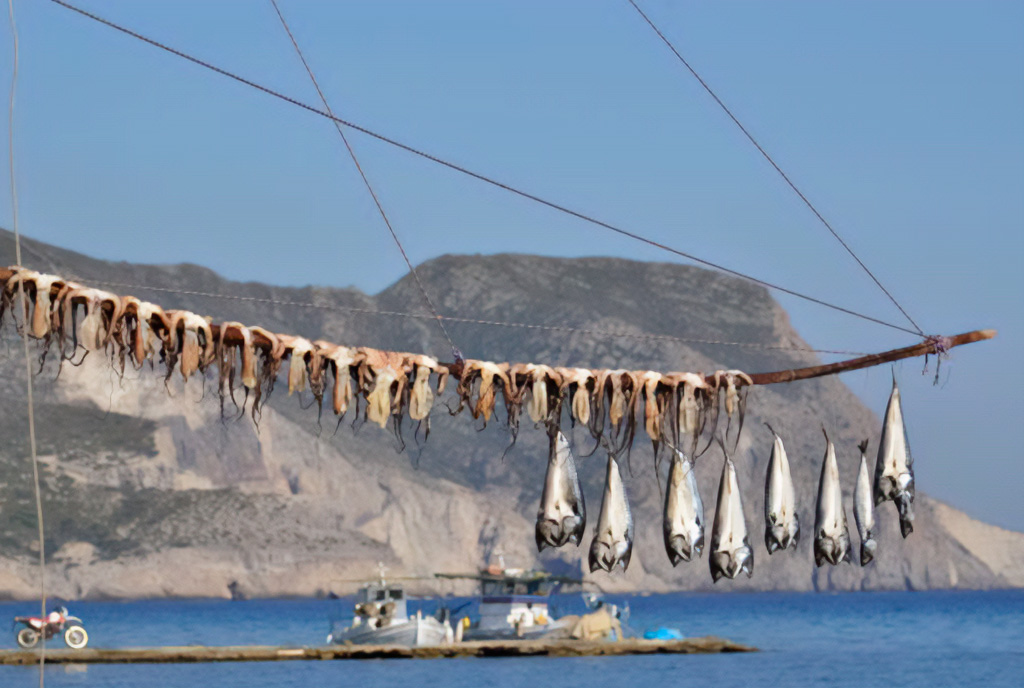
Greeks fuss over freshness like no other people, especially when it comes to seafood.
Many fish tavernas on the smaller islands or in coastal villages have their own fishing boats and serve the day's catch.
"Frozen" is a dirty word, and plenty of waiters will warn a customer if the squid or the sea bream is katepsigmeno, meaning frozen.
Some restaurants will even go so far as to tell you where the fish was caught: nearby or out in deeper waters, which means a longer journey and possibly freezing on board.
Pidima tis Grias
Andros is a green, lush island not far from Athens, home to around 20 shipowning families who have gifted it museums and art collections; even today it is still easier to get around the island by boat than by car.
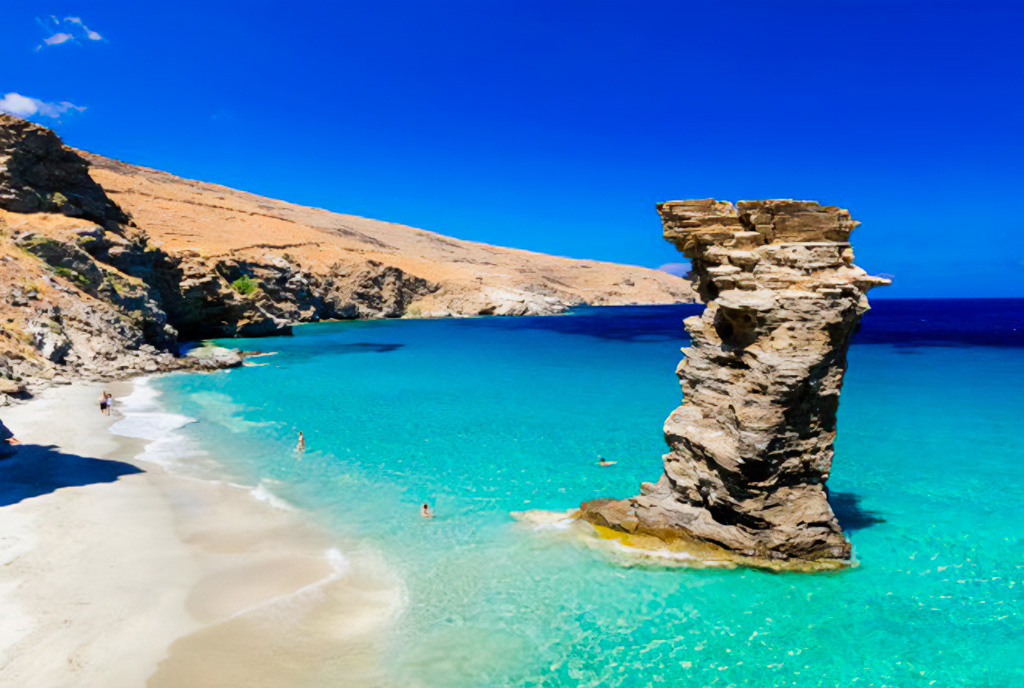
Many of its striking beaches feel remote even at the height of summer, such as Pidima tis Grias (the Old Woman's Leap).
According to legend, an old woman who betrayed the nearby fortified village of Kochylos to Saracen pirates threw herself off the cliff, overcome with remorse, and turned into the upright, isolated rock you can see out in the sea.
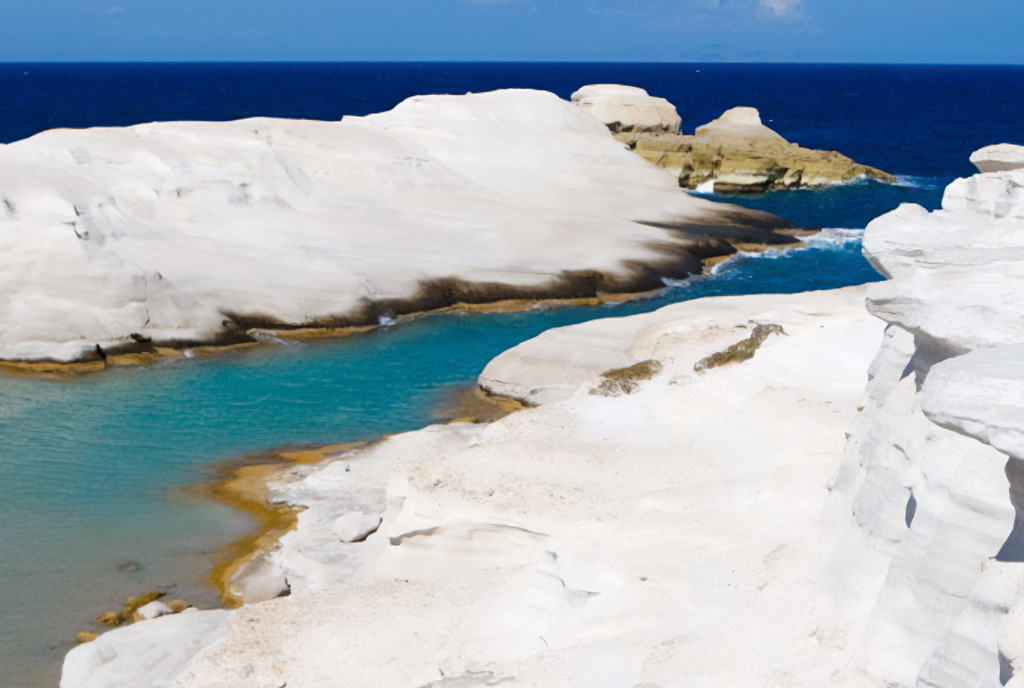
Sarakiniko
Milos is a volcanic island with natural geothermal heat.
The local taverna on Paleochori beach is well known for its stews, which are buried in the sand a little before midnight and are ready to eat the next morning after slow cooking on steady heat for eight hours.
Various eruptions have created more than 70 multicolored beaches, though none is more striking than the pure white limestone shore of Sarakiniko, shown below.
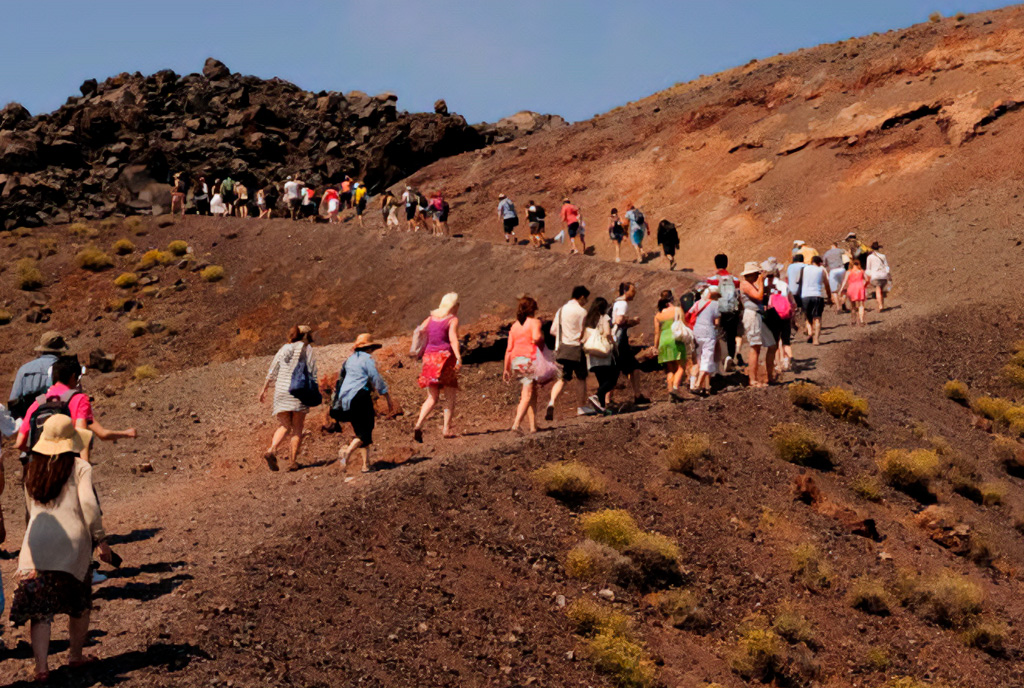
Walking the Santorini Volcano
Santorini is on everyone's bucket list: crescent shaped, it faces a flooded crater to the west, while on its eastern side it boasts endless stretches of black sand you won't find anywhere else in the Aegean.
Hiking the otherworldly slopes of the two still actively volcanic Kameni ("Burnt") islands inside the crater, gazing across at the main island whose whitewashed houses crown the cliffs like sugar icing, is a holiday highlight.
Skopelos

Greece has featured in Hollywood blockbusters since 1957, when "Boy on a Dolphin" was filmed on the island of Hydra, starring Sophia Loren.
There have been many iconic films since: "Never on Sunday," which introduced Melina Mercouri; "Zorba the Greek," whose sirtaki dance at the end became a beloved cliche; "For Your Eyes Only," with Bond at the monasteries of Meteora; "Shirley Valentine," starting a new life on Mykonos.
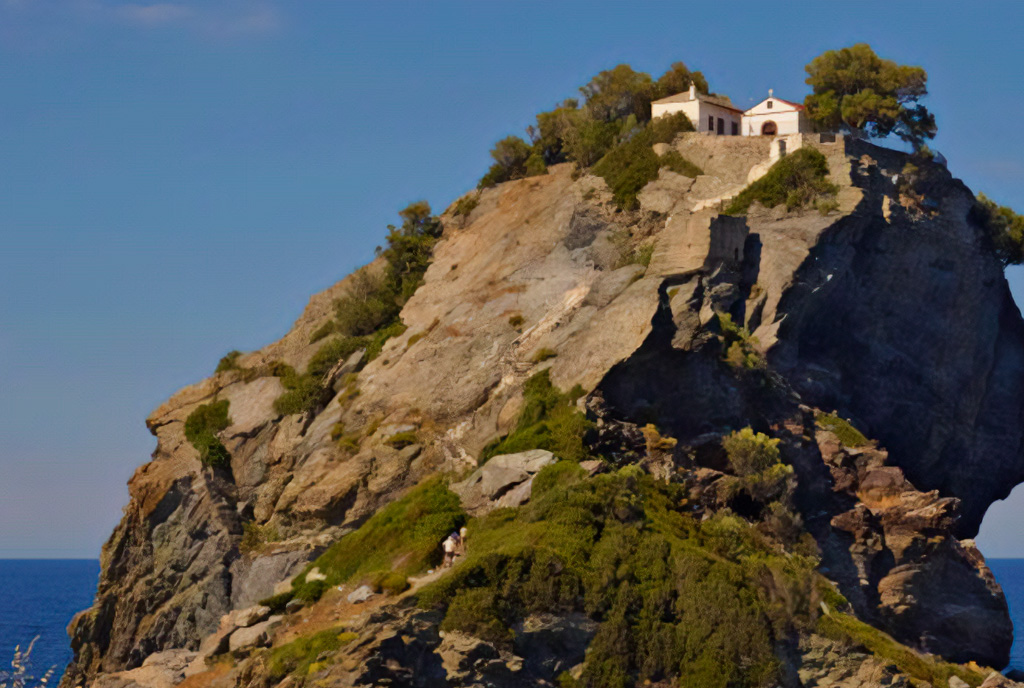
The most successful was "Mamma Mia," filmed on Skopelos. It draws fans of Swedish pop legends ABBA from all over the world to recreate the dance moves on its beaches and climb up to the church of Agios Ioannis in Kastri, shown here, where the final wedding takes place.
Pyrgos, the Marble Village

Despite the onslaught of mass tourism, thankfully many Greek islands still slip under the radar of the big tour operators.
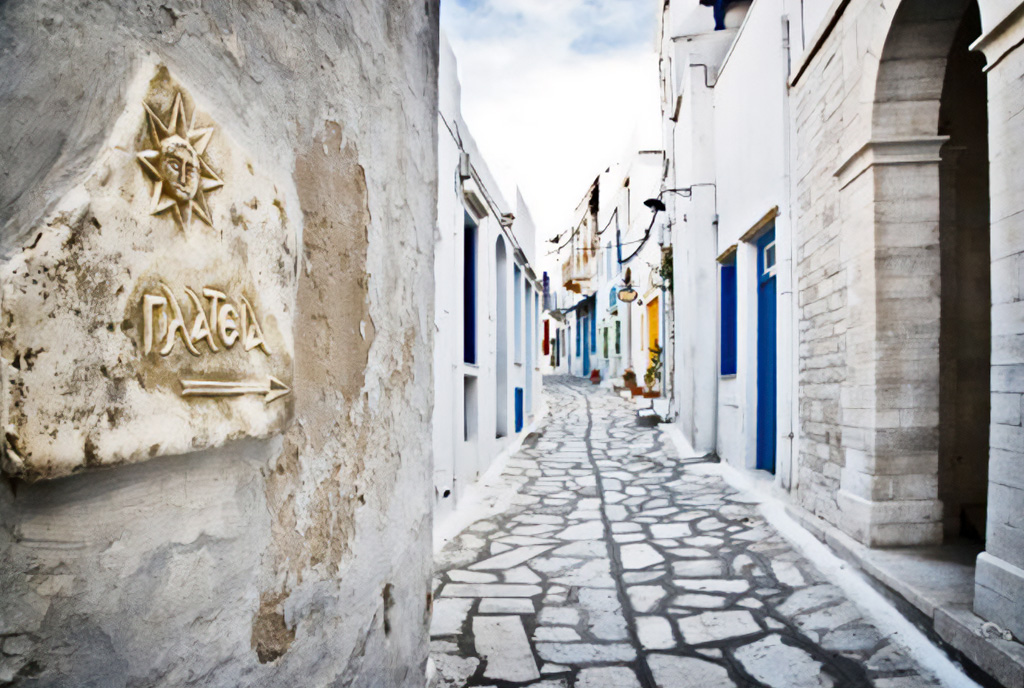
Beyond the usual abundance of beaches, Tinos has been home to marble quarries since ancient times, and its inland village of Pyrgos boasts no fewer than three museums devoted to marble.
Home to a highly demanding school of sculpture, it has a marble bus stop, several marble craftsmen's workshops and a cemetery that could pass for an exhibition gallery of marble statues.
The Palace of Knossos, Crete

Knossos, according to tradition, was the capital of the Minoan civilization, the first in Europe, and it was inhabited from the Neolithic period (7000 BC) right through to Roman times.
The palace pictured here is linked to the legends of the Labyrinth and the Minotaur, as well as the flight of Daedalus and Icarus.
One of the few archaeological sites in Greece that has been partly restored, its main attractions are the Throne Room and the magnificent frescoes that still adorn the walls.
Ouzo

Ouzo is a Greek anise flavored spirit, traditionally sipped from narrow glasses and diluted with water, which turns it a milky white.
It is served alongside small mezedes, the Greek take on Spanish tapas.
Although it is distilled all over Greece, the most famous names, along with two museums, are found on the island of Lesbos (Mytilene).
On its "ouzo trail" you can visit no fewer than 16 different distilleries, each with its own recipe and aromatic ingredients.
The Golden Wreath of Vergina

The UNESCO World Heritage Site of Vergina is the best kept secret in Greece.
Step inside the mound near the town of Veria and you can marvel at four unlooted royal Macedonian tombs, including one belonging to the father of Alexander the Great.
The adjoining museum holds a wealth of artifacts from the tombs, including this golden oak wreath. Weighing 714 grams (1.5 pounds), it is the heaviest, and with 313 leaves and 68 acorns the most intricate, ever found from Greek antiquity.
Paros
Part of the joy of a Greek holiday lies in renting a scooter or a quad bike and finding your own deserted beach to stretch out and unwind on.
While the island of Paros gets lively in high season, the sheer number of secluded coves, inlets and sandy strips you can't reach by car means there's always a stretch of shoreline with your name on it.
Bourtzi Castle in Nafplio or Palamidi Castle in Nafplio

Well defended by not one but three separate forts (one of them in the middle of the bay), it's no surprise that Nafplio became the first capital of modern Greece (1823 to 1834).
Showing traces of its Greek, Ottoman and Venetian past, and with elegant 19th century avenues bursting with bougainvillea, it's the perfect base for exploring the antiquities of the Argolid (Mycenae, Tiryns, Epidaurus), while also making a wonderful day trip from Athens in its own right.
Ceramics

Shopping in Greece is a delight, with local craft traditions handed down through generations of families in jewelry, silverwork, textiles and ceramics.
Rhodes has been famous for its pottery since ancient times; indeed, clay bricks from the island were used to build the dome of Hagia Sophia in Constantinople.
Today the island of Rhodes is once again at the cutting edge with its colorful decorative designs, some modern, others inspired by pieces in the archaeological museum of Rhodes.
The Acropolis

Greece's most iconic monument is a sacred rock dedicated to the goddess Athena, patron of Athens.
Its current form dates to the middle of the 5th century BC and includes several buildings, among them the Parthenon, the archetype of classical architecture that has been imitated the world over.
Plundered over the centuries and partly destroyed in 1687 during a Venetian bombardment of what was then a Turkish fort, the Acropolis still holds on to its charisma.
Rhodes, Lindos
The sheltered bay of Lindos, overlooked by an ancient Acropolis you can still reach by riding a donkey, is one of the safest swimming beaches on the island of Rhodes and hugely popular with families.
If it's crowded, try the smaller, less busy bay on the other side of the Acropolis, whose postcard perfect monastery of Saint Paul is a favorite for both local and foreign weddings.
The Changing of the Guard

Despite its glorious past, Athens is a modern metropolis with a 19th century neoclassical center.
No building from that era is more striking than the old Royal Palace, now the seat of parliament and the site of the Tomb of the Unknown Soldier. It is guarded by the Evzones, the Instagram favorite guards in their traditional red caps with long black tassels, pleated kilts and tsarouchia (red clogs with black pompoms).
The changing of the guard is a major tourist attraction with striking choreography.
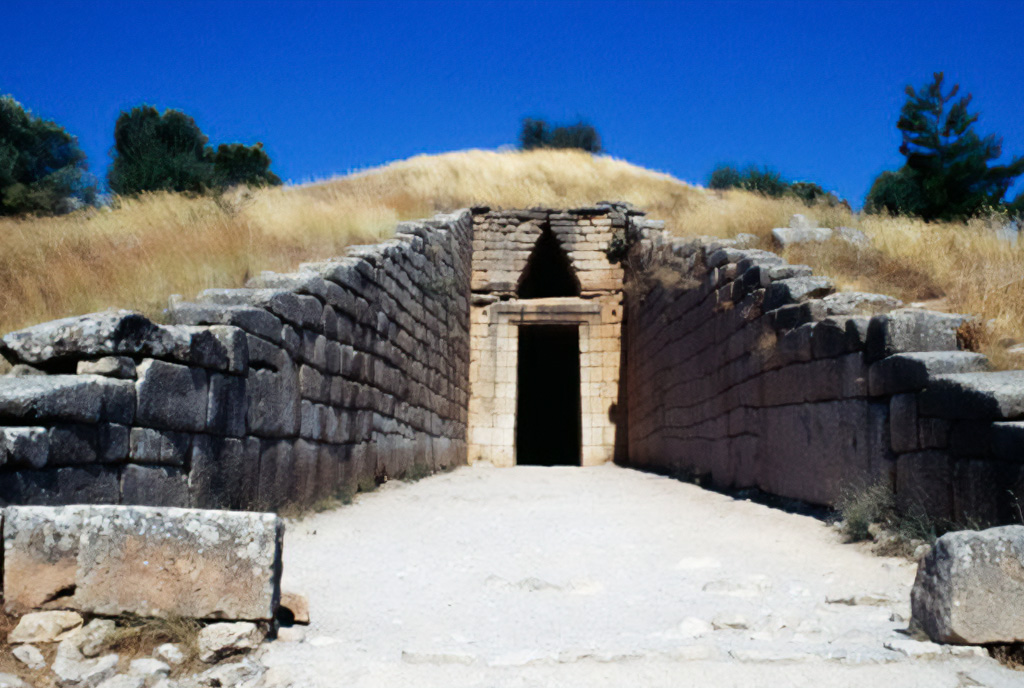
Mycenae
Mycenae, the setting of the Homeric epics, became one of the first excavated sites in Greece when the archaeologist Heinrich Schliemann uncovered several grave mounds in the 1870s.
He named the most impressive one the "Tomb of Agamemnon" because of the wealth of golden objects found inside.
This monumental tomb, whose lintel stone above the doorway weighs no less than 120 tons, is the most awe inspiring relic of the Mycenaean civilization so vividly portrayed in the Iliad.
Delphi

Of all Greece's archaeological sites, none is more spectacularly situated than Delphi, home of the famous oracle of antiquity and the ancient Greeks' center of the world.
It sits on the rocky slopes of Mount Parnassus, in a ravine carved out by the Phaedriades, twin rock formations that flank the sanctuary of Apollo and draw the eye down toward the Gulf of Corinth.
Chania

Many people call Chania the most beautiful town in Greece, and not without reason.
Ancient Greeks, Byzantines, Genoese, Venetians, Egyptians and Turks have all left their signatures on the town and its picturesque harbor.
A short stroll through its narrow lanes will take you past mansions with gateways decorated with medieval coats of arms, charming Jewish merchant houses and well preserved Ottoman mosques with Egyptian minarets; in short, the whole Mediterranean in miniature.
Meteora

The complex of six Orthodox monasteries built vertically atop the rock pillars of Meteora is one of the most breathtaking sights in Greece.
Hermits and mystics have sheltered in the rock caves here since the ninth century AD, though the first monastery was not founded until around 1340.
The steepest monastery (Roussanou) is home to nuns, who as recently as 1930 were still hauled up and lowered down using ropes and nets.
Corfu Town

There is Greece, and then there is Corfu.
First time visitors whose idea of a Greek island is a dry, sun baked rock in the Aegean are amazed by the amount of greenery that blankets Corfu.
A brief period of English rule in the 19th century left its mark too.
There may be a cricket pitch in the center (the only one in Greece), but there's a distinct whiff of rural England about Corfu Town, alongside the usual Venetian touches you find all along the Ionian Sea.
The Little Venice of Mykonos
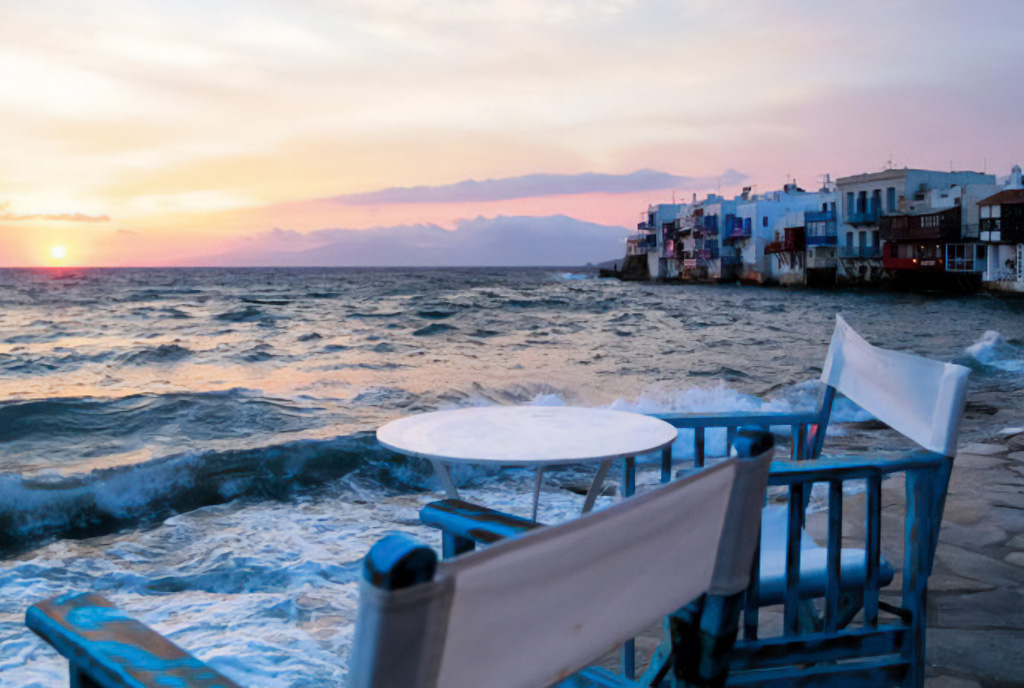
Getting lost in the whitewashed maze of streets in Mykonos Town is part of the island experience that makes even the most cynical globetrotter sigh with delight.
Follow the sun westward, though, and you'll find yourself in "Little Venice," with houses built right up to the waterline and balconies suspended over the sea.
This is where sunset watchers gather for a pre dusk drink at tables that get booked days in advance.
Monemvasia

The granite rock of Monemvasia, dubbed the Gibraltar of the East, hides an impregnable fortified town of the same name, with narrow, romantic streets that haven't changed since the Middle Ages.
The only concession to modern traffic is a small causeway linking it to the mainland, but beyond the gates no cars are allowed.
Its name, meaning "single entrance" in Greek, was corrupted to "malmsey" in English, as was the famous wine that comes from this region.
Lake Melissani

The turquoise Lake Melissani on the Ionian island of Kefalonia lies 20 meters below ground level in a cave whose roof has partly collapsed.
Scattered sunlight lights up its deep waters and the surrounding rock formations in different shades depending on the time of day; the best views are around noon, when the sun's rays are vertical.
Although the cave was only discovered in 1951, the ancient Greeks knew about it: on a small island in the middle of the lake stands a sanctuary of Pan, the god of the forest.
Thessaloniki

Unlike Athens, whose importance faded after roughly the fifth century AD only to be resurrected as the capital of modern Greece in 1832, Thessaloniki, Greece's second largest city by population, has a long unbroken history.
Founded in 315 BC and named after the sister of Alexander the Great, it was the second most important city in both the Byzantine and Ottoman empires after Constantinople.
The iconic 112 foot "White Tower" on the waterfront, shown here, was built by Suleiman the Magnificent and served as a notorious prison right up until the 19th century.
Shipwreck Beach
On October 2, 1980, the ship MV Panagiotis was washed ashore on Agios Georgios beach on the island of Zakynthos.
Speculation about the circumstances that led to the shipwreck has passed into the realm of legend, with the vessel said to have been carrying everything from contraband cigarettes to the Italian mafia.
What's beyond dispute, though, is that it transformed an ordinary sandy cove into one of the most photographed and visited beaches in Greece.
Mystras

Mystras is one of a kind: a medieval ghost town on the eastern slopes of Mount Taygetos, near Sparta.
It was built by French crusaders in the 13th century, but was soon taken over by the Byzantines and became the seat of a medieval principality that spread across the whole Peloponnese.
Abandoned in the 19th century, its frescoed churches, fortifications, mansions and grand palace all add up to the most atmospheric site in Greece.
The Samaria Gorge
One of Greece's most scenic walks, the Samaria Gorge cuts across Crete from north to south for 10 miles.
The cliff walls along the trail rise to 980 feet, narrowing at one famous stretch known as the "Gates" to a width of just 13 feet. The hike takes five to eight hours and can be grueling in the summer heat, so make sure you carry enough water to see it through.
Agios Dimitrios
Greece is a deeply religious country, the first in Europe to hear the apostle Paul preach Christianity.
Every major city honors its own special saint, but no cult is greater than that of Saint Demetrius in Thessaloniki, a Roman commander said to have been martyred around AD 305.
Since today's modern church stands over an earlier one, which was built almost immediately on the supposed site of his martyrdom, the building is probably the longest continuously used Christian place of worship in the world.
Saint Barbara Park

Contrary to popular belief, it really does snow in Greece, especially in the mountainous north, where there are several ski resorts near the town of Drama, Greece's very own Switzerland, pictured below.
Falakro, at 2,232 meters (7,323 feet), is the northernmost ski resort in Greece, with the longest season, and it has 21 runs, including five blacks and nine reds.
The Androklis run, stretching 2,200 meters with a vertical drop of 617 meters, is as good as any you'll find in the Alps.
Zagori
The Pindus mountains in Epirus are one of the last remaining wildernesses in Europe, and the villages of Zagori near the Albanian border offer some thrilling experiences.
Here you can go canyoning, rafting and kayaking on three pristine rivers, or set off on a hike through the Vikos Gorge, which, with drops of up to 3,000 feet, is the deepest gorge in the world according to the Guinness Book of Records.
Street Art

Graffiti artists turned Greece's recent economic downturn to their advantage.
Shuttered shops, neglected walls and abandoned buildings provided the canvas for an explosion of street art.
The booming scene in Athens has drawn artists from all over the world, such as the Bali born WD (Wild Drawing), who has made Athens his home.
Traditional Diples

Greek traditional sweets are very similar to those in the Middle East, in that they are based on honey rather than sugar.
Many of them are prepared for specific festivals.
Diples, pictured above, come from the town of Kalamata in the Peloponnese and are traditionally served at Christmas time. Their simplicity (fried dough turnovers coated in honey and sprinkled with walnuts) belies just how delicious they are.
Litochoro, Gateway to Mount Olympus

Besides being the starting point for every hiking expedition up Mount Olympus, the small village of Litochoro has one of the grandest settings in Greece.
To the west rises the 9,570 foot "home of the Greek gods," while to the east stretch the calm, blue waters of the Thermaic Gulf.
The climb to Mytikas, the highest peak of Mount Olympus, usually takes two days, with an overnight stay in a refuge three hours' walk from the summit.