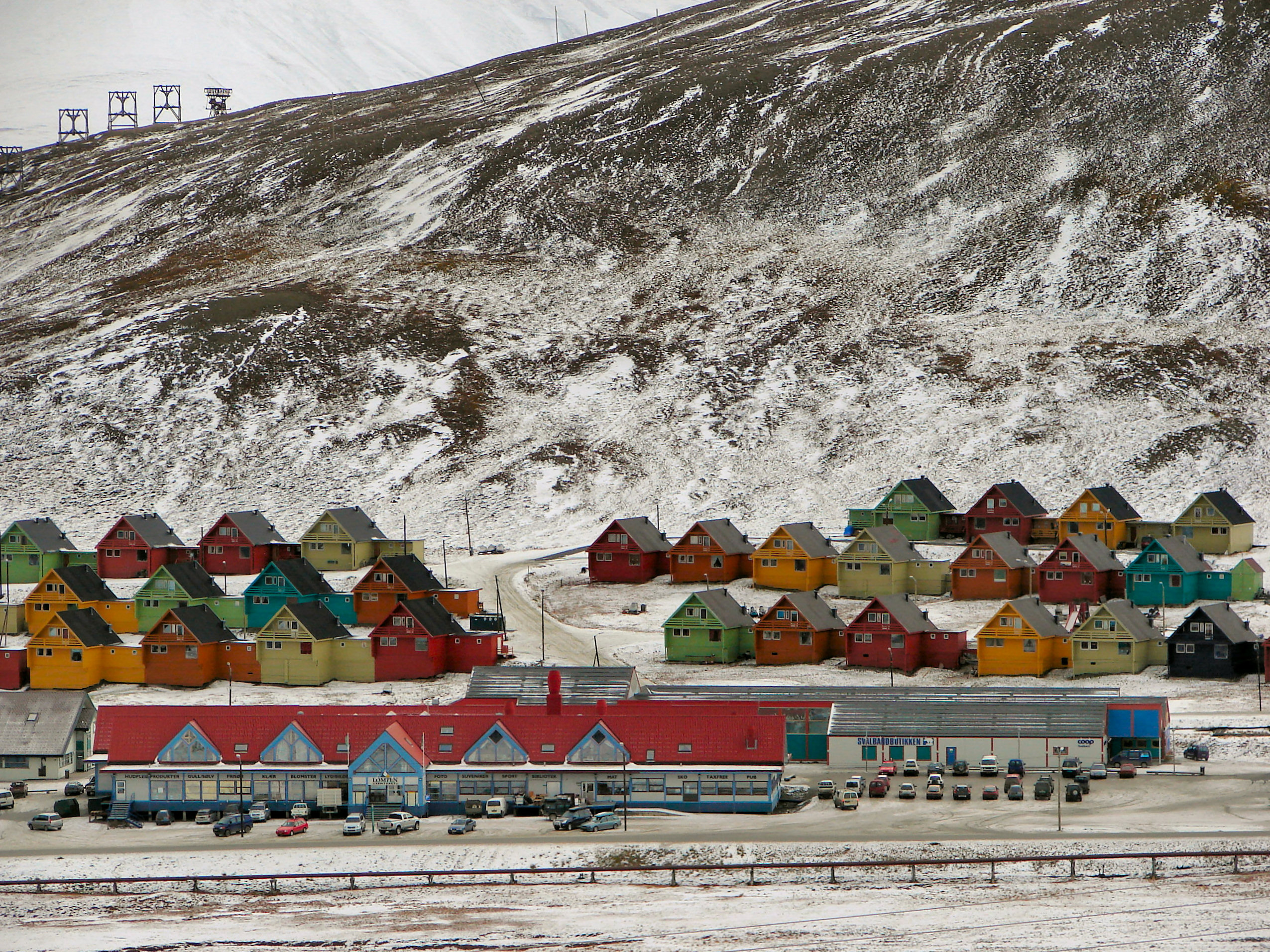


It stays dark four months of the year. And you might run into a... polar bear. This is Longyearbyen: the world's northernmost town, where you cannot be born and cannot die. Yet even here (and perhaps especially here), on the Norwegian island of Spitsbergen in the polar Svalbard archipelago, there is no escaping the subject of two enormous global threats: climate change and Russia's invasion of Ukraine.
Longyearbyen: the world's northernmost town
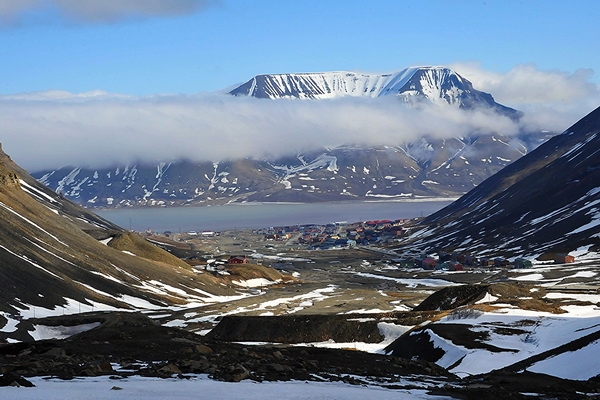
Longyearbyen sits on the island of Spitsbergen in the polar Svalbard archipelago, a dependent territory of Norway. Here you really do feel as though you have reached the edge of the world, because Longyearbyen, at 78 degrees north, is the northernmost town on the planet.
Of course, there are settlements even farther north, such as Canada's Alert (82°28') and Norway's Ny-Ålesund (78°56'), but the first is home only to small groups of a dozen or so researchers and military personnel, and the second to just a few dozen residents. Longyearbyen, meanwhile, is already a town of around 2,500 people (large, for its location).
Partner links: booking through them supports the blog at no extra cost to you.
The history of Longyearbyen
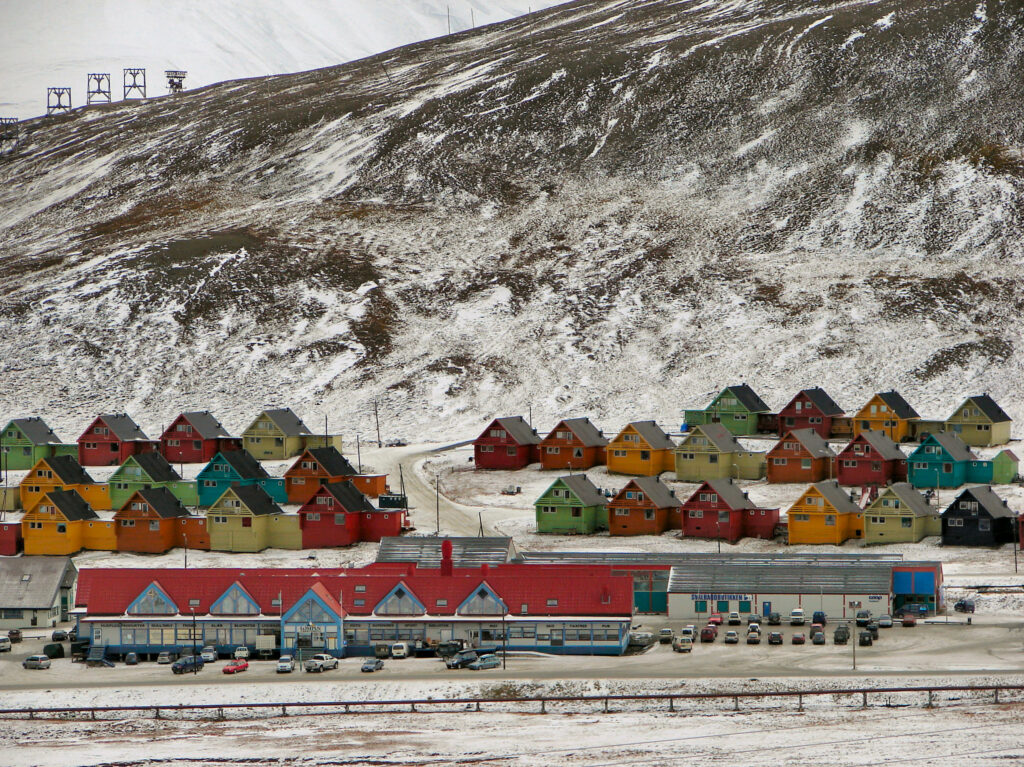
A hunting settlement already existed in the area between the 16th and 18th centuries, but Longyearbyen itself was founded in 1906 by John Munro Longyear, the American owner of the Arctic Coal Company from Boston.
He established a coal mine here, which in 1916, together with the entire settlement, was bought by the Norwegian company Store Norske Spitsbergen Kulkompani. It was the Norwegians who officially gave the settlement the name Longyearbyen (Longyear Town).
The entire Svalbard archipelago came under Norwegian rule in 1925, and Longyearbyen became its informal capital. A governor was also appointed for this dependent territory, who serves as chief of police as well.
Longyearbyen suffered heavily from German bombing during the Second World War. It was later rebuilt. The town grew considerably over the last two decades of the 20th century, when people with no connection to coal mining began settling here.
In 1980, Svalbard's local currency was withdrawn from circulation and replaced with the standard Norwegian krone used on the Norwegian mainland. In 2002, the Svalbard Municipal Council was also created.
Four months of polar night and dramatic climate change
Longyearbyen lies just 1,200 km from the geographic North Pole. This means there are polar days (from April 18 to August 23) and polar nights (from October 27 to February 15). In other words, in late spring and summer the sun never dips below the horizon, while in late autumn and winter the town is almost constantly dark. Because of the surrounding mountains, the sun's rays only reach the town around March 8.
The whole Svalbard archipelago is largely permafrost and tundra, with snow cover lasting from November to March. Yet the landscape is being transformed more and more. Over the past 50 years the climate here has changed dramatically because of global warming.
Winter temperatures range from -25 to 5 degrees Celsius, and summer temperatures from 2 to 18 degrees. The lowest recorded temperature was -46.3 degrees in March 1978, and the highest was 21.7 in July 2020. That last figure is significant, because Longyearbyen is the fastest-warming town in the world. Last March a grim record was broken there: 100 months in a row of temperatures above normal.
On Svalbard as a whole, the rate of warming between 1970 and 2020 was five times the global average, according to a report by the Norwegian Environment Agency. The archipelago's average annual temperature rose by almost 4 degrees over this period, and the average winter temperature by 7 degrees. Average annual precipitation also increased significantly, by about 40%.
This, in turn, poses a serious danger by disrupting the ecosystem and the existing weather conditions. The permafrost is slowly thawing, which affects the foundations of buildings in Longyearbyen and releases more greenhouse gases into the atmosphere, further accelerating the rise in the Earth's temperature.
Avalanches are also occurring more and more often. The one in 2015 claimed two lives and destroyed 11 buildings. On top of that, the warming ocean means it takes longer for ice to form in Arctic waters.
Economy, tourism, education, and transport in Svalbard's capital
Longyearbyen once meant mines, but since the 1990s most coal extraction has taken place in the neighboring settlement of Sveagruva, and the town's last operation closed in 2017.
Meanwhile, Svalbard's capital has opened up to the world. A large airport was built here, along with a church, schools, the Svalbardbutikken department store, and three hotels. Tourism began to take off. Many people come here not only to experience the feeling of standing at the edge of the civilized world. Watching the aurora borealis and observing polar bears from a distance are hugely popular.
Another major source of income for the town is research and science. Several research centers have been set up, as well as the Global Seed Vault. In 1993 a university was established: the University Centre in Svalbard (UNIS), with specializations such as geology, biology, Arctic geophysics, and Arctic technology. More than 700 students from 40 countries study here. Transport to Svalbard is limited. You can, of course, arrive by boat or by plane. Within Longyearbyen itself there is a road network, and many residents own cars. However, you cannot drive far beyond the town with them. That is where snowmobiles come in handy, and there are more of them here than there are residents.
Healthcare and the law. In Longyearbyen you cannot... die. But you will need a gun
Svalbard has a branch of the Norwegian tax authority. There is, however, no court. The islands are administered by a district and appeal court headquartered in Tromsø. Longyearbyen is a demilitarized zone and, unlike the rest of Norway, is not part of the European Economic Area or the Schengen Area.
Under the 1920 Svalbard Treaty, all its signatories (more than 40 countries, including Poland) may stay on Svalbard without a visa, but only Norwegian citizens are granted access to social services (such as social security). Moreover, anyone without "sufficient means to live or earn lawfully" may be expelled by the Governor of Svalbard (though this is rarely enforced).
The town has a hospital, but access to medical care is limited. For example, women are not allowed to give birth on the island. Three weeks before their due date they are sent to hospitals on the mainland.
Another oddity is the fact that on the island you can neither give birth nor pass away. Officially, the law does not forbid dying on Svalbard, but people cannot be buried there because of the permafrost. Or, to be more precise, because the bodies of the dead do not decompose under such conditions. They can, however, attract polar bears.
The local cemetery was closed in 1950, when it was discovered that the bodies of victims of the 1918 Spanish flu pandemic had not decomposed. Scientists warn that such well-preserved corpses may still contain living strains of the virus, which by many estimates killed more than 50 million people worldwide.
So now, if someone is seriously ill, they are transported to mainland Norway. The same happens with the bodies of people who die suddenly on the island.
Another interesting point is that, by law, people are required to carry a firearm when traveling outside the town, in order to defend themselves in case they encounter a bear. The odds of that happening are not exactly slim, given that more than 3,000 of these animals live on Svalbard.
Culture, media, and sport. Film and music festivals beyond the Arctic Circle
Longyearbyen has also developed culturally. A library, a gallery, two museums (the Svalbard Museum and the Airship Museum), a cinema, and a youth club have all opened. Residents can enjoy live music during the Dark Season Blues and PolarJazz festivals. There is something for film lovers too: the Arctic Film Festival.
From 2008 to 2021 an English-language newspaper, "IcePeople," was published on-site. The Norwegian-language weekly "Svalbardposten" is still going, though since 1996 it has been printed on the mainland, in Tromsø. Longyearbyen is also served by the radio station Arctic Outpost.
The town also has a multi-sport club, Svalbard Turn, and a sports center with a handball hall, badminton courts, a shooting range, a climbing wall, and a swimming pool. Interestingly, there is even a fan club (which holds matches) for the English football club Liverpool.
Ukrainian-Russian tensions on Svalbard
Longyearbyen is a town of extremes. And now those extremes have deepened the divisions among its residents. It is all because of another serious global problem (after climate change) that the people of the world's northernmost town simply cannot escape: Russia's invasion of Ukraine.
"There is a certain tension in the air (...). I have never come across so much disagreement," the town's mayor, Arild Olsen, told AFP. This is especially striking given that of the roughly 2,500 residents (from 50 nationalities), about 100 are Russians and Ukrainians.
In the neighboring town of Barentsburg, by contrast, there are only members of these two nationalities: of its 370 residents, about two-thirds are Ukrainians (most of them from the Donbas), and the rest are Russians. This is a purely mining town, where the Russian state company Trust Arktikugol runs a coal mine and a power plant.
Despite Norway's sovereignty over Svalbard, all the countries that signed the 1920 treaty, including the Russians (as successors to the USSR), have equal access to the natural resources found there (and to scientific research), so they are allowed to extract raw materials in Barentsburg. They run everything in the town, from the mines to the shops and restaurants. There is even a statue of Lenin with the inscription "Our goal is communism."
Some residents, among them 32-year-old Ukrainian seamstress Yuliia Lytvynova, believe that the Arktikugol trust silences every voice that criticizes Russia's actions. "As a result, residents now sit quietly, as if nothing had happened," she told AFP.
Lytvynova left for Longyearbyen, but at her request a friend hung a banner in the colors of the Ukrainian flag with an anti-war slogan on the gates of the Russian consulate in Barentsburg. Russia's consul, Sergei Gushkin, who spoke of the "operation in Ukraine," tried to claim that "on the surface there are no signs of conflict, although heated discussions sometimes flare up on social media."
Meanwhile, the lion's share of tour operators from Longyearbyen have decided to stop organizing trips to Russian-run Barentsburg, so as not to bring the company extra income. "That money would go to support Russian aggression. We are not going to help kill our Ukrainian compatriots," Lytvynova stressed.