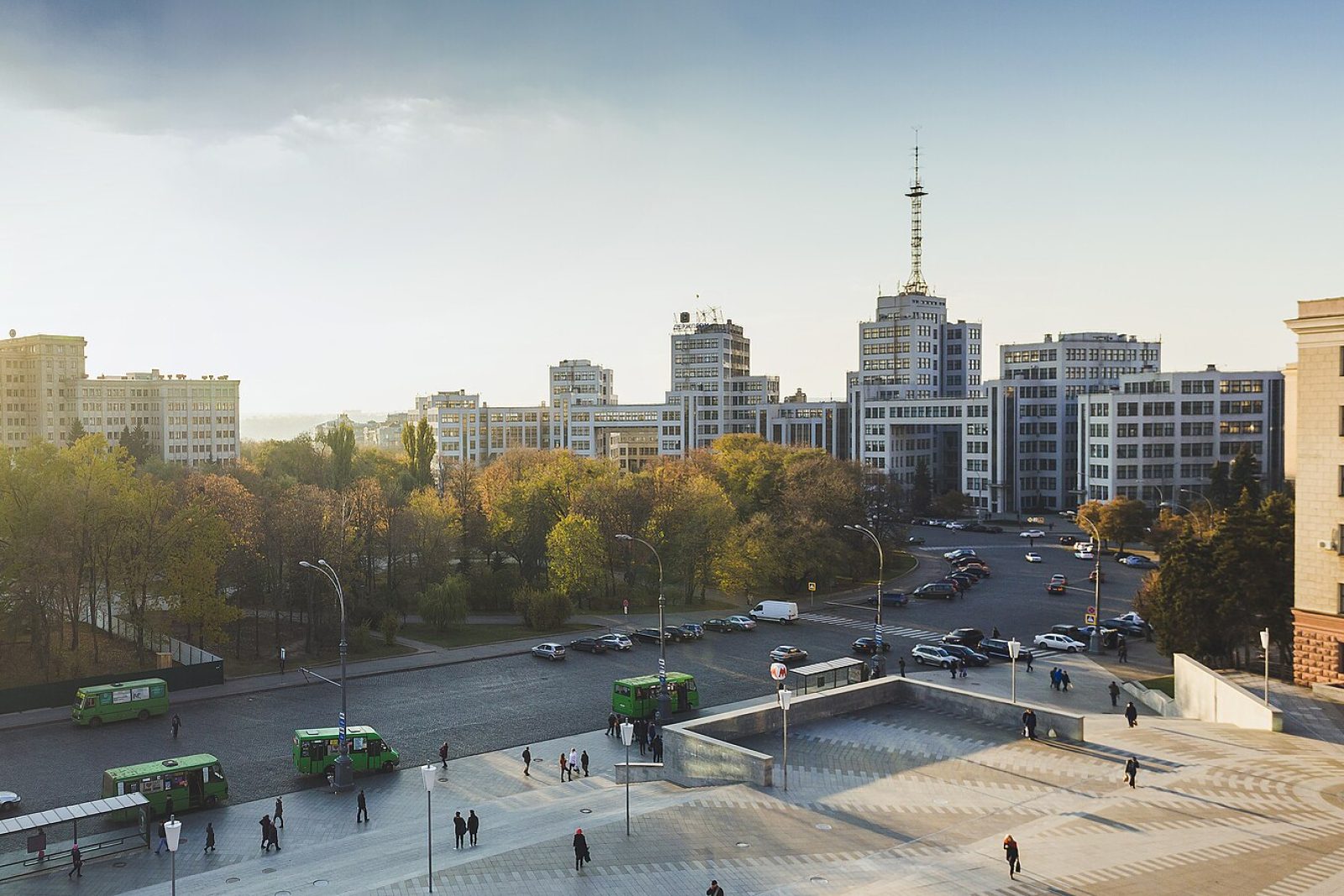


If you are wondering what to see in Kharkiv in a single day, start at Freedom Square: it is one of the largest city squares in Europe, and beside it stands Derzhprom, the first monolithic-concrete high-rise in the Soviet Union and the great icon of Kharkiv constructivism. From there the city unfolds logically, because the historic centre, the Shevchenko Garden and the cathedral hill all sit within an easy walk of one another. Kharkiv rarely makes it into travel lists ahead of Lviv or Odesa, and that is a shame. It has its own, very recognisable aesthetic: a big university city that built itself with ambition.
What follows is not just a list of dots on a map but a route with some logic to it. What sits next to what, where to budget your time, and what visitors usually walk straight past when they shouldn't.
Where to begin: Freedom Square and Derzhprom
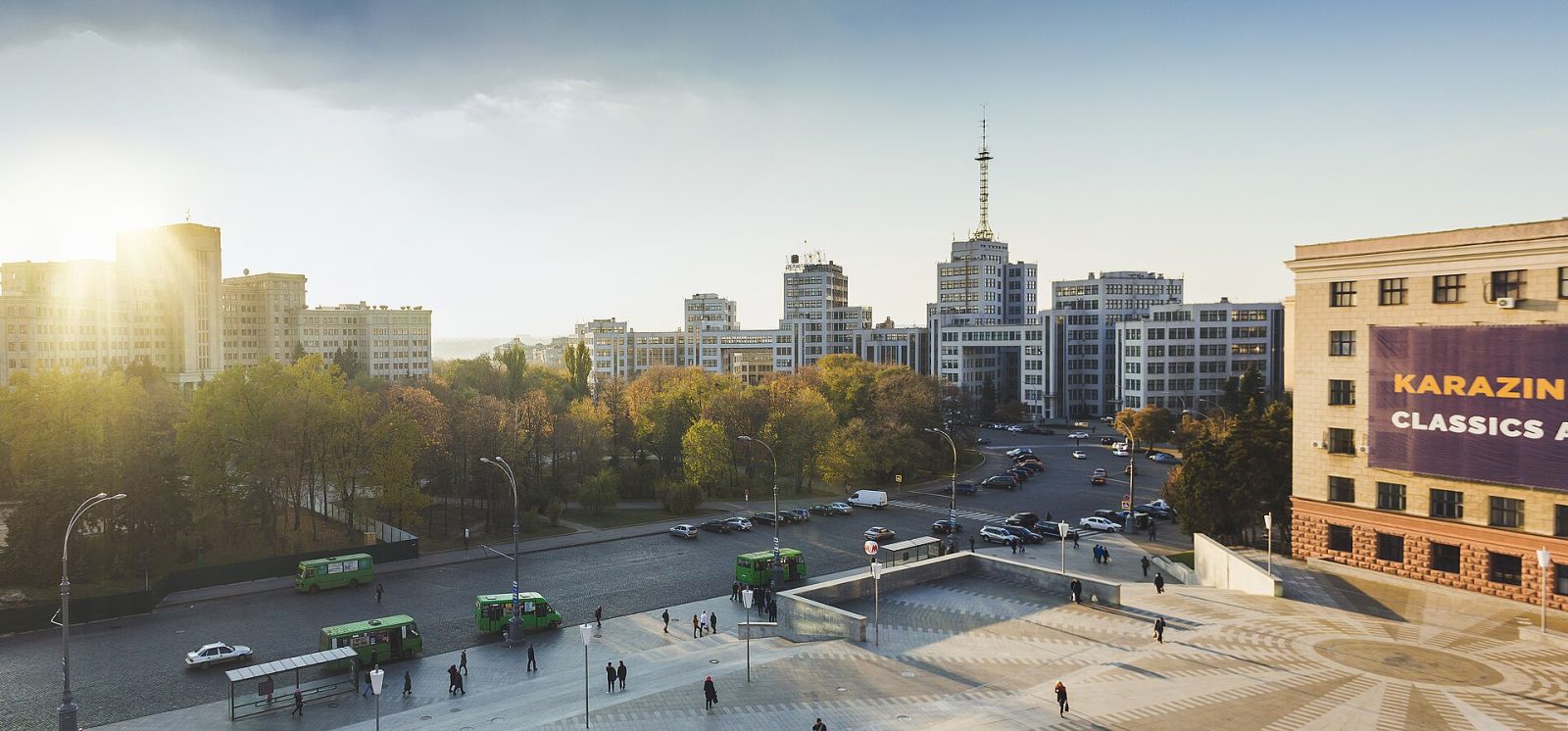
Freedom Square is what the city is recognised by in photos, and the most honest answer to the question of what to see in Kharkiv first. Its scale is hard to grasp on a first visit: a vast rectangle opens into a semicircle framed by long building fronts. In Soviet times it held parades of tens of thousands, and even empty it presses on you with sheer size.
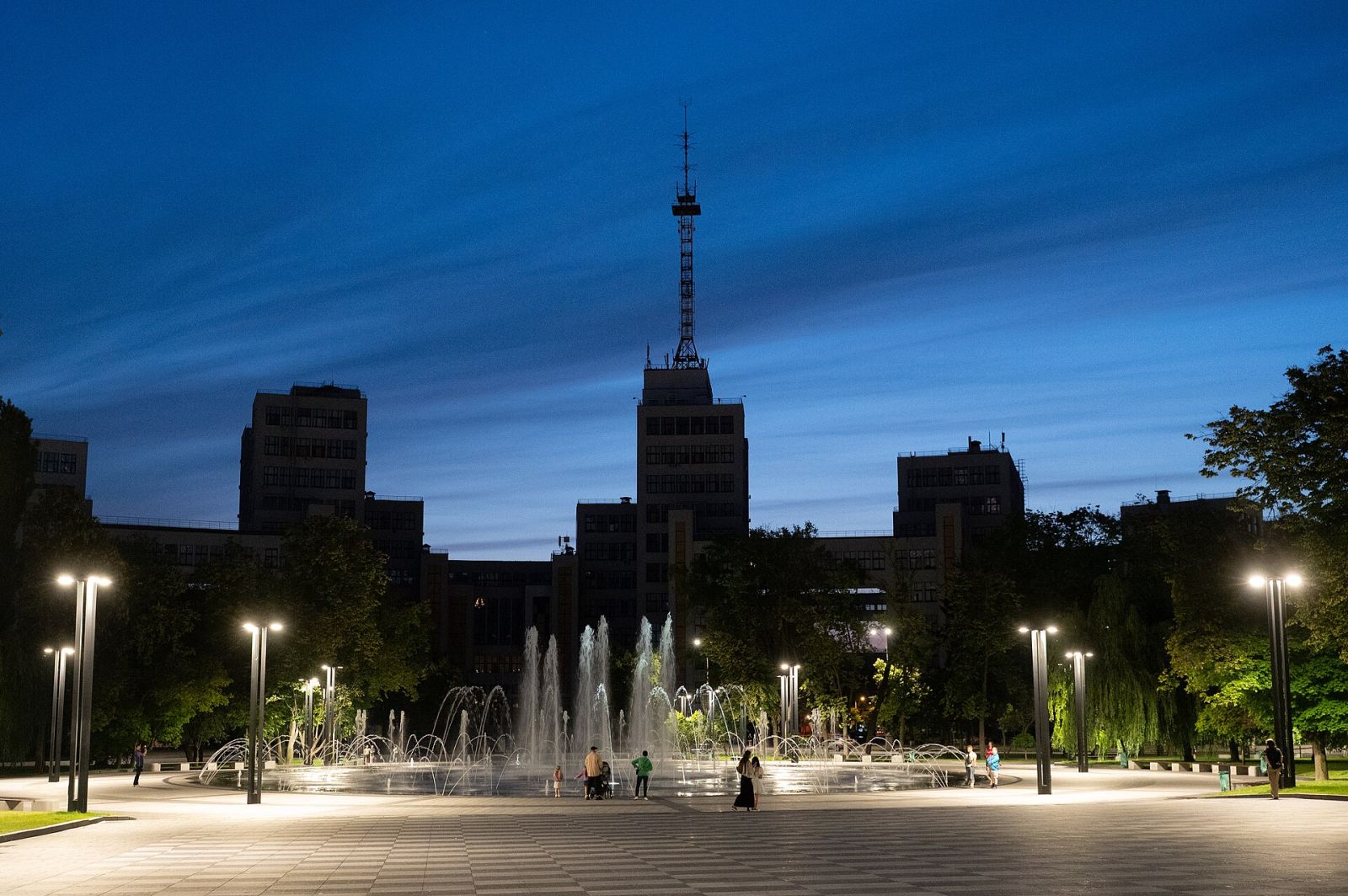
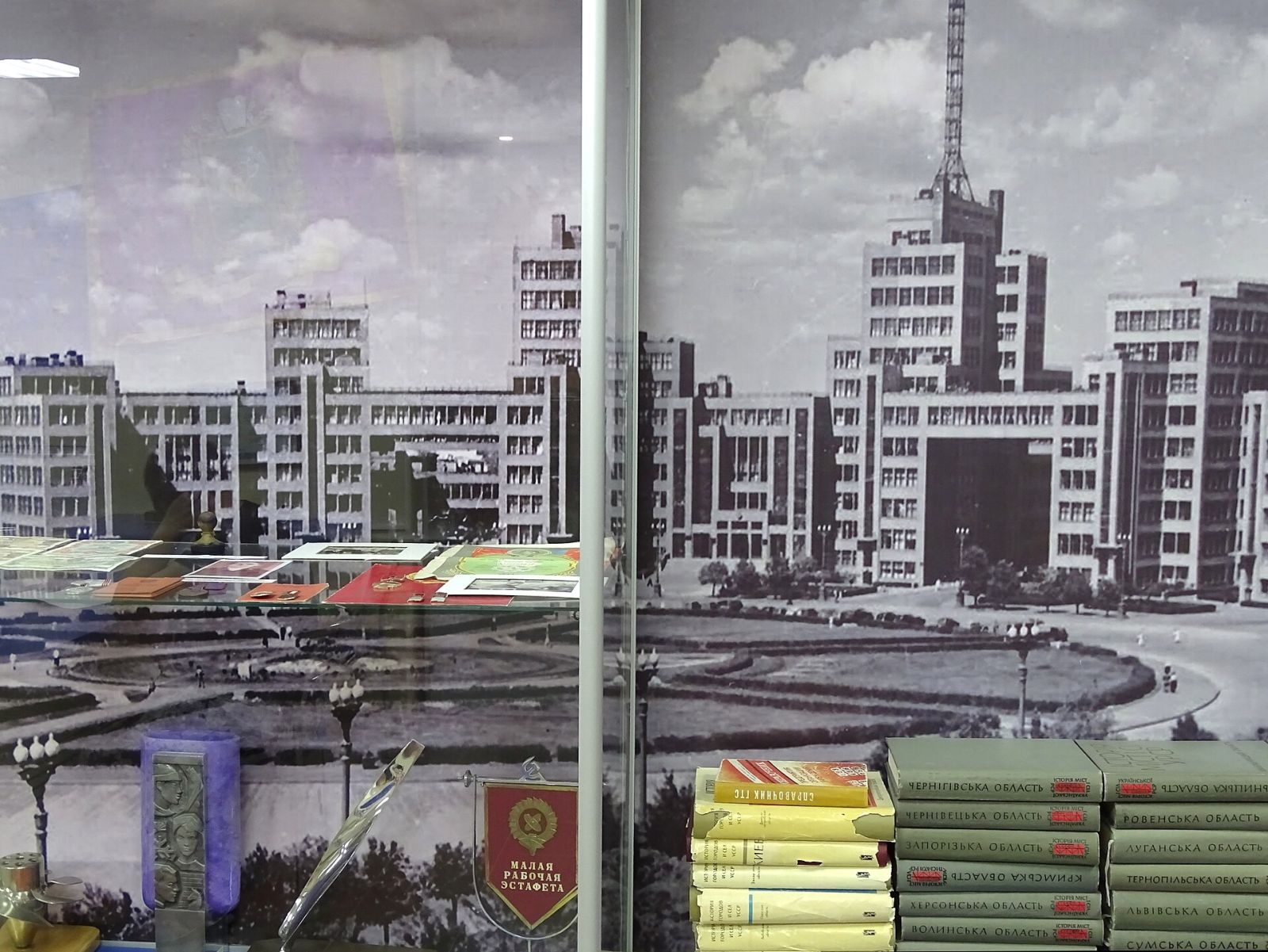
The centrepiece is Derzhprom, the House of State Industry. Built between 1925 and 1928, it was the tallest building in the country at the time and one of the world's first large reinforced-concrete skyscrapers. The constructivism here is not decorated but shown plainly: bare volumes, sky-bridges linking the wings, a rhythm of verticals. By day it looks stern; toward evening, when the lighting comes on, the form finally reads as a whole. The buildings of Karazin University stand right next to it, so there are more students on the square than tourists, which gives it a lived-in rather than a museum feel.
The Shevchenko Garden and the Mirror Stream
A few minutes' walk from the square begins the Shevchenko Garden, an old city park of shady avenues, chestnut trees and a monument to Taras Shevchenko that is considered one of the finest in the country: a multi-figure composition in which the characters of the poet's works rise around his figure. In summer people come here to escape the heat; in winter the garden stands quiet and graphic.
Nearby, on the edge of Sumska Street, stands the Mirror Stream, a small openwork pavilion with a fountain that locals hold as a symbol of the city on a par with Derzhprom. It was built after the Second World War as a memorial, and despite its intimate size it anchors the whole ensemble around it. This is where locals arrange to meet, so it is almost always busy.
The cathedrals: Uspensky and Blahovishchensky
The two main churches of Kharkiv stand on opposite sides of the centre and could hardly be more different, so it is worth seeing both.
- Uspensky (Assumption) Cathedral on Universytetska Street. A classicist church with a bell tower nearly 90 metres tall, raised as a memorial to the victory over Napoleon. For many years the tower was the tallest structure in the city, and it still dominates the old centre. Inside today there is an organ hall, so sometimes it is worth going in not for a service but for a concert.
- Blahovishchensky (Annunciation) Cathedral across the river, by the Blahovishchensky Market. It is impossible to mistake: a huge Neo-Byzantine church with its trademark bands of red and cream brick. It is one of the largest cathedrals in Ukraine, and it is that striped bell tower that most often surprises first-time visitors.
Between them lies the old trading part of the city with the Pokrovsky Monastery, the oldest stone building in Kharkiv, dating to the seventeenth century, so the walk from one cathedral to the other becomes a little tour in itself.
Why go down into the metro?
The Kharkiv metro is not only transport but a sight in its own right, and do not be surprised when locals suggest simply riding it for the stations. This is where you find Derzhprom station, long considered one of the deepest in Ukraine: the escalator ride down is an experience on its own. But depth is not the only draw.
| Station | Why it's interesting |
|---|---|
| Derzhprom | One of the deepest stations, a long escalator, austere design |
| Universytet | Ornate decor, a handy exit to Freedom Square and the gardens |
| Istorychny Muzey | An interchange hub in the very heart of the old centre |
| Botanichny Sad | One of the bright modern stations on the northern line |
A couple of stops cost next to nothing, and the impression is thoroughly touristic. Because of the security situation, timetables and the opening of individual entrances can change, so check the latest before you travel.
Parks and the city's greenery
Kharkiv is unexpectedly green for a city of over a million, and if you have a spare half-day it is easy to give it to the parks.
- Gorky Park, the main amusement park, with a cable car that runs to the forest park above the city. The ride over the treetops alone is worth the ticket.
- Sarzhyn Yar, a deep green ravine with a spring where locals come to fill water bottles; a good place to see the city off-parade, in its everyday rhythm.
- The hydropark and embankments, for anyone who wants quiet by the water away from the bustle of the centre.
How much time to set aside?
The centre of Kharkiv is compact, and the essentials fit into one full day, but to let the city open up it is better to have two.
One day
Give the morning to Freedom Square and Derzhprom, while the light is soft and the crowds thin. Then the Shevchenko Garden, the Mirror Stream and a walk down Sumska to the Uspensky Cathedral. The afternoon: the old centre, the Pokrovsky Monastery, and across the river to the Blahovishchensky Cathedral. Toward evening come back to the square to see Derzhprom lit up, an entirely different building from the daytime one.
Two days
Leave the first day for the centre, unhurried. Give the second to the parks, the metro and the edges of town: the cable car in Gorky Park, a couple of the more decorative metro stations, Sarzhyn Yar, and an unhurried dinner in the evening on a side street rather than on the main drag.
Getting there and getting around
The most reliable way to reach Kharkiv is by train: rail links with Kyiv and other cities are running, and the station sits close to the centre and to the metro. It is the most comfortable option, since the bus takes noticeably longer. Kharkiv lies close to the border and the security situation here is changeable, so before you travel be sure to check current routes, schedules and how transport is running.
Within the city itself your main tools are the metro and your own two feet. Three lines cover every key point, the centre is dense and pleasant to walk, and the outlying parks are an easy metro or app-taxi ride away. Sumska, the main axis of the centre, is a fine route in itself: old mansions, theatres, coffee houses, with almost everything worth seeing in Kharkiv strung along it.
The main thing to understand about this city is that it is not about postcard prettiness but about scale and character. Kharkiv was built as a capital with ambition, and you feel it in every broad avenue. Planning a route helps, but leave room in it to simply stand in the middle of Freedom Square and feel how vast it is, because that sensation is what stays with you longest here.