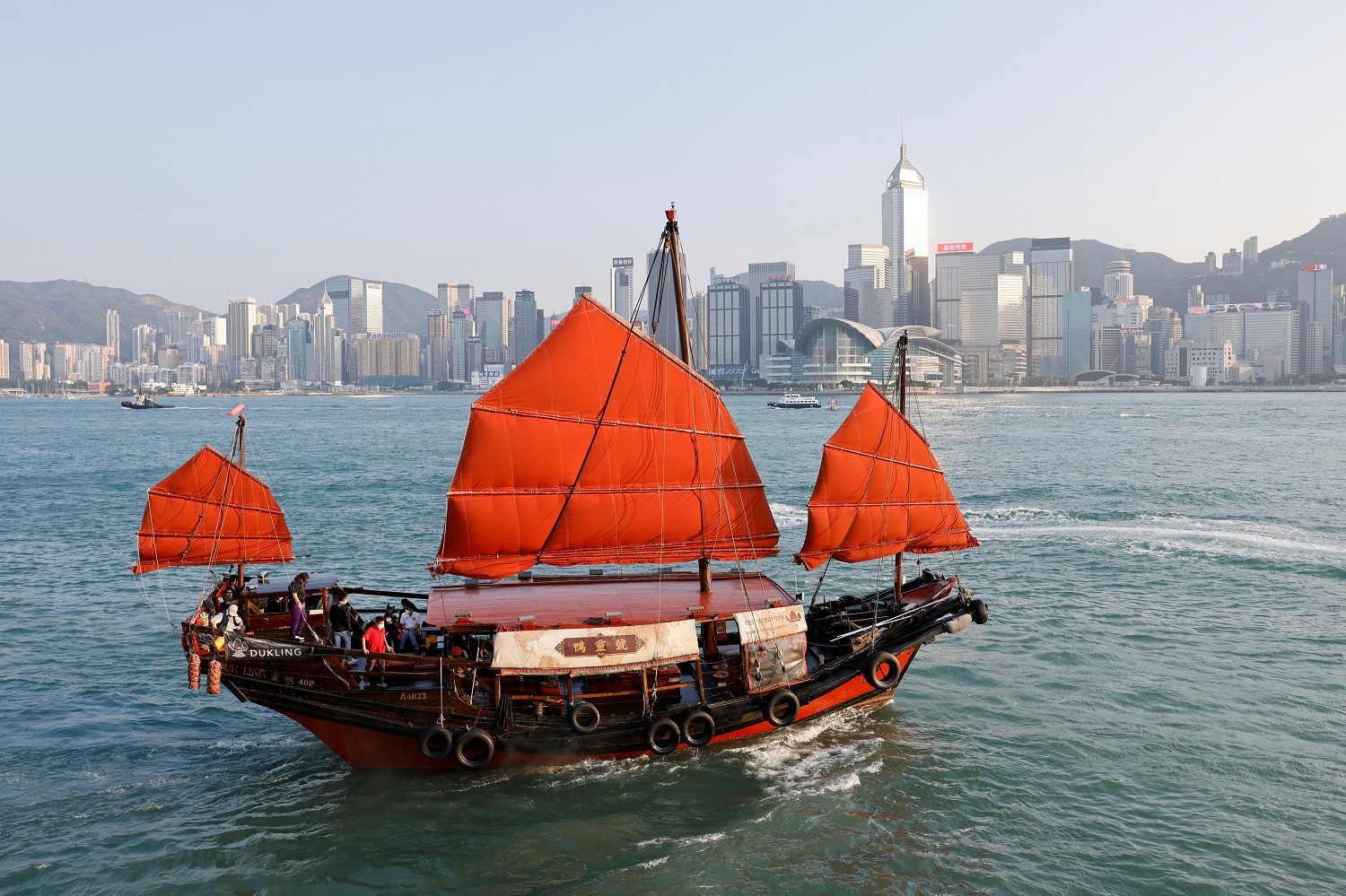


You may not know what a junk boat is, but the odds are pretty good that you have seen one.
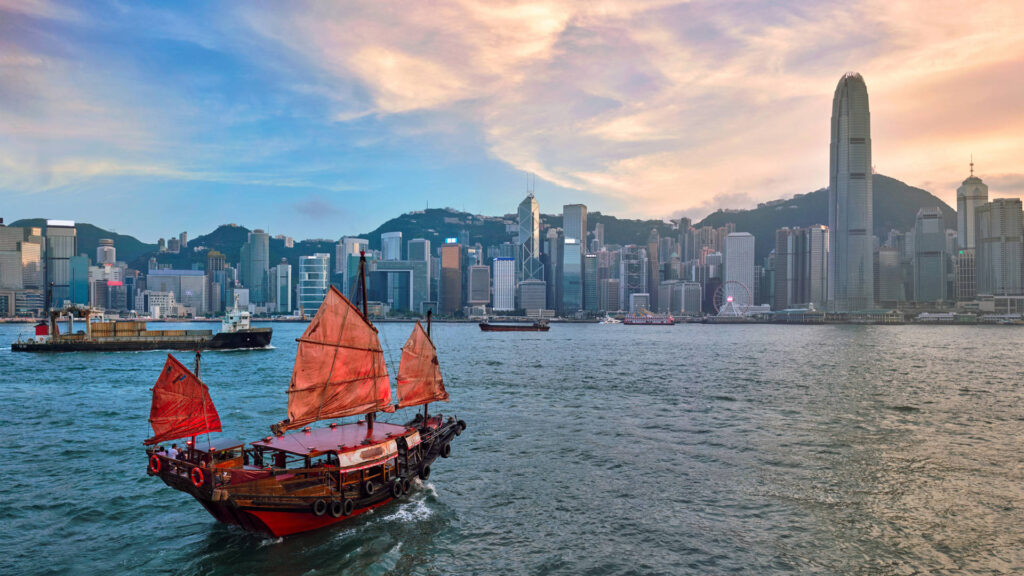
The junk boat, tall and wooden with three bright red sails glowing in the sunlight of Victoria Harbour, is one of Hong Kong's most iconic visual symbols.
These vessels turn up on postcards, retro posters, keychains, T-shirts, ceramics and even the logo of the city's tourism board. But when it comes to finding an actual junk in modern Hong Kong, you will have to look a lot harder.
Partner links: booking through them supports the blog at no extra cost to you.
Dukling is the last surviving Hong Kong junk that is available for public use. In its first life, Dukling was built in 1955 and served as home to a local family of seafarers.
The boat, 18 meters long and weighing 50 tons, offers locals and visitors alike the chance to see Hong Kong's man-made and natural beauty from the water.
It is easy to forget that Hong Kong is not a single island but an entire archipelago. While getting out on the water is a wonderful way to feel the wind on your face on a hot day, it is also a way to grasp the shape and scale of this wildly diverse city.
Like many tourist attractions around the world, Dukling is under threat of closure because of low visitor numbers during the pandemic. At the moment it is available only for private charters due to Hong Kong's virus-related restrictions.
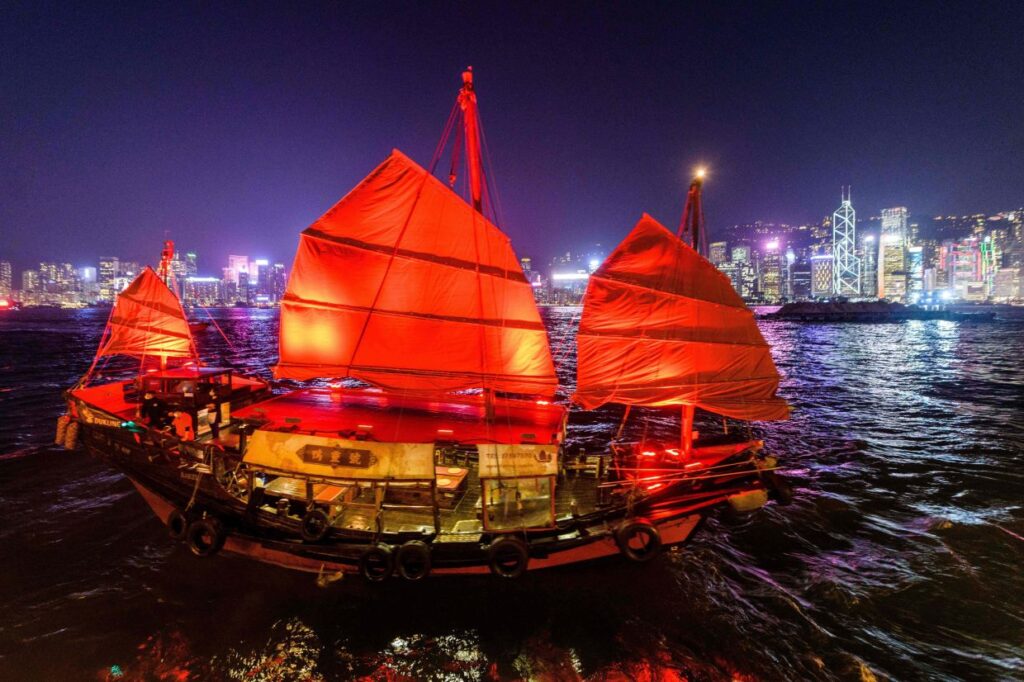
Before the coronavirus, three trips a day ran on weekends, each carrying a maximum of 40 passengers. The Saturday route made several stops in Kowloon, including Tsim Sha Tsui, while the Sunday route ran from Central to North Point. The evening sailing was dedicated to watching the Symphony of Lights, a nightly show in which the skyscrapers along the harbour light up their windows with cheerful patterns and colors just after dusk.
When the Harbour Was Full of Red Sails
Libby Chan, assistant director (curatorial and collections) at the Hong Kong Maritime Museum, explains that many of Hong Kong's earliest residents belonged to one of two groups: those who lived on land (the Hakka) and those who lived at sea (the Tanka).
As recently as the 1970s, many Hong Kongers lived, worked, ate and slept aboard these wooden boats, periodically pulling into typhoon shelters or docks along the city's shoreline to sell their goods and stock up on provisions. Beginning in the 1970s, many locals traded their boat homes for apartments in Hong Kong's now-famous high-rise housing estates, giving up life at sea in favor of more reliably paid work in factories or offices.
But how did junks become synonymous with Hong Kong?
Chan says it all started when Westerners first arrived in the Pearl River Delta, invariably by sea.
"The first group of people who greeted the traders were the boat people. You can see plenty of images of boat people painted by Western artists in a very beautiful style. From that day on, the junk became the logo of Hong Kong."
Even the name "Dukling" is a blend of modern and classical Hong Kong. Its Chinese name is Ap Ling Ho: Ap means duck, ling means soul or spirit, and ho is a way of placing "the" before a name. So a rough translation from English might be "holy duck." Its original owner thought the front of the boat looked like a duck's head.
However, if you type "junk boat" into Google, you will get pages of photos of vessels piled high with rubbish. Search for "duckling" and you will get cute photos of fluffy ducklings. And "duck boat" conjures up those hybrid land-and-water vehicles that tourists ride around San Francisco and Seattle.
So the current owner, local businessman Hazen Tang, decided to deliberately misspell the name Dukling in order to outsmart the search engine.
Restoring a Historic Vessel
Dukling's story runs parallel to the story of Hong Kong.
The vessel's original owners, local shrimp fishermen, sold it to a Frenchman who used the boat for leisure rather than as a permanent home. The Frenchman then sold Dukling to a British expat, who eventually moved back home and abandoned the boat, where it sank during a typhoon in 2014.
Salvaging Dukling from the South China Sea was a complicated, years-long ordeal. First the city authorities had to track down the former owner in the United Kingdom and get permission to raise it. Then it was repaired in Zhuhai, which required additional permits since the city is part of mainland China. The next step was finding carpenters and repairers who still know how to care for wooden boats.
The current owner, Tang, is a Hong Kong resident who was eager to return the vessel to local hands, and to Victoria Harbour. His business, HS Travel International Company Limited, is a Hong Kong-based tour company with offices across Asia.
The finished product is a beautiful, living piece of history that began cruising the waters for tourists in 2015. Charlotte Lee, business development director of Dukling's parent company, says 80% of the boat is original.
The original wooden wheel is still used to steer the boat, but it is so heavy that crew members can only handle it for two hours before they tire out.
Dukling's upgrades went beyond the infrastructure. It turned out that the famous red sails are not really that red. They are actually an orange-brown color that looks redder in Hong Kong's bright sunlight.
The front of the vessel still holds a small shrine to the sea goddess Mazu, before which crew members bow and place incense to wish for a safe voyage, though in the current era women are allowed into this front part of the vessel, whereas in the fishing days it was strictly forbidden.
Beyond Dukling, visitors to Hong Kong can spot two similar boats in Victoria Harbour.
Aqualuna is a local tour company that built two replica junks, both of which carry visitors up and down the harbour several times a day, especially at sunset when the skyscrapers along the waterfront light up their exteriors for the show.
Although the two companies might view each other as competitors, Lee insists there is no rivalry, because the owners of Dukling and Aqualuna want the same thing: to preserve the city's maritime heritage.
"They have heart, and they want to keep the junk boats in Victoria Harbour," she says. "There is no 'real' or 'unreal.'" Lee notes that Dukling can carry only 40 passengers at a time, while each of Aqualuna's two boats holds up to 90 people.
Where to Find Boat Culture Today
TOPSHOT - In this picture taken on November 27, 2020, a traditional wooden tourist junk boat "Dukling" sails in the waters of Victoria Harbour in Hong Kong, which was built in 1955 in neighbouring Macau and is the city's only authentic junk left -- with the other remaining vessels being modern replicas. - The wooden ship has been docked after new measures to stem a fourth wave of the coronavirus were introduced earlier this month, threatening the city's last remaining antique junk. (Photo by Anthony WALLACE / AFP)
As Hong Kong keeps growing, and with more than half of its territory protected for country parks and public green space, finding room to build new homes is always a challenge. One of the most common tactics is land reclamation, usually along the harbour's shoreline. Like the tourism industry after the pandemic, Victoria Harbour is literally shrinking.
But although many Tanka people have moved onto land, traces of their way of life still survive across the city, and they add depth to a journey aboard Dukling.
The name Hong Kong means "fragrant harbour," which was inspired by the red incense burned in temples dedicated to Tin Hau, the sea goddess. (She and Mazu are interchangeable: Mazu means "mother of the sea.") To this day, dozens of Tin Hau temples dot the islands of the Hong Kong archipelago.
In some districts where the Tanka people resettled, such as Tai Po in the New Territories, you can still glimpse fragments of the "old ways" of life at important occasions like weddings and funerals. Many boat dwellers communicated through traditional songs, known in English as saltwater songs.
"The boat people's dialect is different from Cantonese, but they have some overlap. It is a very ancient dialect. It is a very complex sound, and it is easy to sing," says Chan.
Some songs were about navigation, such as the best routes to avoid a storm, while others were about courtship or family. "It is part of our intangible heritage," Chan adds.
The Maritime Museum managed to record a few elderly people singing these songs and speaking their dialect, so that this "intangible heritage" would not be lost forever. It is part of the museum's permanent collection, which is located, quite fittingly, at Central Pier on Hong Kong Island, the same spot where you can catch a ferry to Lamma Island and Cheung Chau.
Despite all the changes in and around Victoria Harbour, there is still room on this waterway for traditional junk boats. As long as there is water to sail on, Dukling plans to keep sailing it.