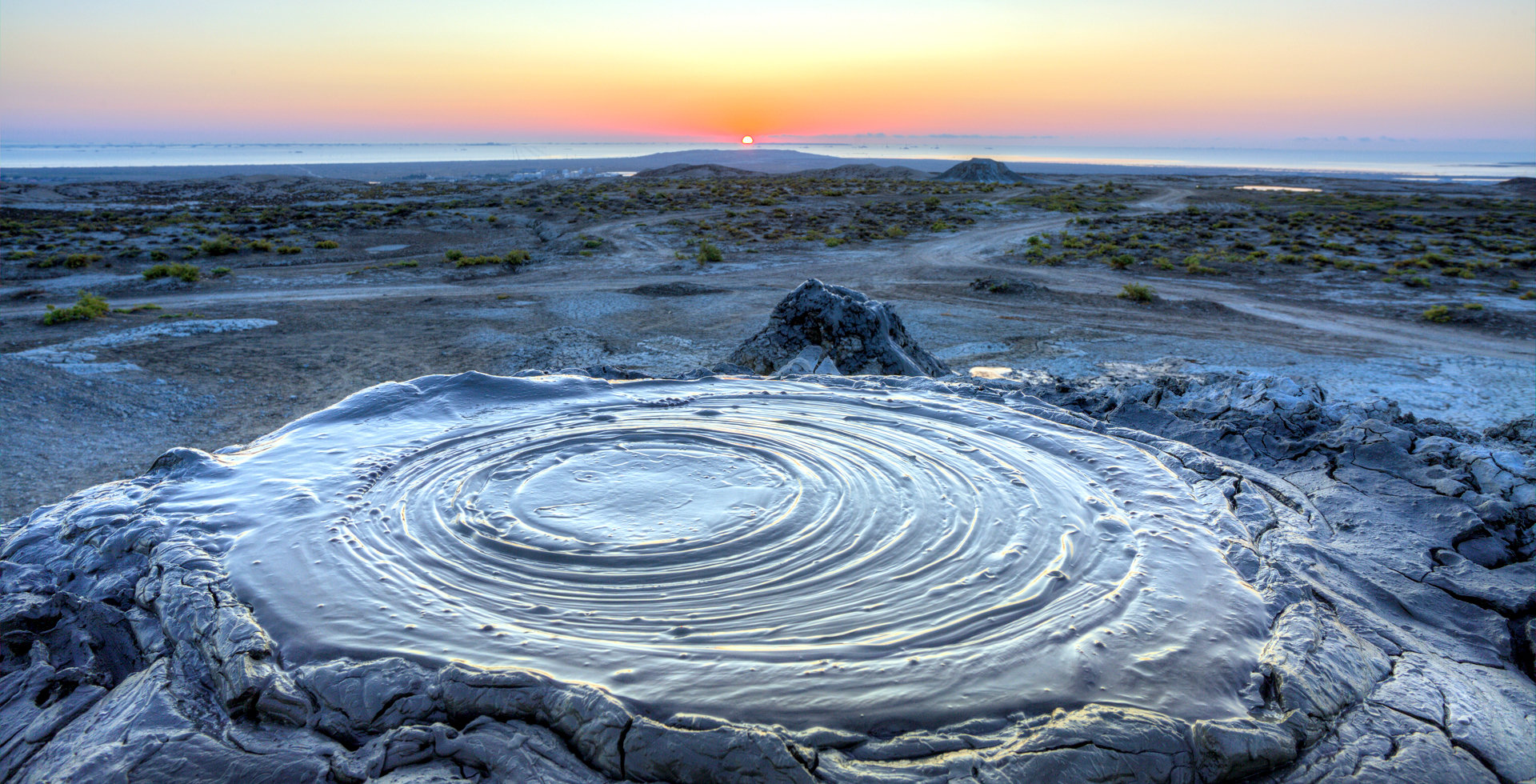


Grey-white land stretches to the horizon, rising in peaks like well-whipped meringue frozen solid in mud and stone.
A sharp wind sweeps across these otherworldly hills, and the ground underfoot is cracked and scaled over.
It could be Mars. But it's Azerbaijan, the world capital of mud volcanoes.
Partner links: booking through them supports the blog at no extra cost to you.
An oil-rich region
This oil-rich country, poised between Europe and Asia, is home to more than 400 volcanoes, and new ones are constantly being discovered.
Ten years ago, a 12,000-hectare state nature reserve was established on the Absheron Peninsula, not far from the capital, Baku.
In July 2018, scientists from Azerbaijan's Ministry of Ecology and Natural Resources set off on a journey by off-road vehicle.
Climbing the steep slopes in a four-wheel drive feels like a rougher take on the dune safaris so popular in the Middle East. But the most striking sights are still to come.
We begin our tour at the mouth of the Deveboynu volcano, or "Camel's Neck." The ground around it is bone-dry, but inside the crater a muddy slurry churns gently, a substance known as mud breccia.
The hills may look peaceful, but beneath this humped, reptilian landscape the Earth breathes and stirs like a slumbering beast.
Where tectonic plates collide
Mud volcanoes are usually found in subduction zones, the parts of the globe where tectonic plates collide, sometimes triggering earthquakes, tsunamis and powerful eruptions.
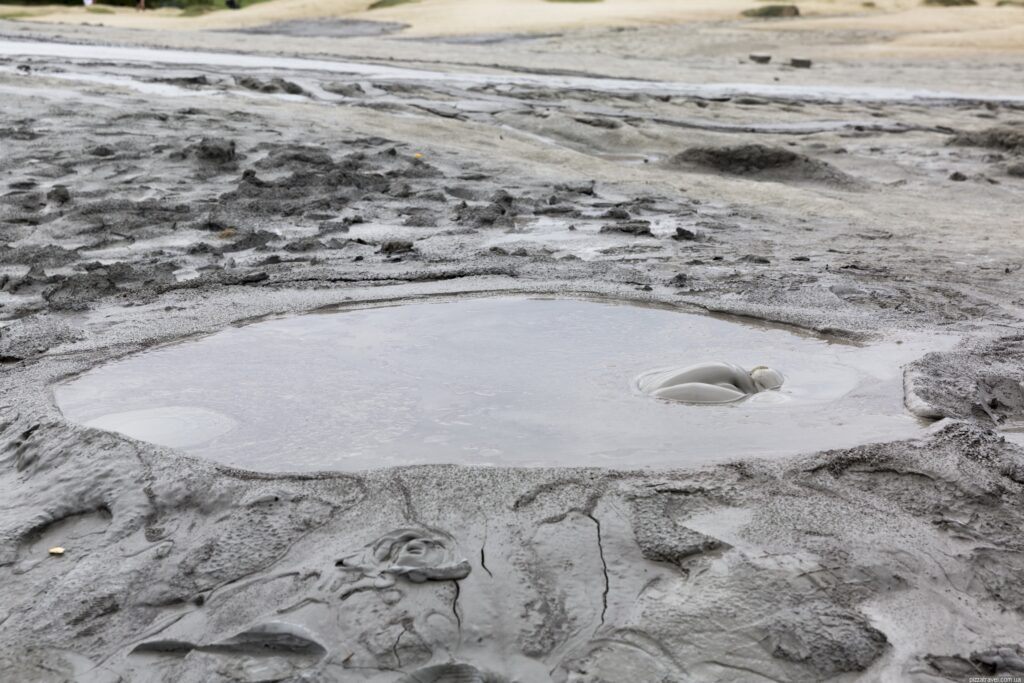
Pockets of underground gas force their way to the surface, spewing out methane and a murky mixture of water and oil.
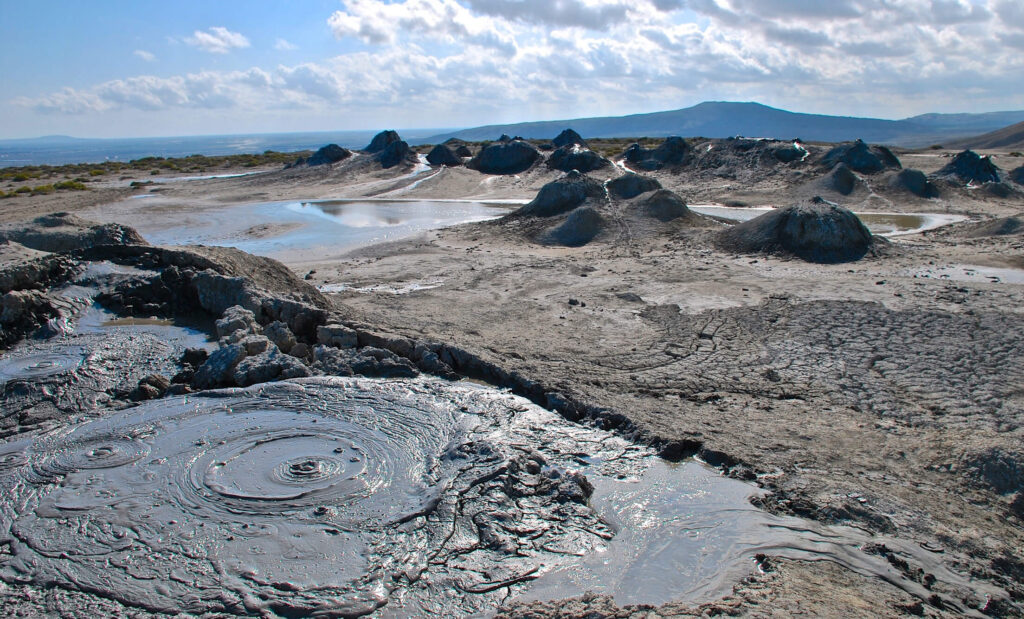
Mud volcanoes never grow to the size of ordinary volcanoes. Most take the form of small, ever-shifting landforms, often accompanied by peculiar sculptures formed from erupted lumps of clay.
These bizarre shapes, says Jeyhun Pashayev, director of the reserve, are "like a picture drawn by a child."
A strange beauty
"If there are mud volcanoes, it means there are hydrocarbon resources underground," Pashayev explains. "As you can see, Azerbaijan has many mud volcanoes, which means it has plenty of oil resources."
The arid lands of the Absheron Peninsula may not be as fresh and lush as the mountainous north, but they hold a strange beauty of their own.
This is the richest region for natural resources, both in oil and in mud breccia, which is used in the chemical and construction industries.
According to Pashayev, "about 20 of the 50 minerals used in cement" can be found in the volcanic mud, which means that before the agreement to create the reserve was signed, people regularly stole mud from the site to build their homes.
As we set off again toward the next volcanic field, Pashayev gestures at a huge plant on the horizon, flanked by a large mound of mud on either side. "That's Garadag, the richest part of Baku. About 90% of the stone used for building houses is quarried here. Depending on its quality, the stone costs between 50 cents and 3 manats ($1.77)."
Mud baths
Unlike ordinary volcanoes, there is no magma or lava here, so the liquid mud isn't hot. Instead it typically stays at a temperature of 22/23 C (72 F).
That mildness means some mud volcanoes are suitable for bathing.
Volcanic clay is sometimes used to treat skin conditions, as well as rheumatism and disorders linked to the nervous system.
Pashayev explains that in Soviet times, volcanic mud was occasionally used to make casts for setting broken bones.
"What's more, using the volcanoes' mud on your skin can give you amazing results," he claims. "You can use [the mud] and see good results, even if you have scars. If a cosmetic doctor can't make scars disappear, the mud volcanoes can!"
Radioactivity
Not every grey pool, however, is safe for the skin.
"Because it comes from deep down," Pashayev says, "some volcanoes bring up radioactive material. It's no joke."
Pashayev's team regularly monitors radioactivity levels, and a safety certificate is issued every year.
The underground world has fascinated people across the globe for millennia, and the strange, turbulent and seemingly inexplicable behaviour of mud volcanoes has long captivated the people of Azerbaijan.
The country is known as the Land of Fire, while Baku is the City of Winds, and some of the gas seeps in this oil-rich region burn continuously, as they do on the slope of the ever-blazing Yanar Dag mountain.
It is believed that the ancient Zoroastrian religion, centred on the worship of fire, was closely tied to this phenomenon.
In 2001, 15 kilometres from Baku, the Lokbatan volcano erupted, sending flames up to 50 feet into the air.
Naftalan: the Azerbaijani resort where guests bathe in crude oil
Mysticism
"Mud volcanoes are mystical," Pashayev says. A few years ago a Danish sound archivist came to the reserve "with an enormous instrument that looked like a piano" to record the sounds from inside a volcano.
What Pashayev heard stunned him. "I swear, I thought it was hell. I heard human sounds, really. Imagine thousands of people screaming 'help us!' from down below."
Pashayev, reaching for an equally vivid turn of phrase, also compares the wind sighing through a mud sculpture to the sound made "when a cow's head is cut off," a common sight on the outskirts of Baku until the rules on slaughtering livestock were changed earlier this year.
And if the Azerbaijani landscape looks otherworldly, that may be because the conditions here are not so different from Mars.
Several possible mud volcanoes have been spotted on Mars, hinting at the presence of water once upon a time, and therefore at the possibility of life.
Millions of snakes
"There are six types of mud volcano," Pashayev explains. "Active. Inactive. Oil-producing. Underwater. Island mud volcano. And collapsed mud volcano."
Azerbaijan has around 140 underwater mud volcanoes, and six island volcanoes fall under the reserve's jurisdiction, though, as scientist Anar Bagirov explains, the team lacks the resources to visit them.
But on one of the island volcanoes, Pashayev explains, the strangest sight is not the churning mud. "From 100 metres away you can see the island shaking. But when you get closer, you see millions of snakes, can you imagine? Millions."
The island is so covered in sea snakes, Bagirov adds, that "you can't find a spot to put your foot down."
What lies beneath
Pilpili Gardag is the final stop on our tour. After we pass a guard, a steep climb up the slope begins toward the most dramatic volcano of all.
The smooth surface of the mud glistens under the blazing rays of the July sun, and huge grey bubbles form and then burst with a satisfying plop.
Mud volcano eruptions vary enormously, from quiet, slow flows of slurry that pour out endlessly to explosive eruptions that hurl out thousands of cubic metres at a time.
In Azerbaijan, Pashayev says, we have "different sizes, different kinds, different sculptures. We have all the types, all the shapes."
The Guinness Book of Records lists the largest mud volcano in the world as an Azerbaijani one, measuring one kilometre at its base and several hundred kilometres in height.
At Pilpili Gardag, the shifting lunar landscape, where the sun reflects in white light off the bleached clay and the summer heat creeps up to 40 C (104 F), has an eerie grandeur.
But the real secrets, the thrilling, living wonders, lie in the many shifting layers beneath our feet.