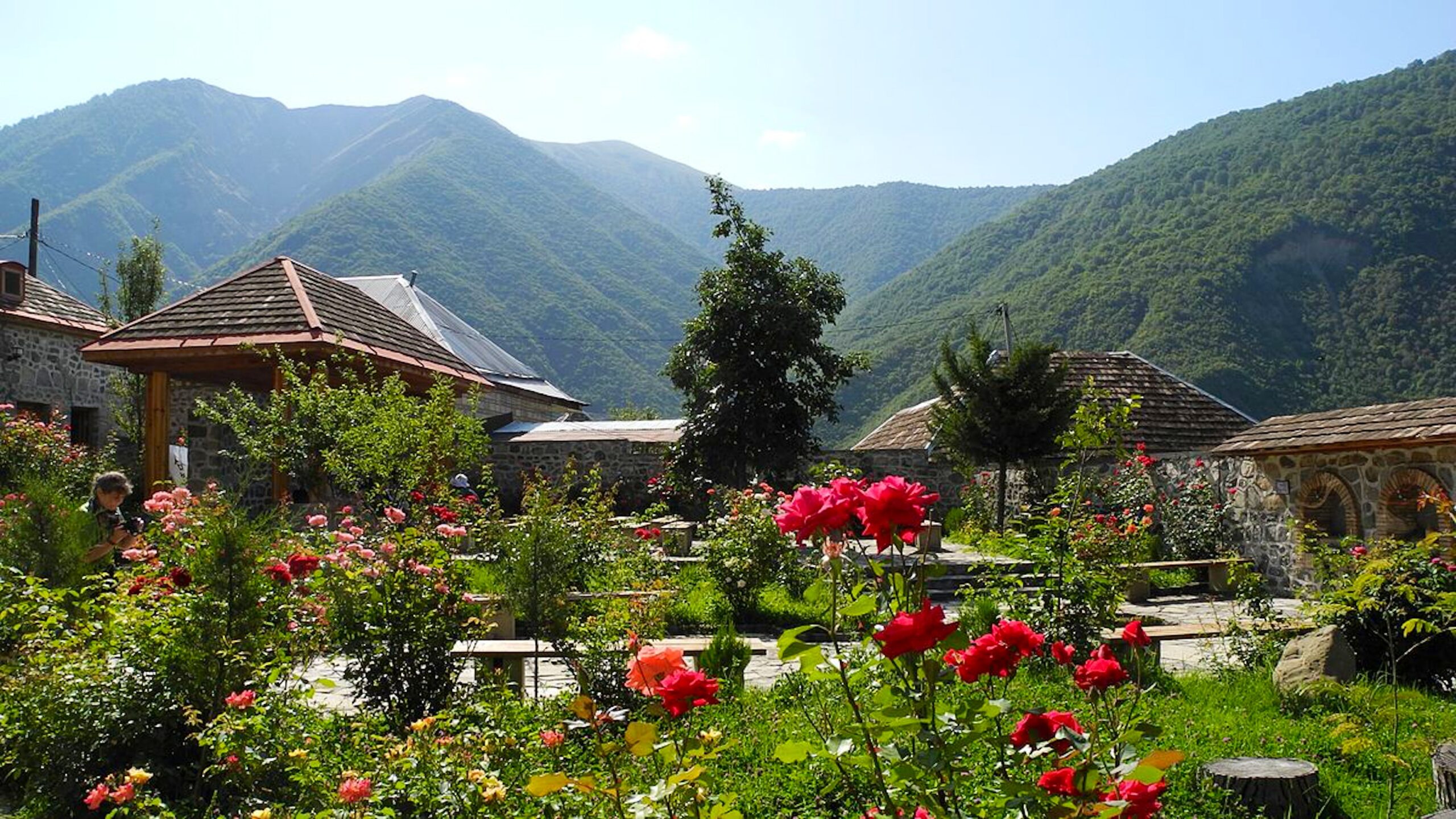


Long before Azerbaijan made its name in oil, it was a land of silk and spices.
Sitting at the crossroads of Europe and Asia, framed by the Caspian Sea and the Caucasus Mountains, it was a vital artery of the Silk Road, the ancient web of trade routes that tied East to West.
Until the 19th century, Sheki, set along the Silk Road in Azerbaijan's northwest, was an international hub of silk production.
Partner links: booking through them supports the blog at no extra cost to you.
Today it is one of Azerbaijan's most picturesque towns, all cobblestone lanes and medieval architecture: a fresh, pastoral escape from the drier south.
It has largely stayed off most travelers' radar, but that may be about to change. In July 2019, its historic center and Khan's Palace were added to the UNESCO World Heritage List.
The roadside inns known as "caravanserais"
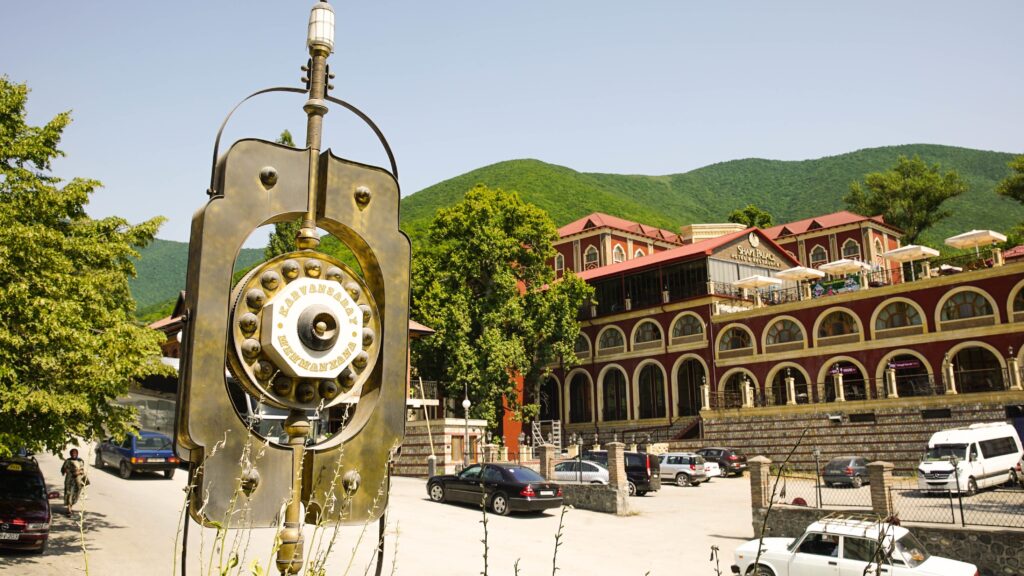
High in the Caucasus Mountains, sealed off from the world by forested peaks, passing merchants and their heavily laden animals would stop here on the road to Tbilisi or Baku and spend the night in one of the town's five caravanserais.
These roadside inns once dotted the entire length of the Silk Road, and today travelers to Azerbaijan, which welcomed a record 2.8 million international visitors in 2018, can rest in a genuine 18th-century caravanserai at the Yukhari Karvansaray hotel.
A mini fortress halfway up M.F. Akhundov Street in Sheki's Old Town, the hotel is entered through an imposing original wooden doorway.
Inside is a two-tier arcade of arches ringing a peaceful central courtyard, where merchants once tethered their camels but which is now dotted with trees and places to rest.
The guest rooms are on the second floor, and while they are certainly spartan (the furnishings and fittings may well date back to the country's Soviet era) at prices starting from 30 manat (about 18 US dollars) a night, it is a small price for a truly historic experience.
Vaulted brick ceilings and small windows in the rooms mean there is no need for air conditioning in summer, though in winter it can reportedly get a little chilly.
The town also has more upscale places to stay for those who choose to sleep elsewhere but still want to visit a caravanserai.
Day visitors can look around the courtyard from noon until seven in the evening, but overnight guests are the only ones allowed to linger here in the morning and evening.
Out back there is a large garden restaurant, along with an atmospheric tea house with stone walls.
The Palace of the Sheki Khans
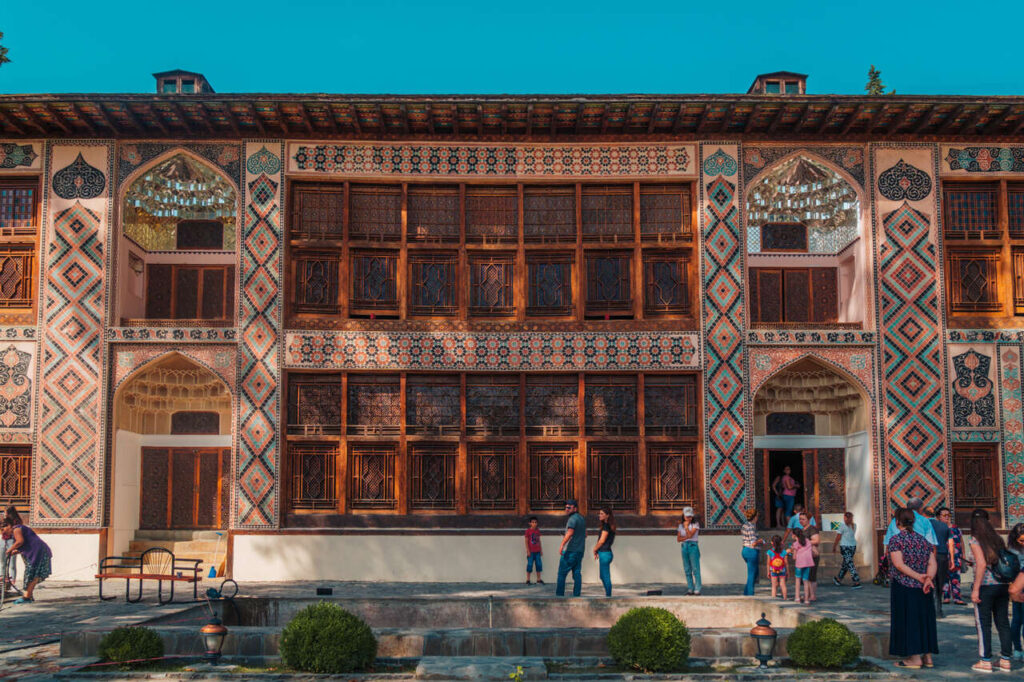
A short walk up the hill stands Sheki's main attraction: the summer palace of the Sheki khans, who ruled this corner of the Caucasus from 1743 to 1819.
Built in the late 18th century, this two-story building has a beautifully decorated interior and exterior.
Russian wood, French glass, Ottoman ceramics and Iranian mirrors all went into the making of this handsome, symmetrical masterpiece.
The facade is largely covered in a mosaic of multicolored glass set into wooden latticework called shebeke, assembled without a single nail or drop of glue. Examples of shebeke craftsmanship can be found all over Sheki.
Inside, six rooms are entirely covered in intricate frescoes depicting flowers, wildlife, battles and hunting scenes.
The Russian invasion in the early 19th century may have brought an end to the khanate, but the painstakingly crafted palace and the tranquil gardens behind it have survived intact and safe, ready to delight visitors for generations to come.
English-language tours can be arranged in advance.
As befits the cosmopolitan character of this trading town, Sheki has a long history of religious diversity, with plenty of churches and mosques across the region.
A few kilometers north of the town lies the Kish Church, built in the first century AD and later used as a church of the Caucasian Albanians, one of the oldest in the country.
Sheki's main streets are lined with souvenir shops selling ceramics, samovars and scarves made from the town's signature product: silk.
Piti, a meat stew eaten with bread, is a local delicacy, while halva (a sticky treat of sugar and nuts) is perfected at Aliahmed Sweets.
Beyond the town, the roads the Silk Road once followed are still busy with traders.
As Soviet-built Zhiguli cars zip along beside more modern vehicles, roadside vendors sell tandir bread, its dough pressed straight onto the sides of a clay oven, and qutab, light as air and pan-fried with greens and seasoned with sumac.
Hungry travelers pull over by the roadside to eat and sip freshly brewed tea at makeshift tables beneath the shade of the trees.
In 2017, Azerbaijan introduced a simple new three-day visa, and this route across the Caucasus has become as lively as it ever was.