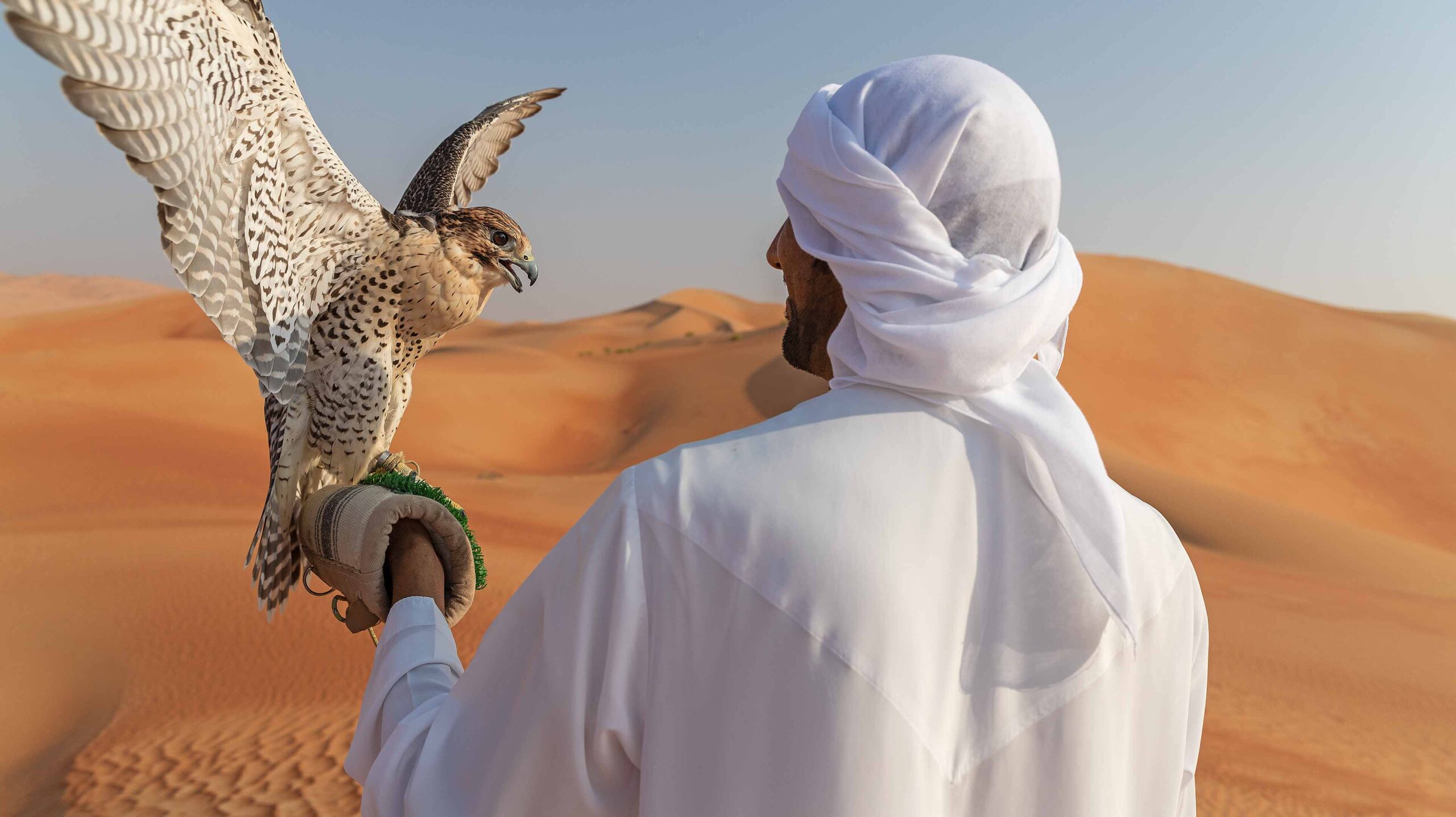


Twelve-year-old Mohammad is the first to spot the tracks.
Leaping out of the 4x4 driven by his father, Ali, he sprints a few yards across the desert sand and follows the trail toward a small shrub. "Rabbit," he says with a grin, pointing at the animal camouflaged against the greyish-yellow sand. Then, with an even broader smile: "It's going to be dead."
Once the prey is spotted, a predator waits on the back seat of the 4x4: a falcon, ready to be released and to prove Mohammad's prediction right.
Partner links: booking through them supports the blog at no extra cost to you.
This is falconry in Abu Dhabi, an ancient tradition that has survived into the modern age and is now open to visitors who come to the emirate in search of richer cultural experiences.
With the rabbit found, the hunting party and its guides, in two other 4x4s, start shouting, honking and chasing the startled animal (giving the word "overkill" a very precise definition).
Another falcon is quickly released from one of the vehicles and streaks alongside the cars racing over the low dunes. The rabbit manages to dodge the bird's astonishingly fast dive and hides in another bush, but only for a moment. Yet neither Said M. Al Mansouri, one of the Emirati falconers, nor his falcon can catch the rabbit even on the second attempt. In the end, it falls to young Mohammad and his falcon, Marzoom, to show the guests how it's done.
The Kill
Marzoom is quickly distracted from his kill, drawn to the carcass of another rabbit, after which he is tethered, and Ali carefully picks him up and hands him back to his son. A gentle spray of water from a diffuser cleans the blood from Marzoom's beak and, according to Ali, helps calm him. The rabbit is dropped into a bloodied sack. It will go into the cooking pot that evening, when the camp will trade stories about how it was caught, how it very nearly wasn't, and about the other hunts of the day.
A scene like this plays out every day from November through February in the vast Al Marzoom hunting reserve. It lies just an hour's drive from the gleaming towers of urban Abu Dhabi and is one of two areas in the emirate where, over the past five years, falcon owners and curious visitors have been able to hunt wild game under careful management.
It is a delicate balance between hunting and conservation, and the reserve is managed by Abu Dhabi's Ministry of Climate Change and Environment. The hunt, tied to the country's Bedouin heritage, is presented as a form of ecotourism. Rabbits and local houbara bustards and curlews are either bred on site or bought from other state-regulated breeders, then released into the desert, where wild animals, including deer, roam across an area of 200 square kilometres.
Visitors such as Said Al Mansouri can choose which quarry they want their falcons to catch, each posing a different challenge for the birds. The unsuspecting prey is released in one part of the reserve and then tracked with the help of guides, giving every excursion the feel of a "real" hunt. A typical day consists of one hunt in the early morning, before the desert heat becomes too intense, and another from late afternoon until dusk.
Cars and Camels
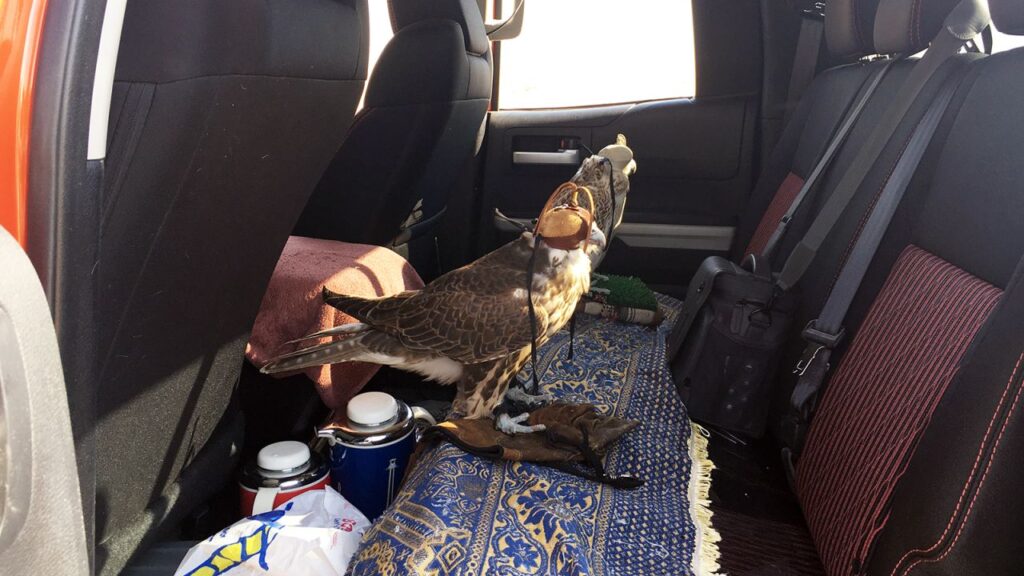
Last season, more than 1,300 people visited the reserve, many of them family groups and mostly from the UAE and neighbouring Gulf countries. According to Mohammad Bashir, the reserve's friendly guest relations coordinator, a typical stay runs from one to three days, though guests can come for just a single morning or afternoon hunt if they wish.
Overnight, guests stay in one of three campsites within the reserve. Overlooking the endless sands of Al Dhafra, Abu Dhabi's vast western region, the camps are well equipped, ranging from the comfortable, with sofas, proper beds and hot showers, to the luxurious King Camp, the only one with a deep bath featuring gilded fixtures fit, quite literally, for a king. Every camp has the essential campfire for storytelling and cooking after the day's hunt.
This blend of traditional and modern extends to how visitors can hunt. While many from the Emirates or Saudi Arabia arrive with their own falcons and their own 4x4s, there is a garage on site housing classic Land Rovers and Toyota Land Cruisers from the 1950s and '60s. All are available to rent, and the Land Rover comes free of charge with a stay at King Camp. But for those who want to go not just back in time but back to a pre-modern era, camels can be hired.
"One visitor from the UK was able to ride a camel and hunt with a falcon; it was strange and impressive," says Mohammad Bashir.
Pedigree
Owning a falcon is not a requirement for prospective visitors to the reserve. Guests can head out with Ali and his falcons, or with other guides and instructors at the reserve, and still get the full experience.
Although falconry and the birds themselves are revered in Abu Dhabi, and the knowledge and skills are still passed down as an inheritance, as with Ali and his son Mohammad, it remains a status hobby with a matching price tag. The most prized birds are the original wild varieties of pure pedigree, affectionately called "wahsha" (or "monster") for their fierce, killer instincts. Such creatures are hard to find, Ali says, and their price can exceed $30,000. And then there is the training. Fully training a falcon can take anywhere from six months to a year, and the trainers at Al Marzoom, who often keep several falcons each, use remote-controlled aircraft decorated with houbara feathers to train the young birds.
For Al Mansouri, this has been one of his favourite hobbies for more than 13 years; he cares for his falcon like a cherished pet.
"Sometimes I go to the reserve 12 times [a year]. I'd like to go more, so I also travel to Morocco, Azerbaijan and Pakistan," he says. "I look after my falcon at home, and sometimes he even lives in the same room where I sleep."