


For the first time, travelers in Tibet can take in sweeping mountain scenery at high speed.
The 435-kilometer railway line linking the Tibetan capital of Lhasa with the city of Nyingchi entered service on June 25, giving all 31 provincial-level regions of mainland China access to high-speed rail.
47 Tunnels, 121 Bridges
Building a high-speed railway across Tibet, often called "the roof of the world," was no easy feat.
Partner links: booking through them supports the blog at no extra cost to you.
Around 90% of the route, which took six years to complete, sits at more than 3,000 meters above sea level.
The Lhasa-Nyingchi line features 47 tunnels and 121 bridges, together making up about 75% of the entire route. Among them is the 525-meter Zangmu Railway Bridge, the largest and highest arch bridge of its kind in the world.
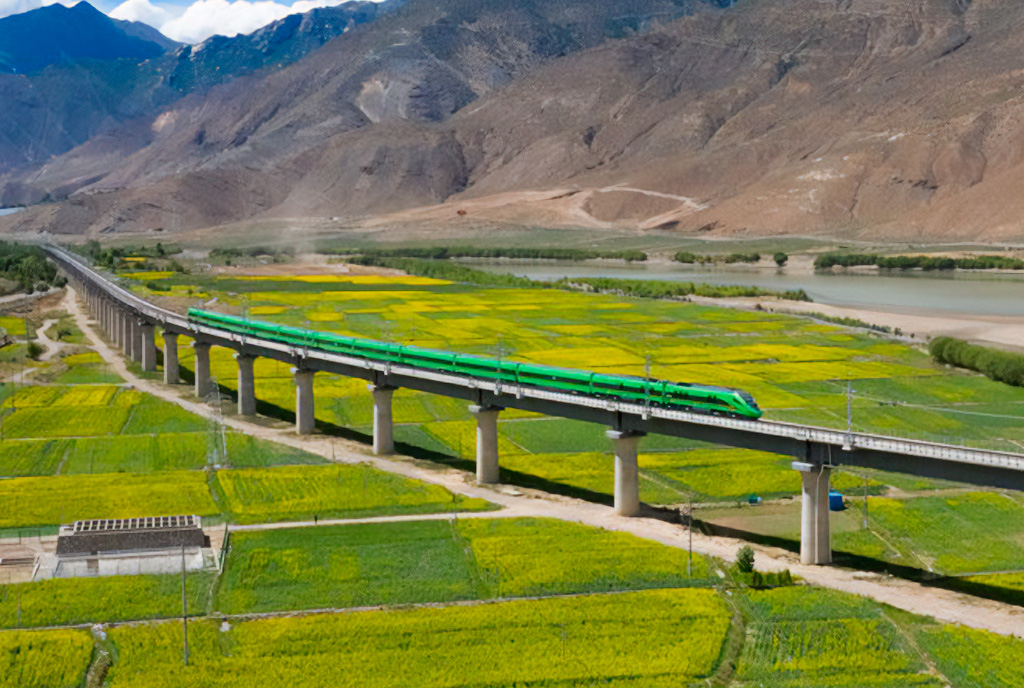
The line cost a staggering 36.6 billion yuan ($5.6 billion) to build. It is served by high-speed Fuxing electric multiple units, developed and operated by China's state-owned railway group.
Traveling at high altitudes, the Fuxing trains are fitted with automated oxygen supply systems that keep oxygen levels steady at 23.6%, slightly higher than the 21% average found in normal atmosphere.
The train windows use a special glass layer designed to shield passengers from the region's high levels of ultraviolet radiation.
The Fuxing trains running on the nine-station Lhasa-Nyingchi line are powered by both internal combustion engines and electric motors. The dual-power system lets them maintain smooth traction across the full 2.5-hour journey, on both electrified and non-electrified tracks.
They run at around 160 kilometers per hour, far slower than the top speeds of 350 km/h that travelers experience on many of China's other lines.
Sichuan-Tibet Railway One-Third Complete
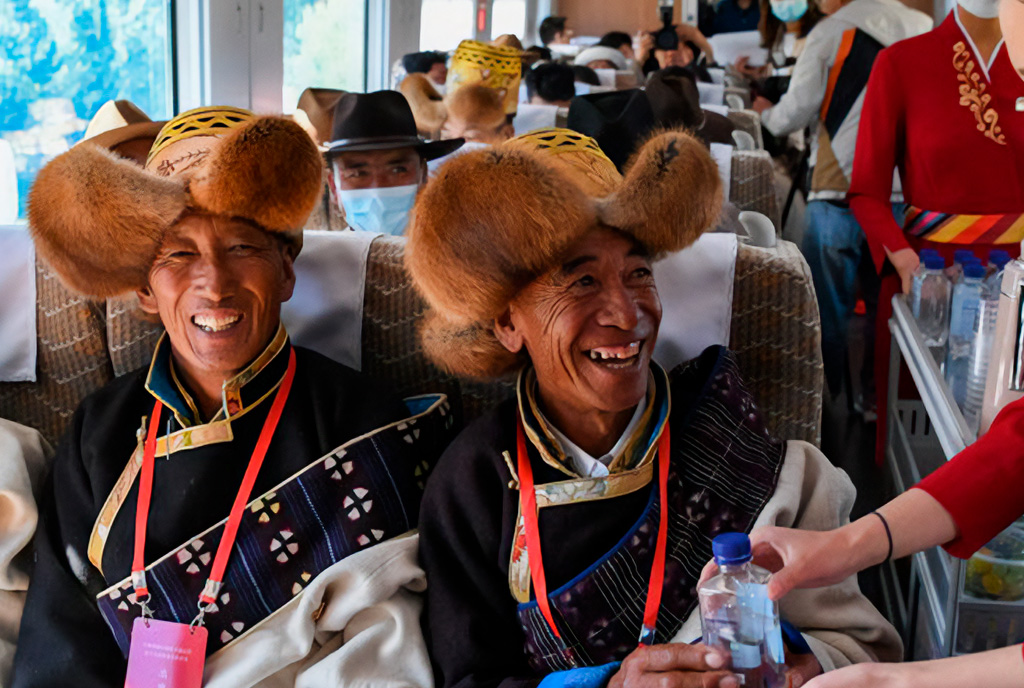
The new Lhasa-Nyingchi route is part of the Sichuan-Tibet Railway, a 1,740-kilometer line that will eventually connect Chengdu, the capital of Sichuan province, with Lhasa, cutting travel time between the two cities from 48 hours to 13.
Construction was split into three phases. The first section, the Chengdu-Ya'an railway, opened in 2018. Lhasa-Nyingchi is the second completed section. Work on the final Ya'an-Nyingchi stretch began in 2020 and is expected to be finished by 2030.
The Lhasa-Nyingchi line is Tibet's first electrified railway. The existing Qinghai-Tibet Railway, a 1,142-kilometer diesel-powered route, opened in 2006 and is considered the highest-altitude railway in the world, linking Xining in Qinghai province with Lhasa.
A Show of China's Economic Might
Stretching into a disputed area between India and China, the Lhasa-Nyingchi railway is just a small piece of China's rapidly expanding high-speed network.
Nearly 40,000 kilometers of lines crisscross the country, connecting all of China's major megacity clusters. By 2035, the network is expected to grow to 70,000 kilometers.
Much like Japan's Shinkansen bullet trains in the 1960s, Beijing sees its high-speed rail as a symbol of the country's economic strength and rising prosperity.
For China's ruling Communist Party and its leader Xi Jinping, high-speed rail is also a powerful tool for social cohesion, political influence, and drawing far-flung regions with distinct cultures into the mainstream.
"The construction of these new railways is part of Xi Jinping's grand plan to 'integrate the vast national market,'" said Olivia Cheung, a research fellow at the China Institute of the School of Oriental and African Studies (SOAS), University of London, in an interview earlier this year.
"It is also meant to reflect his 'new development philosophy,' whose key concept is 'coordinated development.'
"His scheme is grand in that it goes beyond simply connecting existing cities and instead links established cities with new megacities being built from scratch. A famous example that Xi is very proud of is the Xiongan New Area in Hebei province, roughly 60 miles southwest of Beijing."