

Bratislava is built for a short trip: the historic core takes about an hour to walk end to end, and every major sight, from Michael's Gate to the castle, fits inside a two-kilometre radius. This is the smallest capital in Central Europe, home to roughly half a million people, which is exactly why one or two days here feel more productive than three in Prague. There is also a bonus most visitors never cash in: Vienna is an hour away by train, so the two capitals stack neatly into a single itinerary.
The Old Town and Michael's Gate
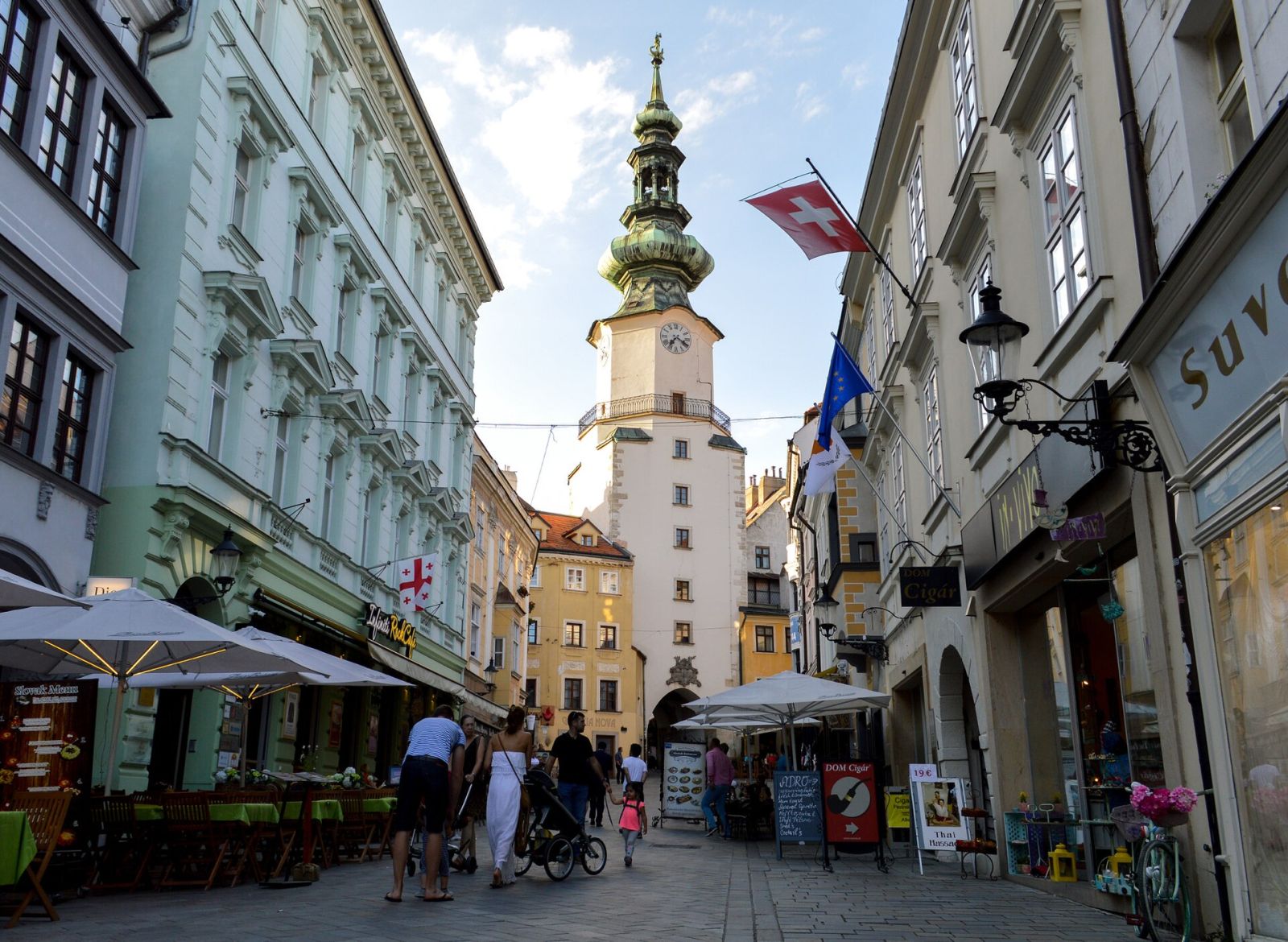
Bratislava's historic centre is compact and almost entirely pedestrian. The natural entrance is Michael's Gate, the only surviving tower of the medieval city walls. Its copper-green spire rises 51 metres, and you can climb to the top gallery for a view over the tiled roofs and the castle hill. Under the arch, a brass "kilometre zero" plate in the cobbles lists distances to world capitals; most people step right over it without noticing.
Michalska street then leads to the Main Square with the Old Town Hall and the Roland Fountain. Next door stands the pink Primate's Palace: the Peace of Pressburg was signed in its Hall of Mirrors in 1805, after Austerlitz, and inside hangs a rare set of 17th-century English tapestries. Somewhere along the way you will inevitably meet Cumil, the bronze sewer worker peeking out of a manhole at the corner of Panska street, the most photographed sculpture in town and its unofficial mascot.
St Martin's Cathedral, tucked under the castle hill, deserves a stop of its own. It looks modest from the outside, yet this was the coronation church of the Kingdom of Hungary from 1563 to 1830, and Maria Theresa was crowned here. Look up: instead of a cross, the spire carries a gilded replica of the Crown of St Stephen, a detail most visitors miss.
Bratislava Castle: four towers above the Danube
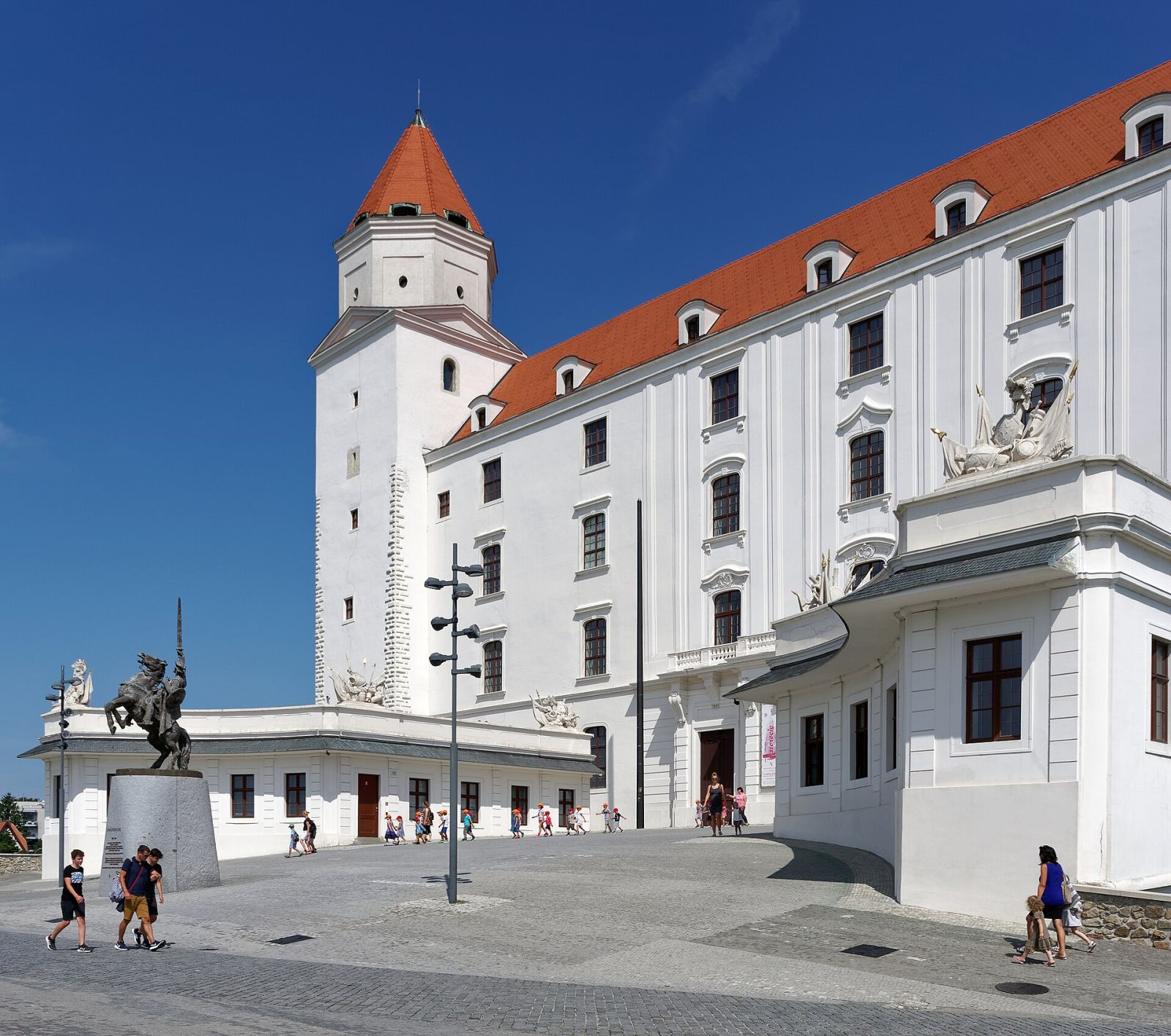
The white castle with four corner towers, watching the city from an 85-metre hill, is Bratislava's signature postcard. Its history is bumpy: the castle burned down in 1811 and stood in ruins for over a century, only fully rebuilt in the second half of the 20th century. That is why the interiors hold Slovak National Museum exhibitions and ceremonial halls rather than original rooms, and frankly the building is more impressive outside than in.
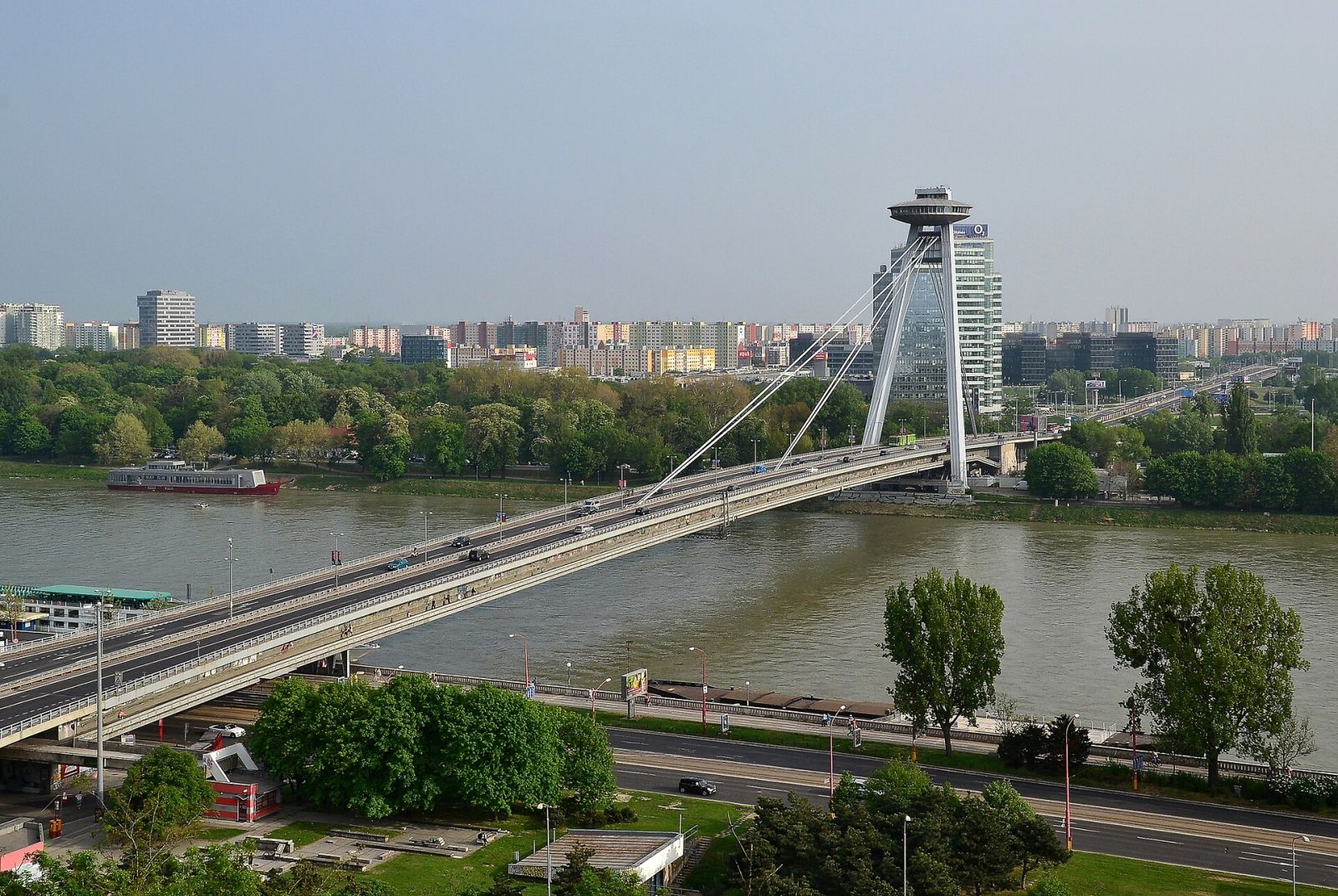
Climb up anyway. The courtyard and the baroque gardens are free, and the terraces offer the best panorama in the city: the Danube, the UFO bridge, the old town roofs and, on a clear day, Austrian wind turbines across the river, because the border runs practically along Bratislava's edge. The walk up from St Martin's takes about fifteen minutes, and at sunset this is the best spot in town.
The Blue Church of St Elizabeth
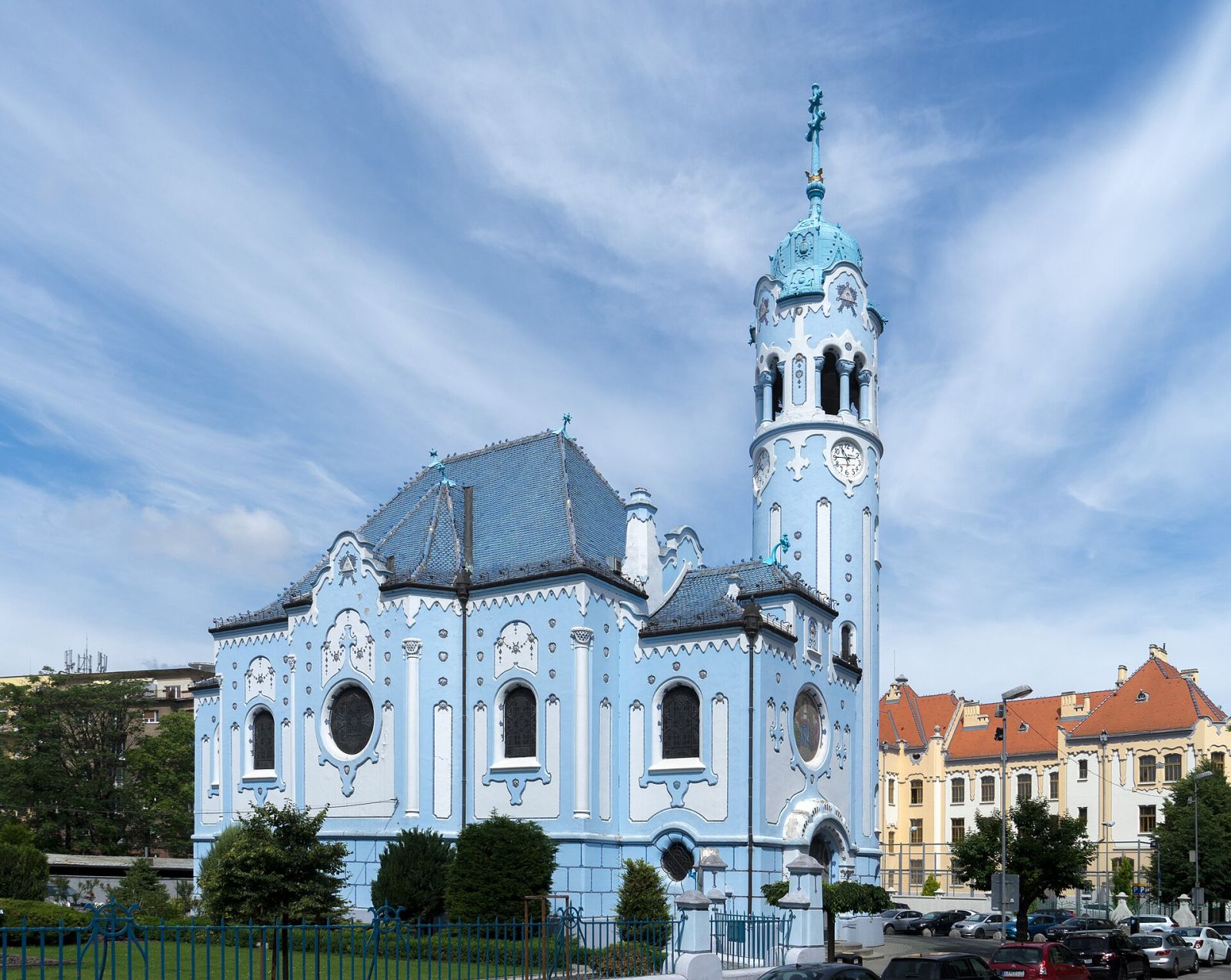
Ten minutes east of the centre stands Bratislava's most unexpected building: the Church of St Elizabeth, known to everyone simply as the Blue Church. Hungarian architect Odon Lechner finished it in 1913 in the Hungarian Secession style, and it really is blue all over, from the facades and majolica to the roof tiles and the fence, like a glazed gingerbread house. Getting inside is trickier: it is an active parish church that opens mainly around morning and evening mass, so check the schedule if you want to see the equally blue interior. Even the facade alone justifies the walk; there is nothing like it anywhere in Europe.
The UFO Bridge and the view from 95 metres
Locals call the SNP Bridge across the Danube simply the UFO: a flying-saucer pod sits on top of its single slanted pylon, holding an observation deck and a restaurant 95 metres up. A lift runs inside the pylon, the deck ticket costs a few euros, and a restaurant reservation usually includes the ride. From up here the city's contrast is at its sharpest: old town tiles and the castle on one side, and on the other Petrzalka, the largest prefab housing estate of former Czechoslovakia, home to a third of Bratislava. The 1972 bridge is a monument of sorts itself: part of the historic quarter below the castle was demolished to build it, and locals still argue whether it was worth the price.
Devin: a fortress above two rivers
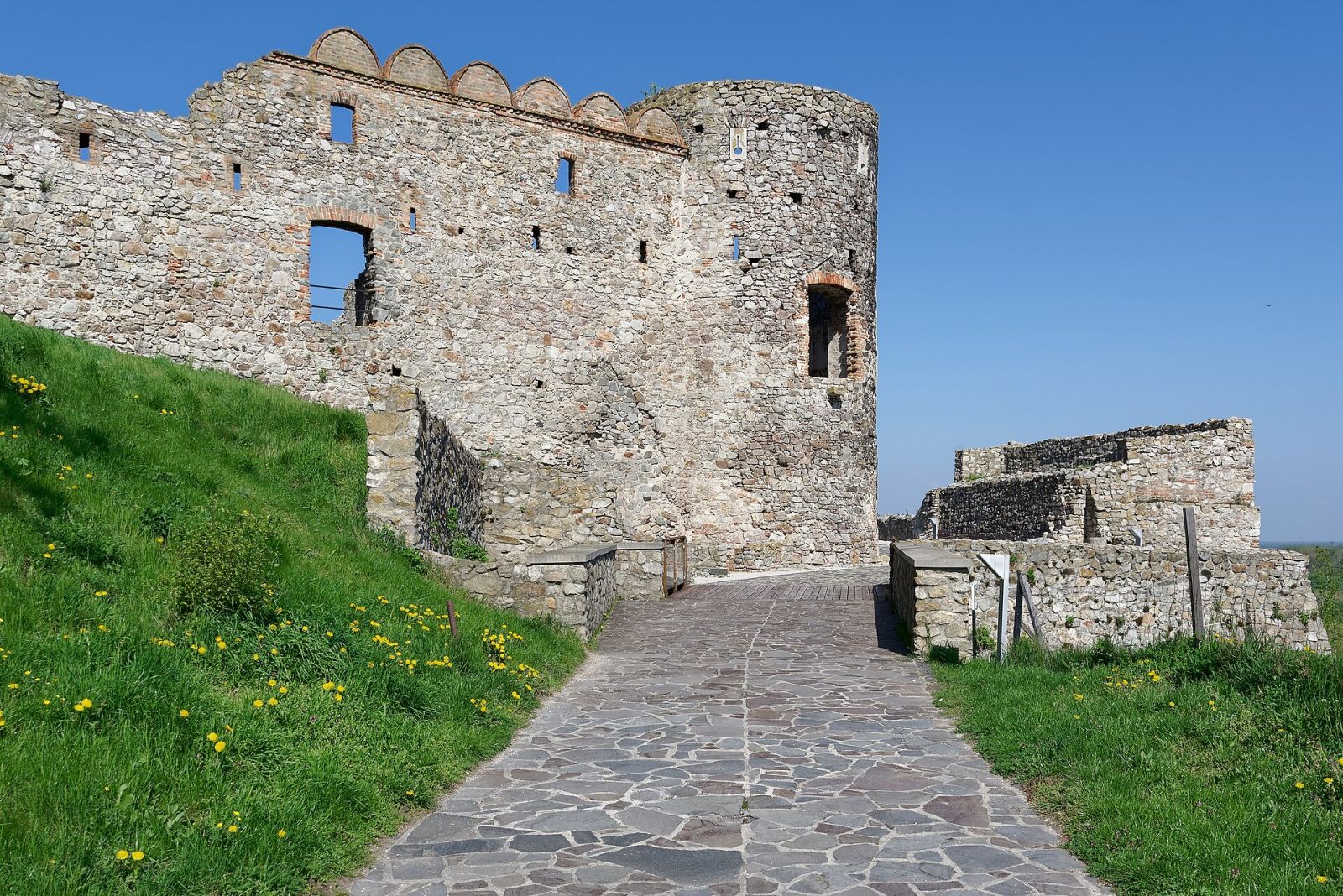
If you have a second day, go to Devin: the ruins of a clifftop fortress where the Morava river meets the Danube, 10 kilometres from the centre. Bus 29 from the UFO bridge gets you there in half an hour. A stronghold stood here from the 9th century, a key outpost of Great Moravia, until Napoleonic troops blew it up in 1809. Today it is a well-kept ruin with museum displays, viewing terraces and the famous Maiden Tower perched on a separate rock, the source of half the local legends.
The power of the place is not just the view. Under socialism the Iron Curtain ran right here: Austria lies on the opposite bank, and armed border guards patrolled the riverside strip. At the foot of the fortress stands the Gate of Freedom memorial to those shot while trying to swim across. Give Devin half a day including travel, and wear proper shoes: the climbs are steep.
Cafes and what to eat
Bratislava's cafe culture dates back to Austro-Hungarian times and is still going strong. The most famous spot, Konditorei Kormuth near the Main Square, looks more like a museum of frescoes and antiques than a pastry shop: pricey, with a queue, but you will not find an interior like it anywhere else. A simpler and equally local option: grab a bratislavsky rozok, the city's signature roll densely filled with poppy seeds or walnuts and protected by EU designation, with a coffee on Michalska or Panska.
For food, the must-try is bryndzove halusky, potato dumplings with sheep cheese and crispy bacon, a dish hearty enough to replace two meals. Slovaks pair it with tangy sheep whey or with Kofola, the local herbal answer to cola that many here honestly prefer to the original. Dinner in the centre is convenient, but terrace prices on the Main Square run noticeably higher than two blocks away.
How to plan 1-2 days?
| Time | What to see |
|---|---|
| Day 1, morning | Michael's Gate, Old Town, Main Square, Primate's Palace, St Martin's Cathedral |
| Day 1, afternoon | Bratislava Castle and gardens, walk down to the Danube, Blue Church |
| Day 1, evening | UFO observation deck at sunset, dinner in the centre |
| Day 2 | Devin until lunch, then cafes, the Eurovea riverfront or half a day in Vienna |
Vienna next door: how to use it?
Bratislava and Vienna sit 60 kilometres apart, the closest pair of capitals in Europe. Regional trains run roughly every hour and take about an hour, a return ticket costs around 20 euros and covers Bratislava's public transport; check current fares before you travel. In summer a fast catamaran runs along the Danube as well, more expensive but scenic. A scheme that works well: base yourself in Bratislava for two days, where accommodation is cheaper, and make a day trip to Vienna, or do it the other way round with an evening hop from a Vienna holiday. Schedules and current events are easy to check on the official tourism portal visitbratislava.com.
Practical details
- Currency: euro. Cards are accepted everywhere; cash is only really needed at markets.
- A city bus links Bratislava airport to the centre in under half an hour. Flying into Vienna is often cheaper: Schwechat airport has direct buses to Bratislava.
- The Bratislava Card covers unlimited transport and museum discounts. Do the maths: it rarely pays off for one day without Devin, but usually does for two days with trips.
- Best seasons: May, September and December, when the Christmas market fills the Main Square. July and August get hot, though bearable.
The bottom line: Bratislava in 1-2 days gives you the full feel of the city without a forced march. One day covers the entire centre with the castle and the UFO bridge, the second adds Devin and slow cafes. And Vienna next door turns a short trip into a double one, which is the strongest reason to come at all.