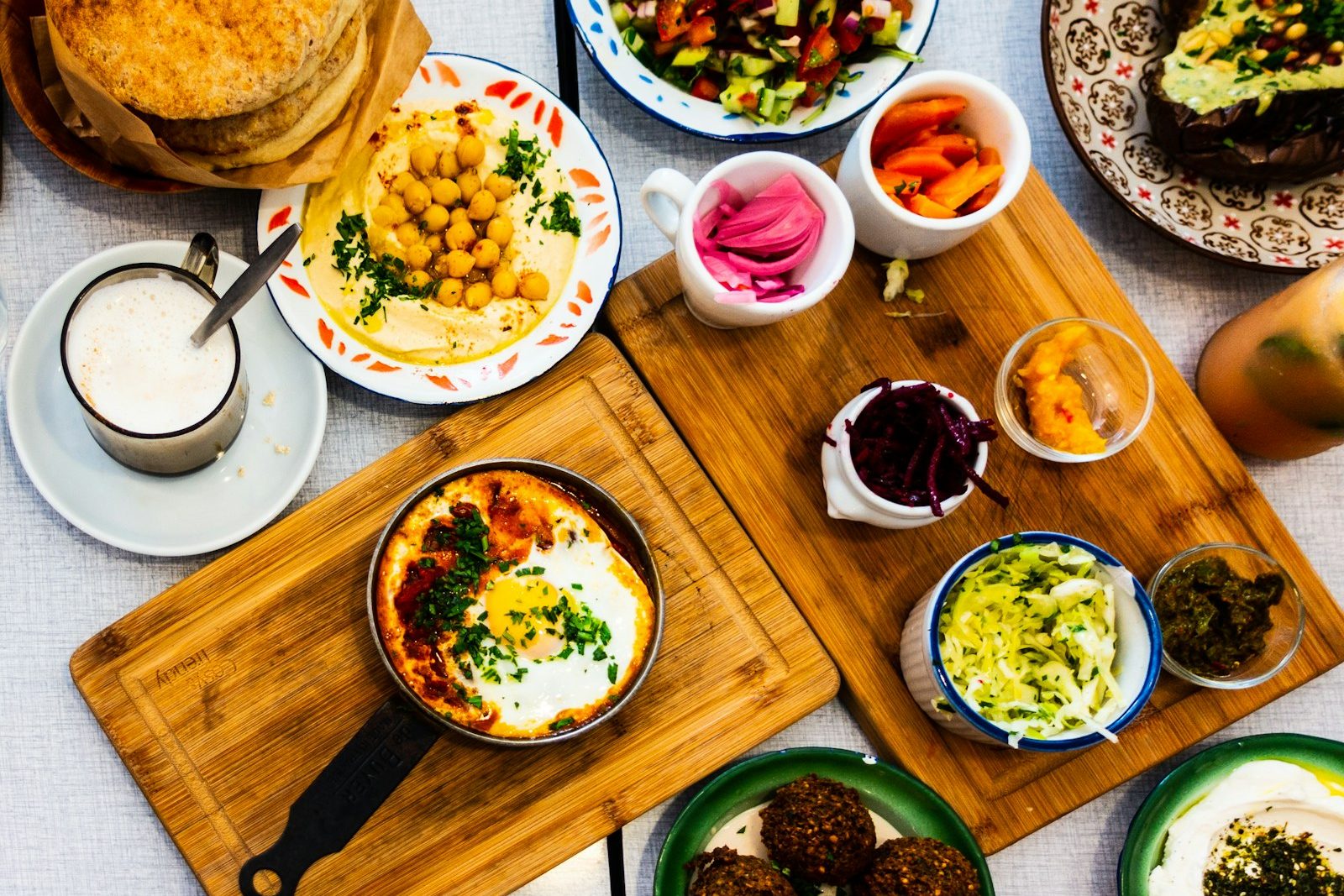


Food in Israel isn't one cuisine but several, sharing a single plate. Underneath sits a Levantine base that the whole region has in common: hummus, falafel, pita, tahini, plenty of olive oil and herbs. On top come the recipes of Jewish communities who arrived here from Yemen, Iraq, Morocco and dozens of other countries. And above it all sits the rule of kashrut, which decides what can even share a menu.
Here's the quick orientation: you'll find hummus and falafel everywhere, and cheaply, but the real interest begins where the cooking gets specific, Yemeni, Iraqi or Moroccan.
Israeli cuisine is a mosaic, not a single recipe
Plenty of tourists come for hummus and falafel and figure they've covered the subject. In reality those two dishes are the common denominator of the entire Middle East, from Lebanon to Palestine. They weren't "invented" in Israel, they're simply at home here, just as they are next door.
Partner links: booking through them supports the blog at no extra cost to you.
What makes the food distinctly Israeli is the second layer. Over several waves of repatriation, Jews arrived from Arab and Muslim countries, and every community brought its own table. Yemenites brought long-baked pastries, Iraqis brought kubbeh and amba, North Africans put fiery tomato on the stove. These dishes never blended into some average, they're still recognizable by their origin, and it's exactly this variety that's more interesting than any "national set."
Why hummus here is eaten warm, and before noon
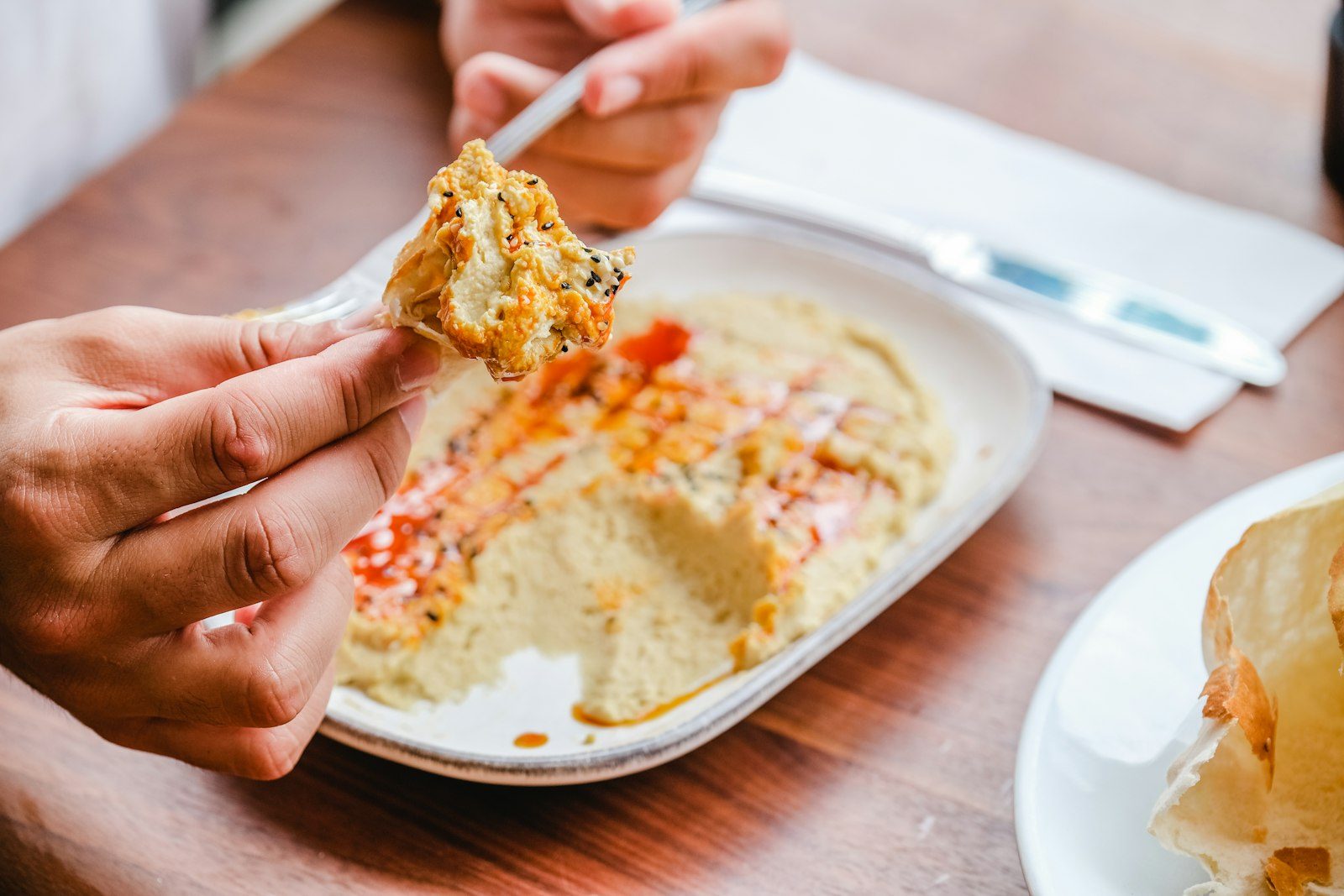
In Israel, hummus is not a cold supermarket dip but a hot main course. Done right, it's served warm and silky, with a pool of tahini and olive oil in the middle, a few whole chickpeas on top and fresh pita on the side. No fork needed: you tear the pita into pieces and scoop.
A place where hummus is the main event is called a hummusia. A classic hummusia has no sprawling menu, and often no menu at all. You choose between a handful of variations:
- Hummus in its pure form, with tahini and oil.
- Masabacha (msabbaha): less blended, with whole chickpeas in a warm dressing of lemon, garlic and hot pepper.
- Ful: with fava beans instead of, or on top of, the chickpeas.
- The "triangle": everything at once in one bowl, for those who'd rather not choose.
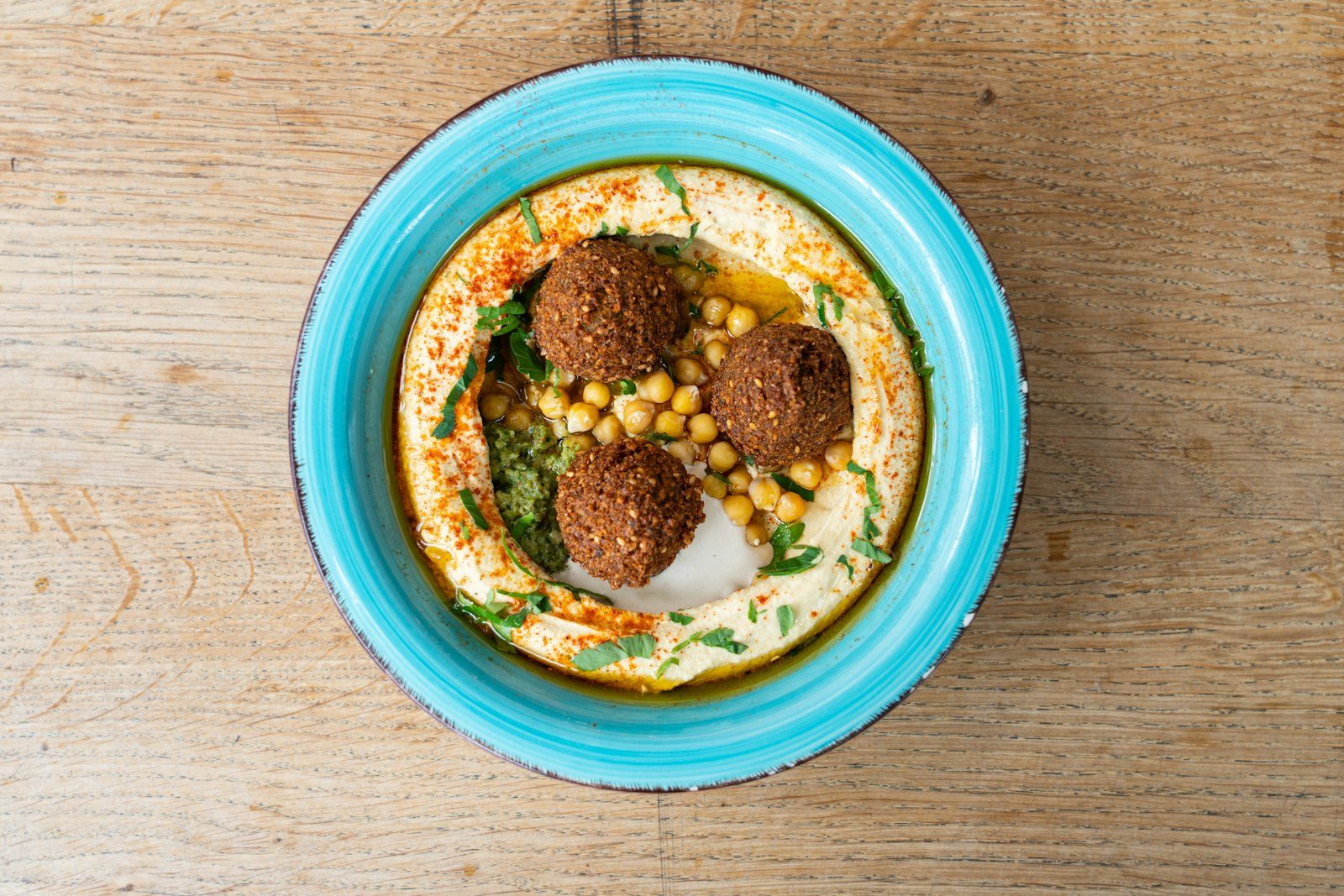
The second quirk of the hummusia is its hours. Many of the best places open early and close the moment the day's hummus runs out, sometimes before lunch. The legendary example is Abu Hassan in Jaffa, which grew out of Ali Karawan's cart in the Ajami neighborhood and still draws a queue every day at midday. Cheap and no-frills: a bowl runs roughly 25 to 45 shekels and comes with pita and raw onion. Come early rather than after two o'clock, when you may find the doors already shut.
Falafel and sabich: two pitas from different kitchens
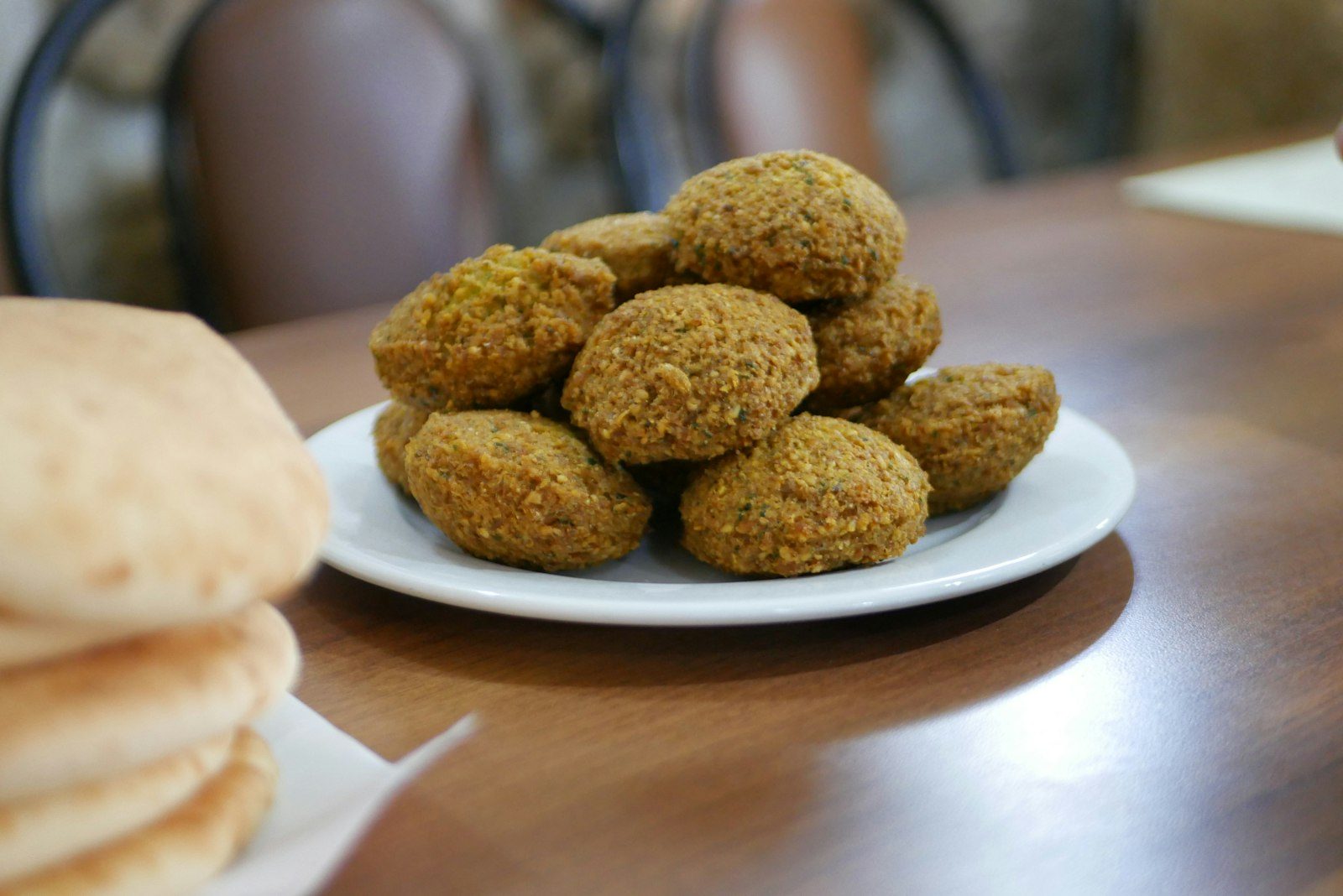
Falafel is fried balls of ground chickpeas, herbs and spices, crisp outside and grassy green within. On the street it goes into a pita along with salads, pickles, fried eggplant and tahini, and this loaded pita costs roughly 25 to 40 shekels. In Tel Aviv people often point you to Falafel HaKosem, a name that translates as "the magician."
Sabich looks similar, but it's a different story and a different community. It's a pita with fried eggplant, hard-boiled egg, tahini, fresh salad and amba, a tangy sauce made from pickled mango. Sabich was brought by Iraqi Jews: for them it was a Saturday-morning dish, because every component is prepared in advance and needs no fire on Shabbat. If you've had falafel anywhere in the Middle East, sabich is the local accent worth trying right here.
Shakshuka came from North Africa, not Tel Aviv
Shakshuka is eggs baked in a thick sauce of tomatoes and peppers, usually right in the pan you eat it from, mopping up the sauce with bread. It's served all day, but by default it's a breakfast. The dish has North African roots, brought by immigrants from Tunisia and Libya, and only later became one of the calling cards of the Israeli breakfast. In Jaffa a whole niche is built around it, with versions running from the classic tomato to a green one on spinach. A cafe portion is roughly 45 to 60 shekels and easily fills one person.
The markets: Carmel in Tel Aviv and Mahane Yehuda in Jerusalem
The most logical place to hunt for street food is the markets, and two of them are worth half a day each.
Shuk HaCarmel in Tel Aviv is the city's main market, loud and touristy, with rows of spices, fresh juices, a street sabich stand opposite the entrance and small hummusias inside. It's more compact and closer to the beach, handy for a bite between errands.
Mahane Yehuda in Jerusalem, which locals simply call "the shuk," is bigger and more varied. Here you'll find hundreds of stalls serving Moroccan, Iraqi, Kurdish, Yemeni, Turkish, Bukharan and Georgian food across a few crisscrossing lanes. By day it's a produce market, in the evening some of the stalls turn into bars. This is the easiest spot to taste dishes from different communities in a single walk, without hopping between neighborhoods.
Dishes by origin: a quick cheat sheet
| Dish | Where it came from | What it is |
|---|---|---|
| Jachnun | Yemen | Dough baked slowly overnight; eaten in the morning with grated tomato and fiery schug |
| Malawach | Yemen | A fried flaky flatbread, served with egg and tomato |
| Kubbeh | Iraqi and Kurdish Jews | Dumplings of bulgur or semolina with meat, often in a sour soup |
| Sabich | Iraq | Pita with eggplant, egg, tahini and amba |
| Shakshuka | Tunisia and Libya | Eggs in a tomato-and-pepper sauce |
| Couscous and tagine | Morocco | Couscous and stews with spicy tomato |
What kosher means when you just want lunch
Kashrut isn't an abstraction for the tourist, it directly shapes what's on the menu and when a place is open. The main rule you'll notice right away: meat and dairy are never served together. Because of this, kosher establishments split into meat (basari) and dairy (halavi), while neutral products that are neither are called "parve" and pair with anything.
The practical consequences at the table:
- In a meat restaurant there'll be no cappuccino after the steak and no creamy dessert; the sweets there are made without milk.
- On a kosher menu you won't find pork or seafood at all.
- Kosher status is confirmed by a rabbinate certificate (a hechsher) on the wall; its absence doesn't mean the food is bad, only that the place isn't kosher.
- Places kosher under the rabbinate are closed on Shabbat, from Friday evening to Saturday evening, and on Jewish holidays.
There's a big difference between cities here. In Jerusalem most establishments are kosher, and on Shabbat the city noticeably goes quiet on the food front. Tel Aviv is more secular: many cafes and restaurants stay open on Shabbat and don't keep kosher, so finding dinner on a Saturday is far easier. If you're planning a weekend trip, keep this in mind, or you risk going hungry exactly when you want a festive dinner.
Desserts: knafeh hot, malabi cold
Two desserts are worth trying even for those who usually skip sweets.
Knafeh is a Levantine dessert of thin kadaif pastry threads and stretchy cheese, soaked in sweet syrup and served hot, orange from the coloring and crisp on top. The flavor balances on the line between salty and sweet, and it's exactly that warm, stretchy center that makes it recognizable. A portion runs roughly 15 to 30 shekels.
Malabi is the opposite by temperature: a cold milk pudding with rose water, drizzled with syrup and dusted with coconut or nuts. A light finish after a heavy hummus lunch. In cold weather the markets also carry sahlab, a warm milk drink from the same family.
What it costs: a 2026 guide
| What | Approximate price, ₪ |
|---|---|
| A loaded pita with falafel, sabich or shawarma | 25-40 |
| A bowl of hummus at a hummusia | 25-45 |
| Shakshuka at a cafe | 45-60 |
| A main course at a mid-range restaurant | 60-100 |
| Knafeh or malabi | 15-30 |
An honest warning about money right away: Israel is expensive when it comes to food. By some estimates, prices for food and drink here run about half again above the average in developed countries, so budget with room to spare. Market food and hummusias are the saving grace: filling up for 25 to 40 shekels is entirely doable, whereas a restaurant dinner quickly climbs past a hundred per person.
Where to start, for you specifically
If it's your first time in Israel, give one morning to hummus at a hummusia before noon and one evening to a market, ideally Mahane Yehuda in Jerusalem, and that's enough to feel both layers of the cuisine. If you've already tried the basic set, the next step is the communities' specific food: Yemeni jachnun for a Saturday morning, Iraqi kubbeh in soup, or Moroccan fish in spicy tomato. And plan your menu around the calendar: in Tel Aviv Shabbat barely gets in the way, in Jerusalem you're better off stocking up on food before Friday evening.
To keep going on this topic, read our guides to other cuisines in the "Food and Drink" section, in particular about the food in Turkey and Japanese cuisine, to compare how different countries build their street table.