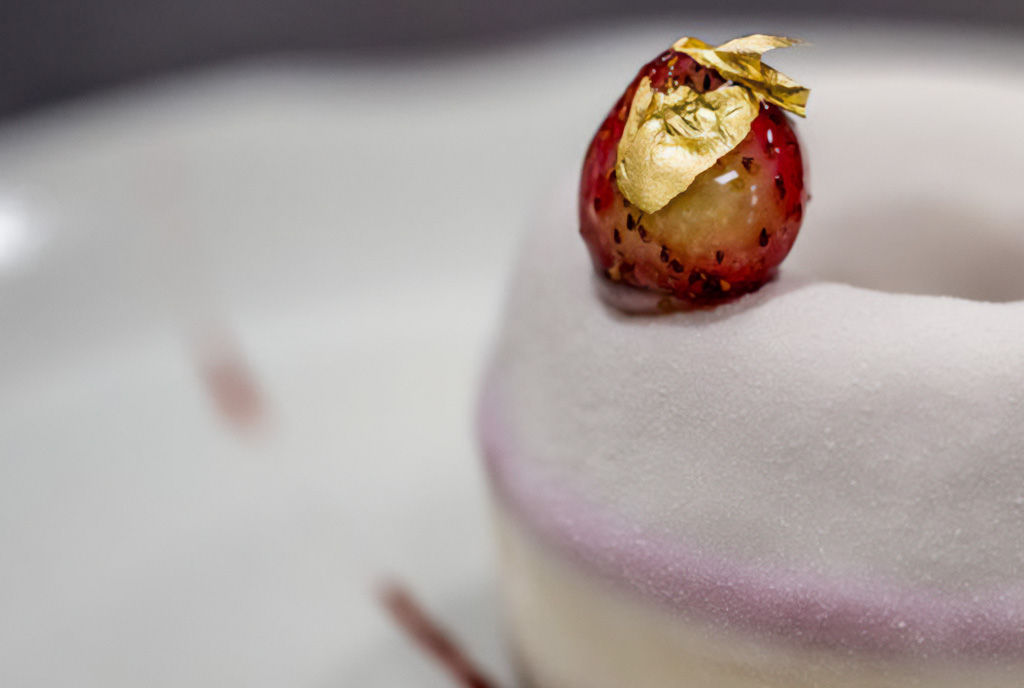


Gold is still big business in Dubai, even with reports of a 20-year low in demand for gold jewelry across the UAE. According to figures from the Dubai Multi Commodities Centre, the emirate handles roughly 25% of the world's trade in the precious metal.
Dubai makes no secret of its love affair with gold, coating sports cars in the stuff and installing vending machines that dispense bullion. And then there's the world-famous Gold Souk.
In a place where symbols of wealth have become everyday, it's perhaps no surprise that there's a market for consuming gold in the most literal sense.
Partner links: booking through them supports the blog at no extra cost to you.
One of Dubai's most prestigious hotels, the Burj Al Arab, is decorated with roughly 1,790 square meters of 24-karat gold leaf. Some of it has made its way behind the bar too, folded into the foam of a cappuccino or stirred into cocktails at Gold On 27, perched on the 27th floor, 200 meters above sea level.
Scattering gold everywhere isn't necessarily a matter of taste, though. In fact, gold has no flavor at all when you eat it. So why serve it, and why do guests happily accept it?
«Gold is synonymous with luxury, with something that carries a level of decadence,» explains Etienne Haro, executive assistant food and beverage manager at the Burj Al Arab.
The hotel gets through as much as 700 grams of gold, sourced from Italy and India, each year for its dishes and drinks.
Edible gold usually comes as gold leaf, flakes, or dust, unlike the solid gold used in jewelry. It's biologically inert and therefore safe to eat, even if it's flavorless.
«Diamonds are a little hard to chew, so gold lends itself better to being worked into cocktails,» Haro jokes.
Among the gold-laced menu items are white chocolate blended with gold, a purpose-built pepper grinder for dusting «golden snow» over food or cocktails, gold sugar cubes for tea-based mocktails, and a pure gold decorative spray.
The bar's most iconic cocktail, named Element 79 after gold's atomic number, is made with a non-alcoholic sparkling wine flecked with gold, food coloring mixed with pure gold, and a golden sugar cube. The result is a shimmering tornado that never stops spinning.

Beyond being Instagram-worthy, every cocktail is designed to introduce international guests to Dubai's history and vision, Haro explains. The cocktails are split into three sections, Old Dubai, New Dubai, and Future Dubai, with names like «Light Sweet Crude,» «City of Gold,» and «2020.»
«Gold is like a thread that helps us tell that story, because it really is something intrinsic to the history of the city and of the Emirates as a whole,» says Haro.
Among the Burj Al Arab's guests there's clearly an appetite for extravagance, as Haro and his team often have to field ambitious requests.
Every month, for instance, a regular guest pre-orders a cake completely covered in gold and made to her own specific recipe, the manager says. Haro's team has also dreamed up a cheesecake shaped like a giant golden doughnut and a gold five-course menu for a car company.
But Haro says there are times when he has to draw the line.
«One guest recently asked us to create the world's most expensive cocktail for him, name the cocktail after himself, and make sure it would be one of a kind,» he says.
Haro turned the request down: «As much as we're a business, obviously we always want to make sure we keep a certain level of integrity.»
A Rich Tradition
While gold is added to dishes today as a way of flaunting wealth, in medieval Europe it was reserved for the nobility, explains Barbara Santich, emeritus professor of food studies at the University of Adelaide, Australia.
During that period of history, gold was thought to have special properties, much the way the Chinese believe oranges bring good luck, Santich explains.
«Because gold, silver, and precious stones had virtues, if you cooked them in a broth, [the belief was that] some of the goodness would seep into the soup,» Santich says.
«It's a bit of sleight of hand, and it's all about belief: if you think something is doing you good, it will do you good.»

These days, Santich says, gold adds nothing to a dish's gastronomic merits: «It really is all in your head.»
«Used sparingly, gold can be very pleasant,» Santich says, pointing to dates or chocolate finished with a fleck of gold. «But when every single dish can be served with gold, it's just too much.»
24 Karat, an Italian restaurant in a Dubai Marriott, offers an extra helping of gold flakes across its entire menu, whether it's a burger, a pizza, or a salad.
A Golden Publicity Stunt
Dubai is hardly the only city serving gold for dinner. In fact, the most expensive commercially available pizza in the world can be found at Industry Kitchen in New York, USA.
The $2,700 pizza has to be ordered 48 hours in advance and comes topped with foie gras, two kinds of caviar, truffles, and 24-karat gold leaf.
And then there are the brazen publicity stunts. In 2012, a New York food truck unveiled its tongue-in-cheek «Douche Burger» for $666, a foie gras patty topped with lobster, truffles, caviar, and a mist of champagne, all wrapped in gold leaf.
Dubai food critic Samantha Wood says she first noticed edible gold in the emirate six years ago, when an overpriced gold-topped cupcake made headlines.
«It's very Dubai to do something like that. They love superlatives and they love focusing on something that grabs the headlines,» says Wood.
«(Edible gold) might look good, but I don't think it adds anything. If it does anything at all, it just makes the dish more expensive.»
Another Dubai food critic, who goes by the name Dan EmirEATi, has similar thoughts: «Dubai is probably the right market for edible gold... I think there's a good correlation between the kind of car people drive and how much edible gold they like to eat in their food.»
But both critics agree that edible gold isn't as widespread as people might think.
«I think Dubai has actually moved away from it,» Wood says. «I think the restaurant scene has grown up a bit now.»