

As a boy, Mihir Vaya helped his father run a jewellery business that was only just getting off the ground in Dubai.
He remembers crossing Dubai Creek with him on an abra boat as his father set out to sell his wares. He remembers when the Gold Souk, which today holds hundreds of traders, was just a handful of rickety kiosks clinging like barnacles to the banks of the creek. But most of all, he remembers helping his father in his workshop. He and his sister would hold the gold wires so they could be twisted into intricate pieces of jewellery.
"They were probably little things, these small tasks. But you felt so important," Vaya says. "Ever since then, I've been drawn to working there."
Partner links: booking through them supports the blog at no extra cost to you.
Ashwin Vaya, Mihir's father, was one of thousands of Indian gold traders, jewellers, craftsmen and businessmen who flocked to Dubai in the late 20th century to make their fortune in the booming gold trade. Along with enterprising Emiratis and other immigrants from across the region, these are the people responsible for Dubai's rise as an international gold hub.
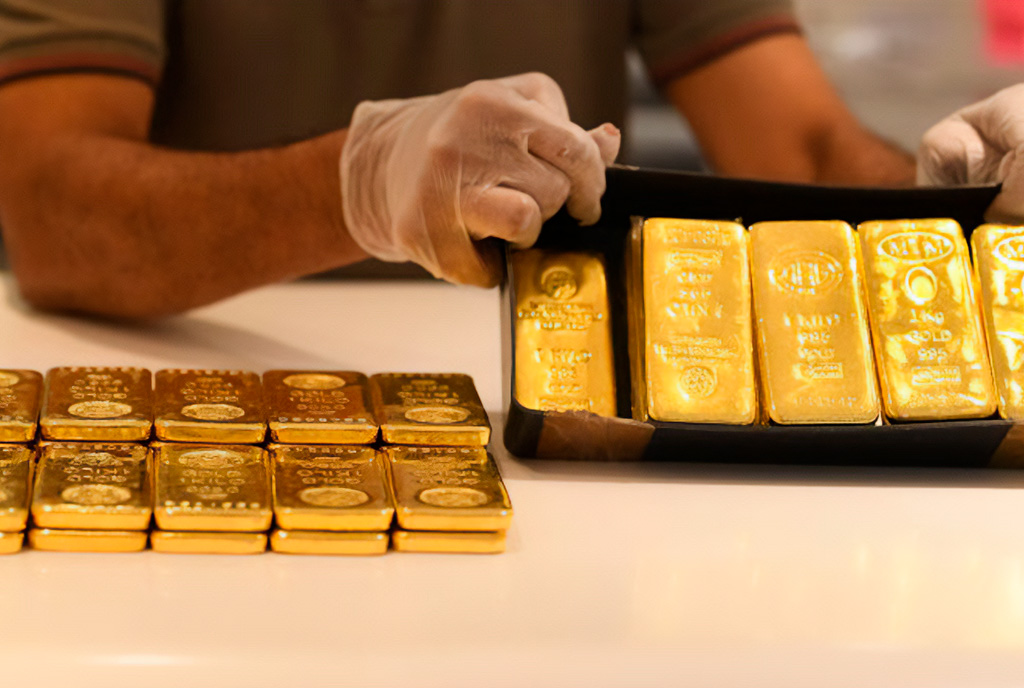
Before the pandemic, the gold and jewellery market accounted for 20% of the UAE's total non-oil exports, most of it coming from Dubai. By some estimates, between 20% and 40% of the world's gold supply passes through Dubai each year.
The Rise of the Souk
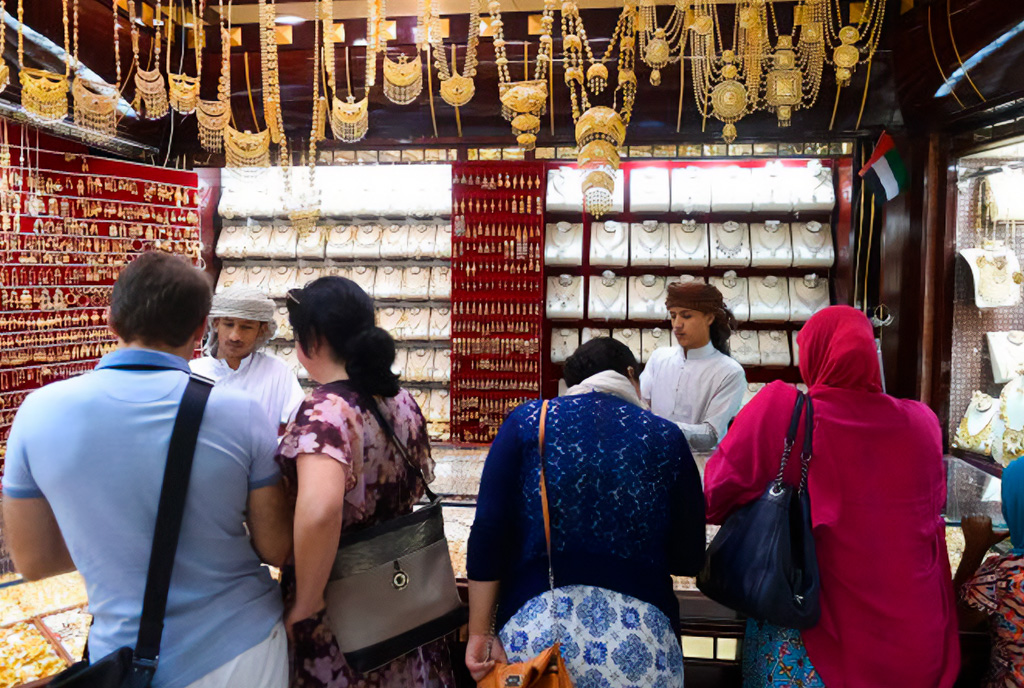
The maze-like alleyways and carved wooden roofs of Dubai's Gold Souk haven't changed much over the past century, aside from a bit of modernisation.
What has changed is its size and scale. Over the years the market has grown from around 400 square metres to a sprawling powerhouse more than two kilometres wide and three kilometres long.
More than 700 traders now do business here, mostly in the Gold Souk or in the Meena Bazaar just across the creek. Many of the shops here have been in family hands for decades.
In the early 1900s, when the Gold Souk was just getting started, only a handful of local jewellers worked along the banks of Dubai Creek, trading along the spice route. Things picked up in the 1940s, when new trade policies encouraged Iranian and Indian entrepreneurs to open their shops. But the real boom began in the decades after the 1970s, when the city's fortunes were transformed by the discovery of oil.

The City of Gold
Jayant Javeri remembers those heady days fondly.
Originally from Mumbai, Jayant arrived in Dubai with his brother Anil in 1971, the same year the United Arab Emirates was founded. The Javeri brothers grew up in the gold business in Bahrain: their grandfather founded a currency exchange company that also sold gold bars, and their father lent a hand. But the Javeri brothers wanted to start something of their own.
Their first shop in Dubai was a general trading company that dealt in gold through orders placed by their grandfather.
But in 1990, sensing the steadily growing demand for gold across the Gulf, they founded Javeri Jewellery, which they say was the first gold shop in the Meena Bazaar in Bur Dubai. Today the Meena Bazaar is home to hundreds of large jewellery chains and family shops, and it is a little cheaper for sellers than the Gold Souk. But in 1990 there were only the Javeri brothers and "a few other buildings".
In the years that followed, as word spread back in India, thousands of people came to Dubai hoping to repeat the success of those who had come before them. The 1990s were the peak of the UAE's gold rush.
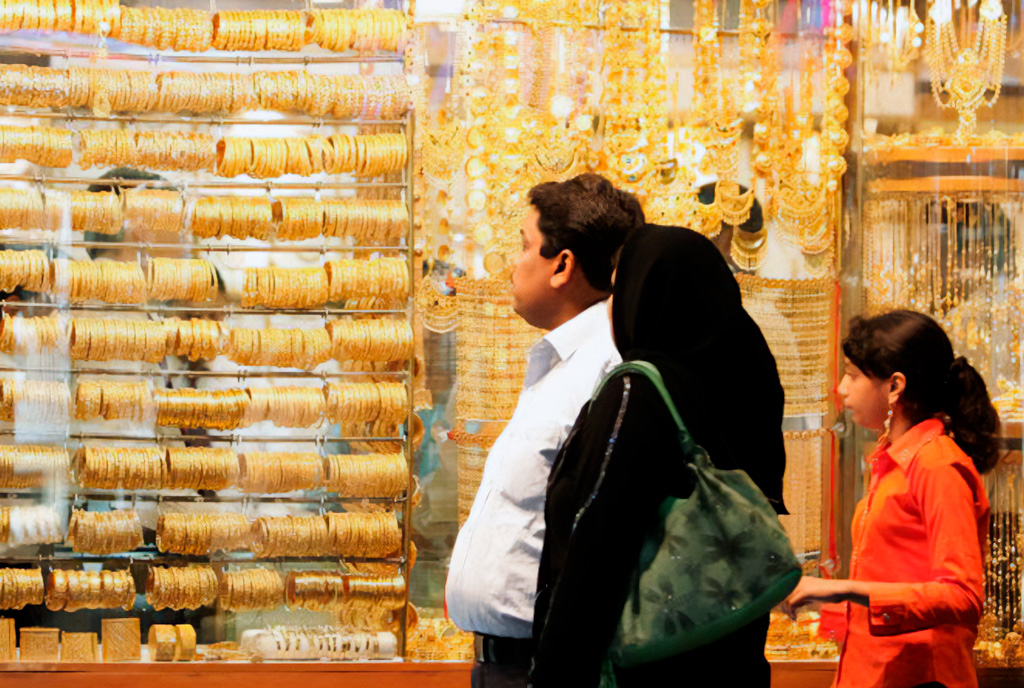
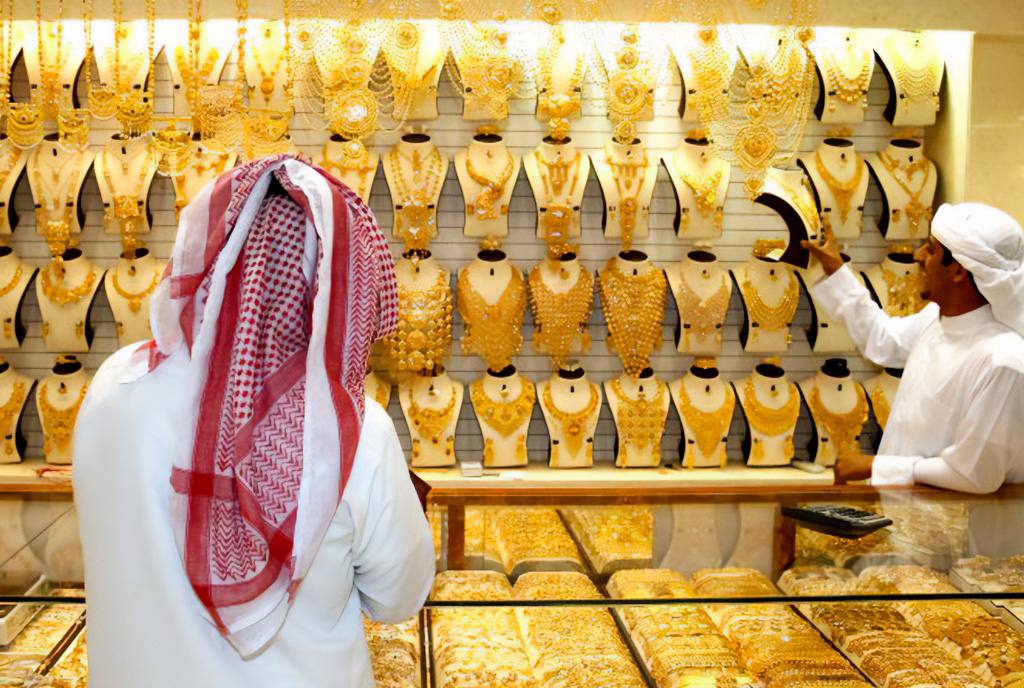
This sprawling bazaar of gold traders, diamond dealers and jewellers took the shape it still holds today: glittering shop windows that seem to be trying to win over passers-by by dazzling them. You won't see displays like these at Macy's.
Dubai earned its nickname as the "city of gold", a relatively affordable place to buy gold and precious stones, a reputation it holds to this day.
This was down to low taxes (the 5% VAT introduced in 2018 is the only tax levied on gold here, and tourists can claim it back), fierce competition, government regulation and the fact that, unlike elsewhere in the world, jewellery prices in Dubai aren't fixed but follow the daily market rate of international gold prices. Yes, that means you can haggle, even inside the shop.

Fierce Competition
The journey of Mihir Vaya and his family to the UAE was much like the Javeris'. Mihir's grandfather started a jewellery business in Gujarat, India, in the 1940s. He made and sold the pieces himself. Then his son, Ashwin, took over.
Ashwin expanded the business by focusing on wholesale jewellery sales and travelled to Kuwait to make his fortune. When the Gulf War broke out in 1990, he set off for Dubai.
"We grew up with the jewellery business. We watched Dad go to the market and get a good price. We'd ride the abra to the Meena Bazaar. Back then there were no big traders," Mihir says.
Mihir started working with his father full-time when he was 21. Over the decades since, he has watched the gold trade take on its current shape.
"There's fierce competition now, and all the trends have changed. It used to be all handmade. Now all the design is done on a computer, and we have casting machines. It's less personal and more mass-produced."
The modern trade is not without its contradictions. The UAE imports gold from a number of countries that practise artisanal and small-scale gold mining (ASGM), which, while an important source of income for rural communities, is often unregulated and linked to dangerous working conditions.
The Secret to Success

For most gold sellers in Dubai, the secret to success is a loyal crowd of regular customers and relationships built up over decades. People here aren't inclined to go hunting for bargains; the clientele isn't fickle.
Mehul Petani is proof of this.
Petani can be found most days at Cara Jewellers in the sprawling Gold and Diamond Park in Al Quoz, usually serving one of his loyal customers while a queue patiently forms in the background.
The Petani name is a common one in these parts. This one Mehul has three cousins and a brother-in-law working here. Many of the others are men he has known since childhood.
That's no coincidence. Founders Kiran and Anil Petani recruited workers from their home region of Gujarat to staff their first shop in 2005.
Mehul came to Dubai in 2007 barely speaking English and knowing nothing about the gold and diamond trade, having grown up in a family of farmers.
Fast-forward 13 years, and he is one of the most sought-after salesmen in the city. He says more than 90% of his customer base are regulars.
"It's all about honesty and transparency with customers," he says. "Whatever you're selling, you have to tell the truth so they get value for their money."
That means no haggling, Mehul says, because his regular customers trust him so deeply that they know they're already getting the best price.
In fact, it's not uncommon to pick up a piece of jewellery and pay far less than you were quoted. This is the element of trust Petani talks about.
Salesmen don't work on commission, which means Mehul works six days a week, 12 hours a day (six on Fridays) out of love for the job.
The Big Players

And while some of the early gold trading companies and jewellery shops have stayed decidedly old-fashioned, such as Javeri Jewellers, others have pushed for expansion.
Cara, Damas and Joyalukkas are now household names. The founder of Pure Gold Jewellers, Indian businessman Firoz Merchant, has become one of the city's most prolific philanthropists, spending millions of dirhams to help free foreigners from prison. Malabar Gold now has a larger annual turnover than Tiffany and Co, with 215 retail outlets around the world.
For Jayant Javeri, competing with these big players is impossible. Javeri's prices are higher because they have to be; his business doesn't buy gold in bulk. He often looks at these competitors and thinks: "their business is better than mine".
But the bigger outlets believe there's room for everyone in the market.
Babu John, founder of Sky Jewellery, grew up in Kerala, India, before opening the first Sky Jewellery in Dubai's Gold Souk in 1988. Today he has more than 20 showrooms across the Gulf. In the Gold Souk alone they have three shops within 200 metres of each other. But business, before the pandemic, was still thriving.
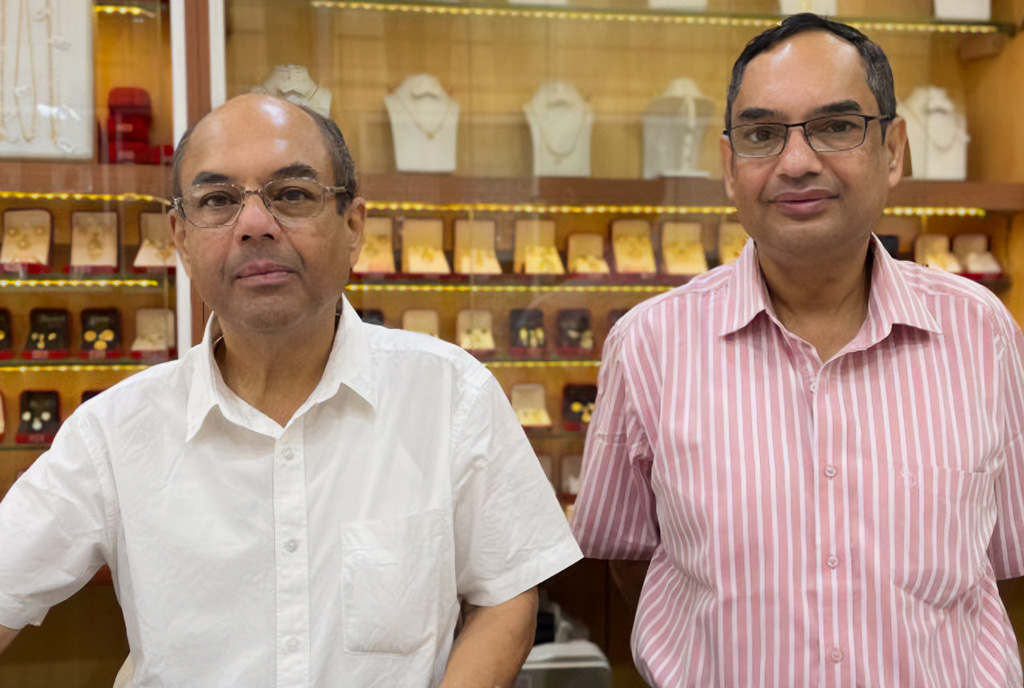
The brothers behind the successful Meena Jewellers chain, Sanjay and Vinay Jethwani, were considering a huge expansion across Dubai last year for the shop they inherited from their father in 1993. That was put on hold.
Because after decades of rapid growth in the UAE's gold trade, it was the Covid-19 pandemic that finally slowed things down.
At its lowest point in 2019, the price of gold was around $1,200 an ounce. After hitting a record high of more than $2,000 an ounce in 2020, it has now fallen back to around $1,800.
Hoping for Brighter Days

Mehul says the pandemic wiped out around 40% of his sales. Mihir and his family had a "terrible" six months and weren't sure they'd ever be able to start up again. The Javeri brothers felt a brief upturn during Diwali, but when they were interviewed late last year, business was once again barely there.
Rajesh Poplai, founder of Al Anwaar Jewellers, is hoping for brighter days ahead.
Poplai, too, grew up in a family of jewellers in Mumbai, where his father was a well-known wholesaler of gold and freshwater pearl jewellery. The family moved to Dubai, and when Rajesh was just 16, his father opened a shop for him to oversee.
"My parents weren't educated, but I did well in school. Under my father's guidance I sold a lot of gold and pearls," Rajesh says.
A lot has changed since then. The margins, once generous, are now thin. There's more pressure to be the best at everything. It's "a completely different playing field", he says.
"There are many, many players, too many offers, too much of everything. Customers are spoilt for choice. But we're a local brand, and people pay for the emotion and the experience."
Rajesh takes pride in the offerings that set him apart: exquisite pieces he describes as "art", pigeon-blood rubies, Golconda diamonds. He admits, though, that many people aren't interested in what they don't know.
"I love to sell the best of the best, but not everyone appreciates it. Business is about selling good-quality goods at good prices."
These days Al Anwaar has outlets in Mumbai and Dubai, including a coveted spot in the Dubai Mall.
Rajesh is proud of their growth. But he isn't sure it could have happened anywhere else in the world.
"The locals know us, we grew up with their culture and their blessings. This region has done so much good for us."