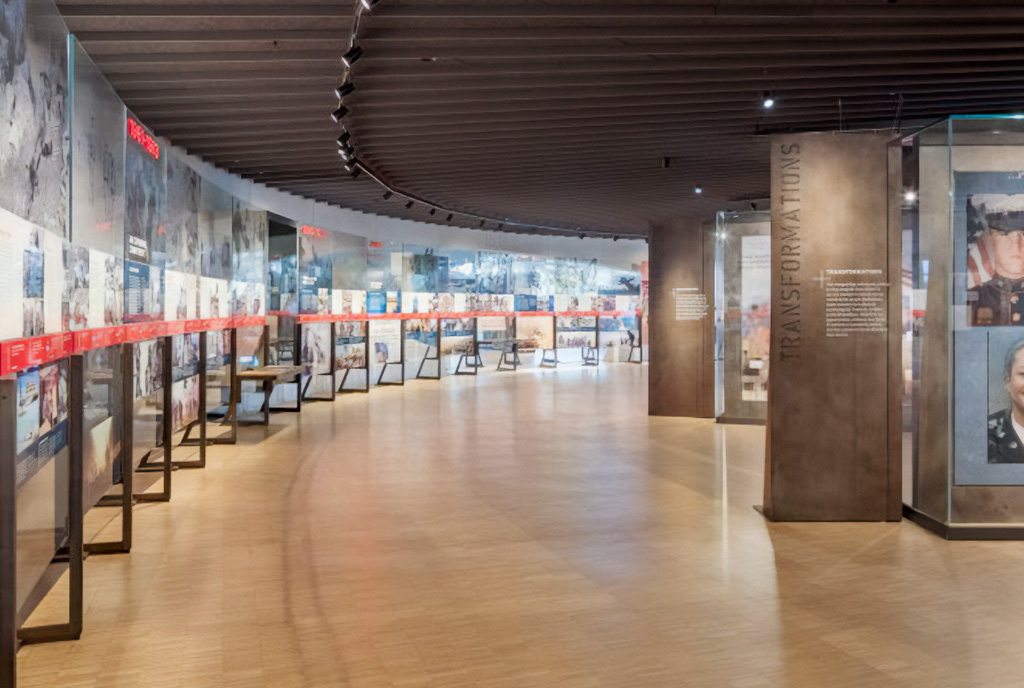


Military museums across the United States and around the world often invite visitors to walk through exhibits about the world wars, honoring the memory of the men and women who gave their lives for their country.
The National Veterans Memorial and Museum has a broader goal: to represent veterans, not just war.
Stories of war are certainly present, but they are not the main focus. Instead, the attention falls on the decision to serve, on training and boot camp, on the sacred oath, on deployment and service roles, on the separation from friends and family, on survival, sacrifice, and the journey home.
Partner links: booking through them supports the blog at no extra cost to you.
Columbus, the capital and largest city of Ohio, is home to the National Veterans Memorial and Museum. The $82 million project opened in October 2018 after six years of planning and construction.
The museum was granted national status by Congress and President Donald Trump.
The museum's participants, the veterans whose stories fill the various exhibits, and the organizers all believe that the accounts on display here have never truly been told before, not in this way, not this thoroughly.
Thank You for Your Service
The 53,000-square-foot building sits along the Scioto River in downtown Columbus. Conceived by the late John Glenn and created by the architecture and design firm Allied Works, the structure features an outdoor ceremonial space and a rooftop sanctuary at the center of concentric concrete rings.

The museum's exhibits make clear that it is neither a war memorial nor a military museum. It is a space devoted to the stories and experiences of all veterans. Theodore Roosevelt, a war hero, is featured alongside those you would never find in a history textbook.
African Americans, Latinos, Asians, men, women, the poor, the wealthy, well-known politicians, and virtually unknown people from every era, from the Revolutionary War to the war in Afghanistan, are represented and honored here.
While many civilians may find it hard to draw parallels between these very different periods of history, the NVMM ties these stories together through video interviews, audio recordings, touchscreens, handwritten letters, and a timeline.
Military matters may no longer be taboo, but they are hardly the most accessible topic either.
The exhibits at the NVMM aim not only to honor veterans but also to educate civilians. With fewer men and women in service than ever before (in fact, less than 1% of the population), there is less conversation about the armed forces as a whole.
During World War II, for instance, 16 million people served. In 2018, there are fewer than three million members of the Department of Defense, including those on active duty, in the reserves, and in staff roles.

Guy Worley, president of the Columbus Downtown Development Corporation, wants the museum to "unite, inspire, and educate" young people. Since most of the population in the United States has not served in the military, Worley believes it is important to foster understanding between different groups.
Glenn played a key role in creating the NVMM and securing its place in educating the non-military community about how and why we enjoy our freedoms.
The Choice to Serve
Because veterans' stories are complex and layered, the museum guides visitors through a journey with many stages. The goal is not to persuade people to enlist, but to help them understand what it means to serve, and perhaps to inspire different acts of service.
Colonel Tom Moe, a retired member of the U.S. Air Force, left behind a wife and a 3-month-old daughter when he shipped out to Vietnam. Moe was a prisoner of war for more than five years, yet his homecoming is just as much a part of his journey as the agonizing years he endured in captivity.
He has been involved with the NVMM from the very beginning, and he believes it is essential for those with no ties to the military to "really understand the impact that veterans have on society, the positive impact."
Moe's decision to join the Air Force can be traced back to family members who fought in World War II. Moe says he wanted to "try to do for the people of Vietnam what my father and relatives did to help free Germany and Japan, and so on..."
Standing before a replica of his footlocker in the museum, Moe pauses before acknowledging the role his wife, Chris, a civilian, played in his service. It is one of many elements in the museum that try to "show the family side," which he believes can help connect veterans and civilians.
Visitors who stop at the footlockers can lift the lid and hear both Colonel Moe and Chris, his wife of 53 years, speak. Photographs of the couple over the years weave together a complete story.

Every Role Matters
Jaspen Boothe, a disabled veteran who served in the Army for 17 years, first as a truck driver (88 Mike) and then as a human resources officer in ROTC (a college program that prepares young people for military service), says she was surprised to be asked to take part in creating the museum.
"Why do you want to interview me? Why do you want me to be a part of this?" she wondered.
Having never deployed to Iraq or Afghanistan, Boothe says she did not have what many consider a "sexy" military job.
In fact, it was a cancer diagnosis that kept Boothe behind a desk rather than out in the field, but she does not view her role as any less important, and she does not think anyone else should either.
Once the NVMM made its intentions clear, to be a museum that portrays the full military experience of any person of any role, gender, rank, and era, Boothe was on board.
"I think everyone who wore the uniform has a story, and it is important that all of those stories are told," Boothe says.
For her, the decision to serve her country had a great deal to do with honor, a word that deserves to be spoken with care. Boothe believed that if she took on a "difficult and honorable" profession, defying the stereotype of the single mother, her son would "learn that he too can achieve anything he wants, as long as he is dedicated and disciplined in getting the job done."

'We're All Green Here'
Jason Dominguez, who served in the Marine Corps and was deployed to Iraq, has also been actively involved with the museum since its creation. Like Moe, Dominguez was inspired by those who came before him. For as long as he can remember, he had always wanted to serve his country.
What he found in the Marine Corps was a diverse group of people from all walks of life and circumstances who shared at least one thing in common: the decision to serve.
"We're all green here. We're all green," Dominguez says, recalling his early days in the Marines, where every "color of the rainbow" stood together. Despite those outward differences, Dominguez says the only thing that mattered was that they were in it together, solving problems and overcoming hardships.
In the same way, physical objects such as real military rucksacks, uniforms, and personal footlockers may look different on the outside, but they are more alike than they are different. Museum visitors can try on pieces of various military uniforms and lift the heavy rucksacks that soldiers carry, catching a full-length glimpse of themselves in a mirror that is also part of this intimate, interactive exhibit.
When Dominguez and his wife, Raven, first walked through the museum, she voiced her surprise at seeing a Civil War era rucksack. "This is crazy," she exclaims, her eyes wide.
Dominguez stopped at the footlocker exhibit. "I love seeing footlockers from different eras," he said, pointing to a plastic locker from Iraq and another, sturdier one, from the Vietnam War era.
"Baby, I miss you. How are the kids? I can't wait to come home. The food is terrible. I'm cold, send me more socks." Relatable thoughts, needs, and wishes. Veterans can relate, and civilians can empathize.
Taking the Oath
Visitors can linger over the historical timeline on the left as they move through the museum's circular space, or they can spend time with the many interactive components on the right, closer to the edges of the space.
This is where the "Taking the Oath" section is found.
Dominguez recalled taking the oath. He compared it to getting married.
"You are making a commitment to something greater than yourself," he said, adding that "there are many who were born under our flag, but there are few who actually chose to become a part of it."
Coming Home
Rather than showing the stories of war and honoring the men and women who fought and stopping there, the NVMM carries the story forward. What was it like for soldiers to come home after combat? What do these reunions look like?
Moe's return, for example, meant, among other things, getting to know his daughter all over again. It meant coming back to Chris, who had been responsible for raising their daughter on her own for many years.
As for coming home, Moe never wavered in his belief that it would happen.
"I never had any doubt that I would come home," Moe says, growing emotional as he talks about friends who were not as fortunate. For him, the museum preserves the memory of the fallen, the men and women who died for their country.
These losses are the most meaningful part of Moe's service. Not his survival as a prisoner of war, not his resilience in the face of a difficult and emotional time in the U.S. Not his post-service work for Notre Dame's ROTC program. No, it is the men and women he lost. The lives America lost.
Boothe's experience differs from Moe's, and yet it too, like so many individual aspects of the veteran experience, shares a common denominator: compassion.
As the founder of Final Salute, an organization dedicated to providing safe and appropriate housing for homeless women veterans and their children, Boothe saw firsthand the lack of support services available to women veterans and decided to do something about it.
"I took an oath 17 years ago never to leave a fallen comrade, so I'm just doing my part," Boothe explained. "If everyone did something, there would be nothing left to do, and the world would be a better place."
The National Veterans Memorial and Museum is located in Columbus, Ohio. This Midwestern city is within a day's drive or a one-hour flight for much of the United States and Canada. John Glenn Columbus International Airport offers several daily flight options. The museum is open from 10:00 a.m. to 5:00 p.m., Wednesday through Sunday; Wednesdays are reserved for guests aged 65 and older, individuals with underlying health conditions, and those accompanying them.