

Donkeys pick their way through narrow lanes past doorways and low arches, suddenly bearing down on startled tourists, while the locals carry on their way without paying them any mind.
The old stone walls carry the gentle hum of conversations in Arabic, Syriac, Armenian, Kurdish, Turoyo, Turkish and Aramaic, the ancient Semitic language believed to have once been spoken by Jesus.
This is Mardin, a city in southeast Turkey where thousands of years of history are visible on every corner.
Partner links: booking through them supports the blog at no extra cost to you.
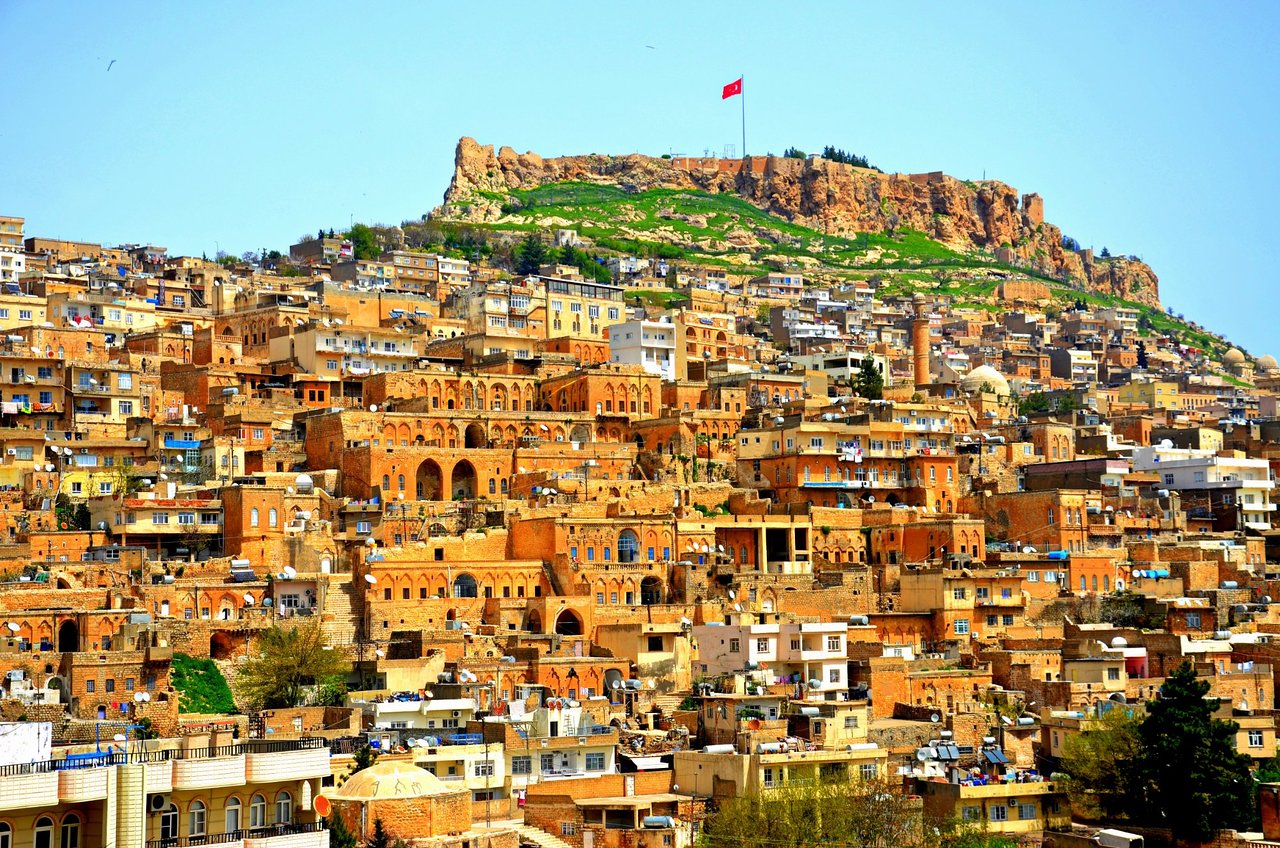
Seen from above, Mardin's buildings glow like white gold, forming a line of terraces built into a hillside that looks out over modern Syria. Once, though, this city was part of Mesopotamia, the region bounded by the Euphrates and Tigris rivers.
Mardin has a layered history and sits where great civilizations such as the Sumerians and Babylonians rose to power.
Changing Hands
In Mardin, there is history and culture around every corner.
At one time or another, almost everyone owned a piece of Mardin. The Nabataean Arabs called it home from 150 BC to 250 AD, but by the fourth century it was an important Syriac Christian settlement founded by the Assyrians. Then came the Romans and the Byzantines.
In the 11th century the Seljuk Turks decided to make it their own, but they were thwarted by the arrival of the Artuqid Turkomans in the 12th century.
This dynasty, originally from northern Iraq (Diyarbakir, in present-day Turkey), managed to hold on to power for three hundred years, until the Mongols took the reins. They, in turn, were succeeded by a Persian Turkoman monarchy.
Remarkably, when the Ottoman Sultan Selim the Grim seized power in 1517, the city still had a Christian population. Today, Mardin has a unique atmosphere and character thanks to this wealth of ethnic and religious traditions.
Despite its great age, Mardin is a living, vibrant city where the past lives on in the present.
Take Kirklar Kilisesi, also known as Mor Behnam, one of seven Syriac Orthodox churches. Originally built in 569, it is a place where the past and present meet.
Architecturally, the church is simple in itself. On the outside, an elegant domed bell tower crowned with a cross sits in a rectangular courtyard enclosed by golden walls. Inside, regular services take place as part of an unbroken tradition that Aramaic Christians have kept alive for more than 700 years.
The Queen of Snakes
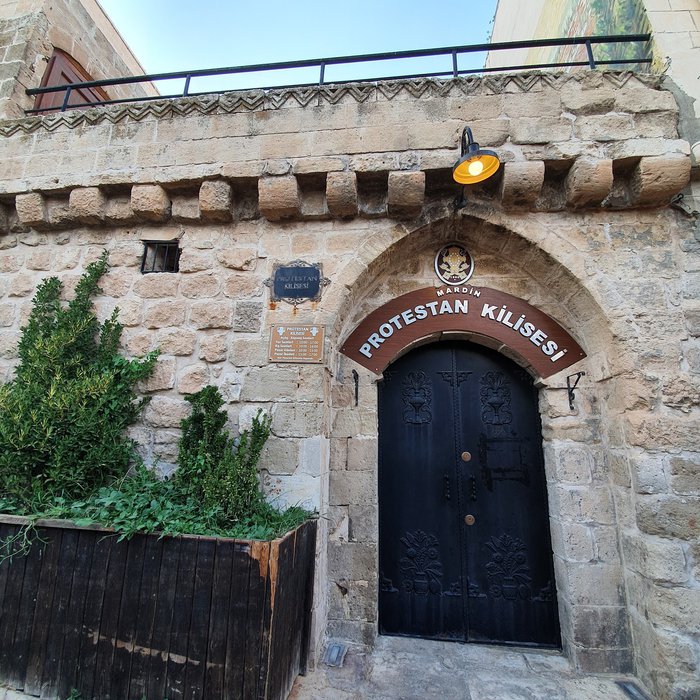
A few streets away stands Mardin's Protestant church, built by American believers more than 150 years ago, where a congregation is active again after a break of nearly 60 years, and where shop windows are decorated with paintings of the Shahmaran.
The mythical half-serpent, half-woman Shahmaran takes her name from Persian. Shah means king (or in this case queen), and mar means snake, so Shahmaran was the queen of snakes. According to Anatolian folklore, she lived in Mardin.
The ornamentation of the Abdullatif Mosque, built in 1371, stands in sharp contrast to the austerity of the churches.
Its two great portals are decorated with carving so exquisite that it is hard to believe they were made from solid stone. A recessed stalactite carving forms the centerpiece, framed by vertical and horizontal patterned stonework.
The Deyrulzafaran Monastery (House of Saffron) is the original seat of the Syriac Orthodox Patriarchate.
The mosque is a sublime example of Artuqid-period architecture, and the Zinciriye Medresesi religious school, dating from 1385, is another. The seminary, also known as the Isa Bey Medresesi in honor of the last Artuqid sultan, has an impressive doorway built with refined masonry. The ribbing of the stone domes on the roof makes them seem lighter than air. Pretty gardens lead to a small mosque with a richly carved mihrab niche pointing the way to Mecca.
The post office is also well worth a look, and for good reason. Converted for public use in the 1950s, it caught the attention of domestic tourists in the early 2000s when it was used as a set for the popular Turkish miniseries "Sila".
The building was originally designed as a private home by the Armenian architect Sarkis Elyas Lole in 1890. Steps lead through a small arch onto a large terrace overlooking the Sehidiye Mosque and the empty plains beyond.
In 1889 Lole also built cavalry barracks, which now house the Sakip Sabanci Mardin City Museum. The museum's displays include realistic paintings and contemporary exhibitions that give a clear picture of everyday life in Mardin, both past and present.
At the Mardin Museum, housed in the former Assyrian Catholic Patriarchate building dating from 1895, ancient history is represented by artifacts from Mesopotamia and Assyria, Roman mosaics and objects from the Ottoman era.
An Underground Refuge
Mardin is thought to have taken its name from the fortifications on the hilltop.
Walk in any direction and Mardin's streets will reveal wonderful views, and none rivals the Ulu Camii, the Great Mosque. Although it was founded by the Seljuk Turks, its present appearance owes much to the Artuqid ruler Qutb al-Din Ilghazi II.
He commissioned new work in 1176, and the Ottomans completed it in the 18th and 19th centuries.
The surface of the mosque's single surviving minaret is decorated with Seljuk, Artuqid and Ottoman inscriptions. This obsession with detail is reflected in telkari, the filigree silver jewelry sold in many shops, although most pieces are made in family workshops in nearby Midyat.
A few miles from the city stands the somber yet majestic Deyrulzafaran Monastery (House of Saffron), the original seat of the Syriac Orthodox Patriarchate. This large walled complex was built on a site once devoted to sun worship.
Although it was destroyed by the Persians and later plundered by the 14th-century Mongol-Turkic conqueror Tamerlane, the original underground sanctuary still survives.
Guided tours lead visitors through finely carved 300-year-old wooden doors, past Syriac inscriptions, centuries-old wooden kettledrums and thrones, hand-embroidered biblical scenes and other religious artifacts. Simple guest rooms accommodate the devout who come to attend services held in Aramaic.
Meanwhile, excavations at Dara, an important Eastern Roman military town 19 miles from Mardin, have been under way since 1986.
The finds have been abundant, to say the least. The most recent was an olive workshop dating from the sixth century. It confirms that the town was an important center for olive oil production and trade, as well as the site of numerous military conflicts.
Many underground cisterns left over from Mesopotamia's original irrigation system are open to visitors. One is so vast that locals call it the "zindan", or dungeon, and tell stories of it being used as a prison. It descends 82 feet underground, with access through the basement of a village house, provided you can find the person with the key.
Another ancient landmark of Mardin is its citadel. In the Roman period the city was called Marida, an ancient Neo-Aramaic word meaning fortress.
The citadel stands very high above the city, and although a path leads almost to its very gates, it is not open to visitors. Some may feel the effort (and the risk of heatstroke in summer) is worth it for the sake of the magnificent views.
Others prefer to stay in town and enjoy a glass of wine. Most local winemakers are Assyrians. They follow age-old traditions and use regional grapes for wines quite unlike any you will find elsewhere in the country. It is, perhaps, a fitting way to pay tribute to Mardin's multicultural makeup.