

Driving the beautiful winding back roads of Georgia's remote western region of Imereti is a real joy, though it isn't something you'd normally link to a religious experience.
That is, until you turn onto a hidden lane marked by a signpost with a church on it.
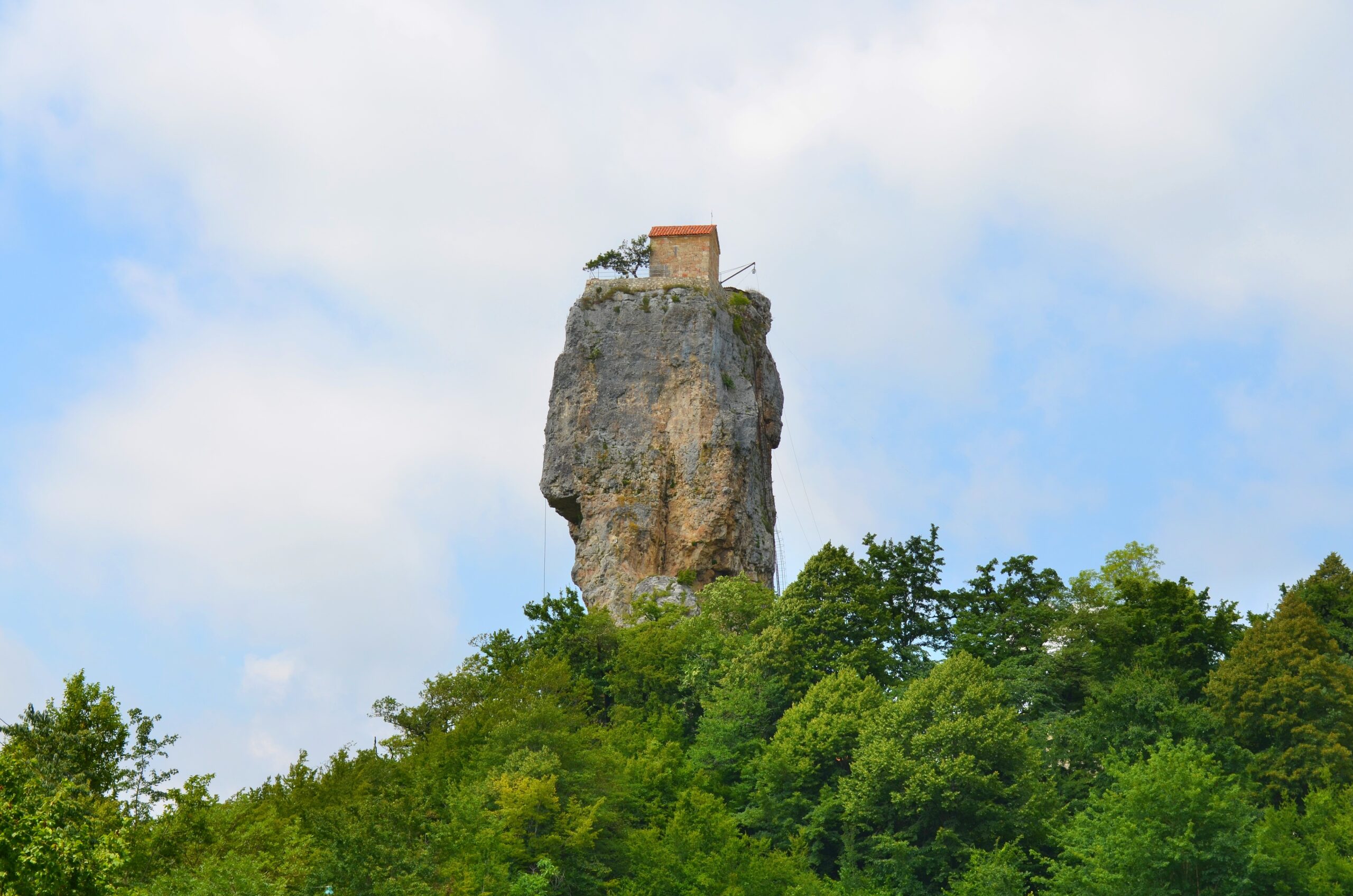
This is the road to the Katskhi Pillar, a natural limestone monolith that soars more than 130 feet, or 40 meters, into the air, crowned by what may well be the most isolated and sacred church in the world.
Partner links: booking through them supports the blog at no extra cost to you.
Set roughly 200 kilometers (about 125 miles) west of Georgia's capital, Tbilisi, this remarkable landmark is famously hard to reach. No trains run to this part of the region, so the only way here is by car or bus, but it's well worth the effort.
The final stretch is done on foot, a 20-minute walk during which the monolith suddenly rises on the horizon of Georgia's brilliant landscape. It's an enchanting sight, and it only grows more striking the closer you get to the pillar. A steep climb up crumbling steps is the sign that visitors are almost there.
At the foot of the column, a monastery and a small chapel come into view on the right. To the left, the 130-foot limestone column towers in all its captivating splendor.
The Wine Cellar
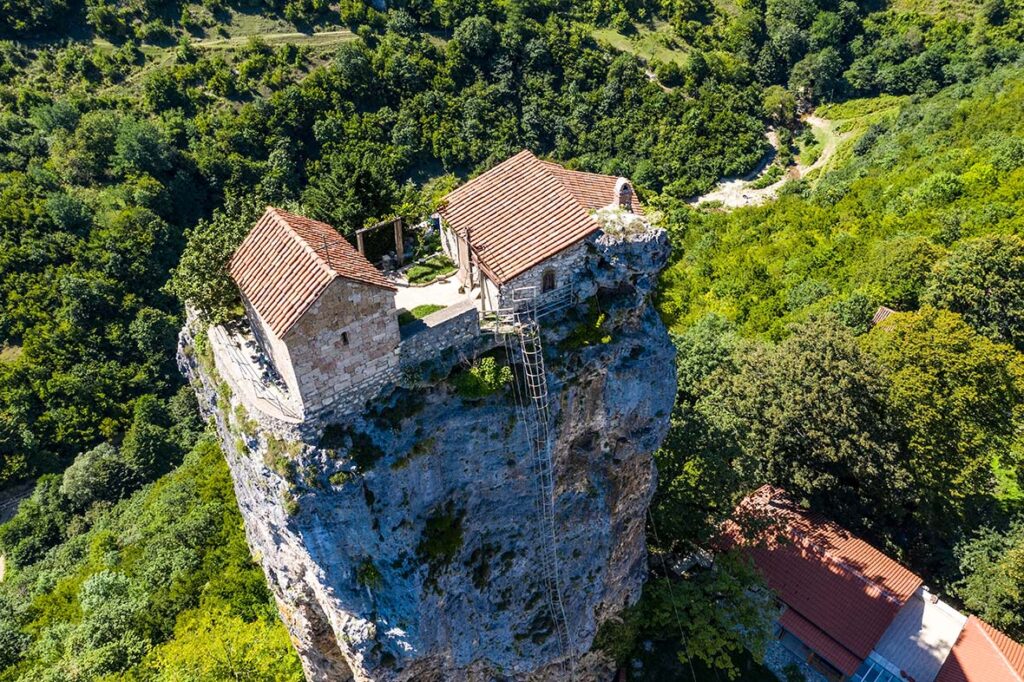
The Katskhi complex is one of a kind. Perched on top of the column is a church built between the 6th and 8th centuries and dedicated to Maximus the Confessor, a 7th-century monk. Alongside it are a burial chamber, a wine cellar, a curtain wall and three hermit cells.
Each day the monks who live below make the nerve-racking 20-minute climb up a thin metal ladder bolted to the side of the rock. It's believed that this daily pilgrimage, praying at the summit, brings them closer to God.
Until 2015 you could meet Father Maxime Qavtaradze here, who spent most of his time on the pillar for 20 years and was the last monk to live at the top. In 1995, Qavtaradze built a new church on the rock.
Beneath the column, or rock, stand a newly built Church of Simeon Stylites, a monastery and the ruins of an old wall and bell tower.
Today the pillar is still revered as one of the holiest sites on Earth. Local monks are the only people on the planet allowed to make the 20-minute climb up the steel ladder set on the side of the column to the very top.
The ascent from the monastery below to the church above is a daily pilgrimage, considered the finest way to offer oneself to God.
Strict Rules
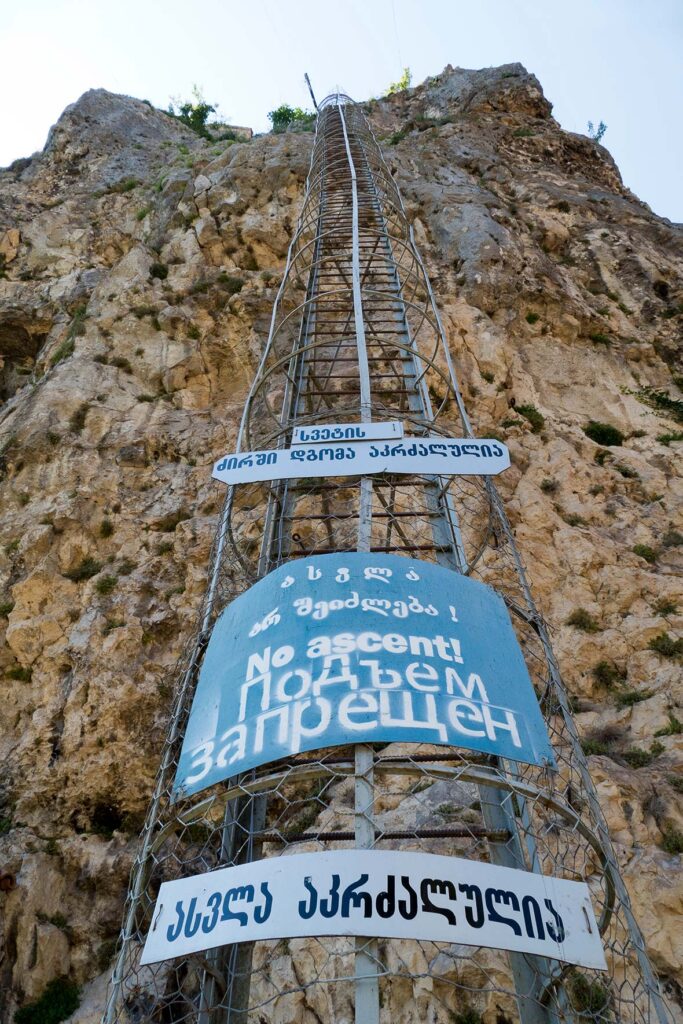
Only men belonging to the religious order may now climb the ladder to the heavens. Women have never in history been allowed to ascend the column.
The head of the monastery, Ilarion, explains that since 2018, by order of Patriarch Ilia II, the spiritual leader of the Georgian Orthodox Church, the public has been forbidden from climbing the column to visit the church at the top.
"The Patriarch issued a decree stating that only monks may enter the church at the top of the pillar. Until he lifts that order, we have no right to let visitors up there," says Ilarion.
Even though they are now among those barred from climbing to the summit, locals take great pride in their landmark, honored around the world as the "pillar of life" and the "symbol of the true cross."
Local resident Giorgi Tsertsvadze believes the restrictions that have been introduced will help preserve the Katskhi shrine.
"Only religious people can climb the mountain, and we respect that decision," he says. "Part of it is to protect the buildings, but it's also to keep the place holy."
The pillar itself remained unconquered until 1944, when an expedition led by Georgian mountaineer Alexander Japaridze and writer Levan Gotua set out for the summit to study it more fully.
At the time it was thought the buildings on top of the pillar had been constructed in the 5th and 6th centuries, but the Georgian National Museum later revised that estimate to the 9th and 10th centuries.
A Forbidden Journey
Ilarion says: "There are many false stories about the pillar, so it's important that people hear the true one.
"The first monks began living in the church in the 10th and 11th centuries, and they lived at the top of the pillar. Today the monks don't live there; we only climb up to pray, and then we return to the monastery below," he adds.
Even though climbing to the top of the pillar is now forbidden, there's still plenty to see at the Katskhi complex.
The monastery building and the surrounding complex were restored in 2009 as part of a state program, and the work continues to this day, letting visitors experience something close to how it was more than 1,000 years ago. A new visitor center and a small souvenir shop are currently under construction.
You can still climb to the first level of the column, where there is a place for prayer and a 6th-century cross carved into the limestone, one of the earliest surviving examples of Christian symbolism. Here you can also light a candle and pray in a hollow cut into the rock.
"This site was first recognized as Christian in the 6th century, when a cross was carved into the base of the pillar," Ilarion recounts. "The church was built later, and despite its age, the complex is fully functioning even today."
At ground level stands the Church of Simeon Stylites, a small, quaint chapel adorned with decorative and applied art and religious artifacts. This quiet, peaceful building is open for visitors to pray. Inside is a collection of magnificent frescoes, along with a small altar and a place for prayer where you can light a candle.
As you leave the chapel, a wonderful view opens up over the beautiful Georgian countryside, with the column standing off to the right.
In the distance, through a gate to the right of the chapel, the monastery itself is also visible. Ilarion and the other monks are happy to stroll the monastery grounds, chatting with visitors and sharing their wisdom with anyone who wishes to hear it.
How to Get There
There are two main routes to reach the Katskhi Pillar.
From Tbilisi
The bus ride from Tbilisi's Didube bus station to Chiatura takes three to three and a half hours. While there are no official websites for national buses and/or marshrutkas (minibuses) in Georgia, buses generally run hourly from 7 a.m. to 9 p.m. daily. Once you arrive in Chiatura, a local taxi will take you to the Katskhi Pillar.
From Batumi
Buses from Batumi to Kutaisi run hourly from 7 a.m., and the journey takes a little over two hours. In Kutaisi, passengers can switch to another bus and reach Chiatura in about an hour. Along the way, the buses stop right at the entrance to the pillar complex.