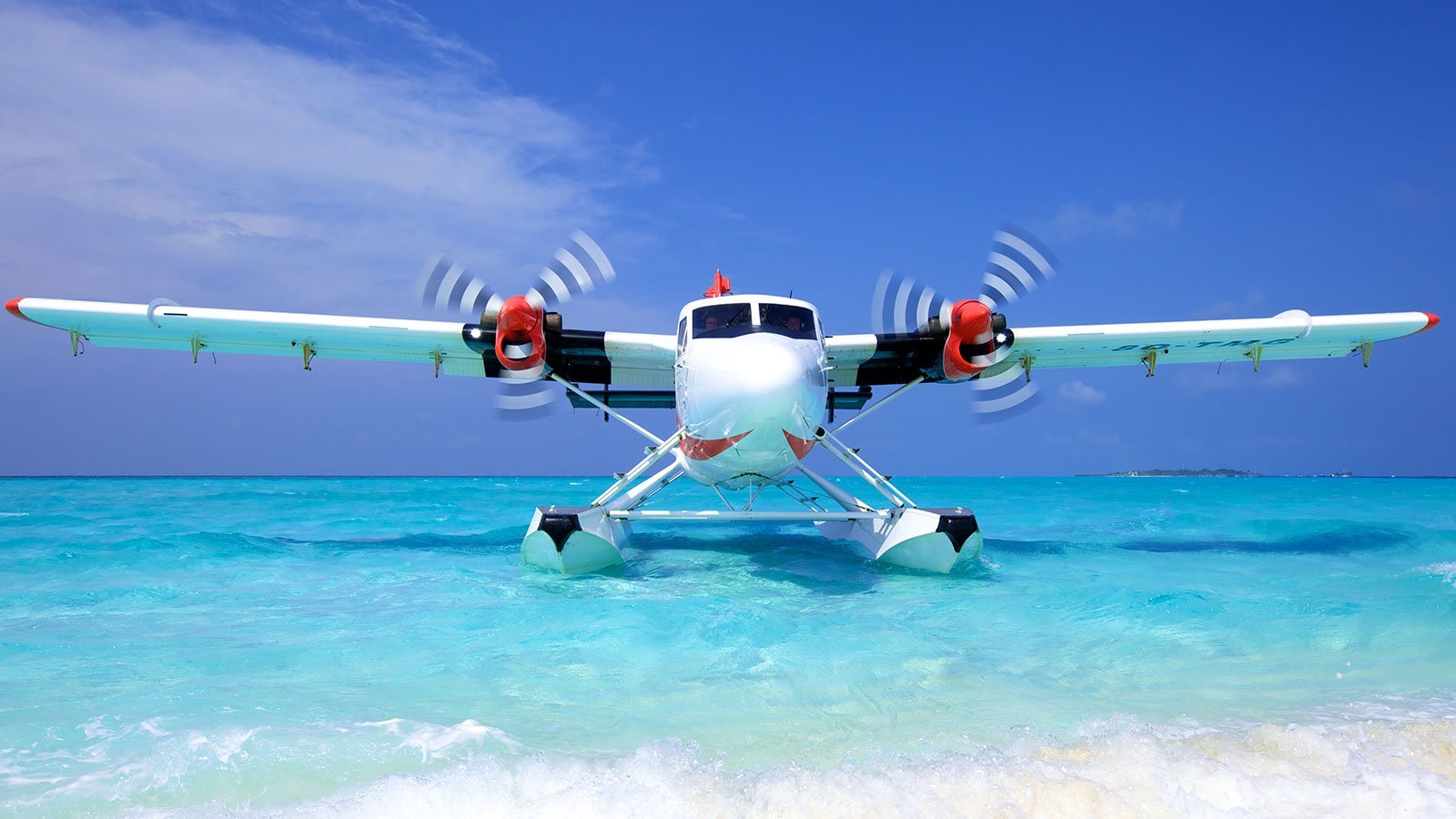


If you are heading off on a Maldives holiday, there is a very good chance your trip will include a seaplane flight.
This popular Indian Ocean destination is made up of 26 atolls dotted with more than 1,000 islands, home to dozens of resorts, all spread across an area of 90,000 square kilometers.
As more resorts open in ever more remote spots, reaching them by boat from Velana International Airport in the Maldivian capital of Male becomes simply out of the question for most travelers.
Partner links: booking through them supports the blog at no extra cost to you.
That is where Trans Maldivian Airways comes in.
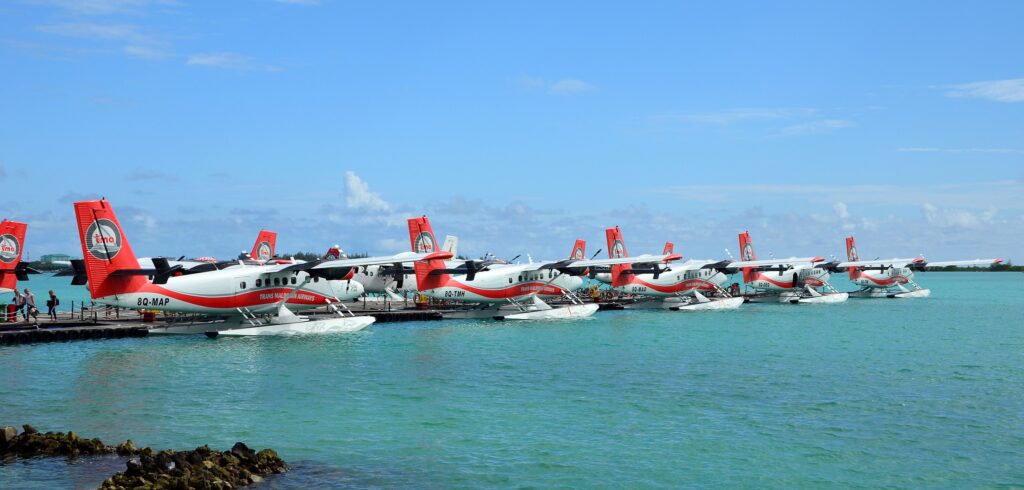
It is the largest seaplane operator in the world, with a fleet of 50 aircraft flown by around 200 pilots, and it runs more than 100,000 flights a year, ferrying passengers to dozens of Maldivian resorts.
There are a few things that set Trans Maldivian pilots apart from their commercial counterparts around the globe.
For a start, their runway is, quite obviously, on the water.
Then there is their attire. While the pilots wear a standard uniform from the waist up, it is paired with shorts and sandals.
That is, unless they are up in the air.
"We call ourselves the 'barefoot pilots,' because once we are in the plane we actually take off our sandals and fly barefoot on the pedals," says Captain Andrew Farr.
"It gives you a really nice feel."
It is quite a sight to watch these intrepid pilots slip off their sandals, tan lines showing, as they steer the air-conditioning-free aircraft up from its aquamarine base and into the sky, the engines roaring loudly, the smell of fuel filling the air.
Landing on water versus land
Farr, who has worked for the airline for more than 10 years, hails from Canada.
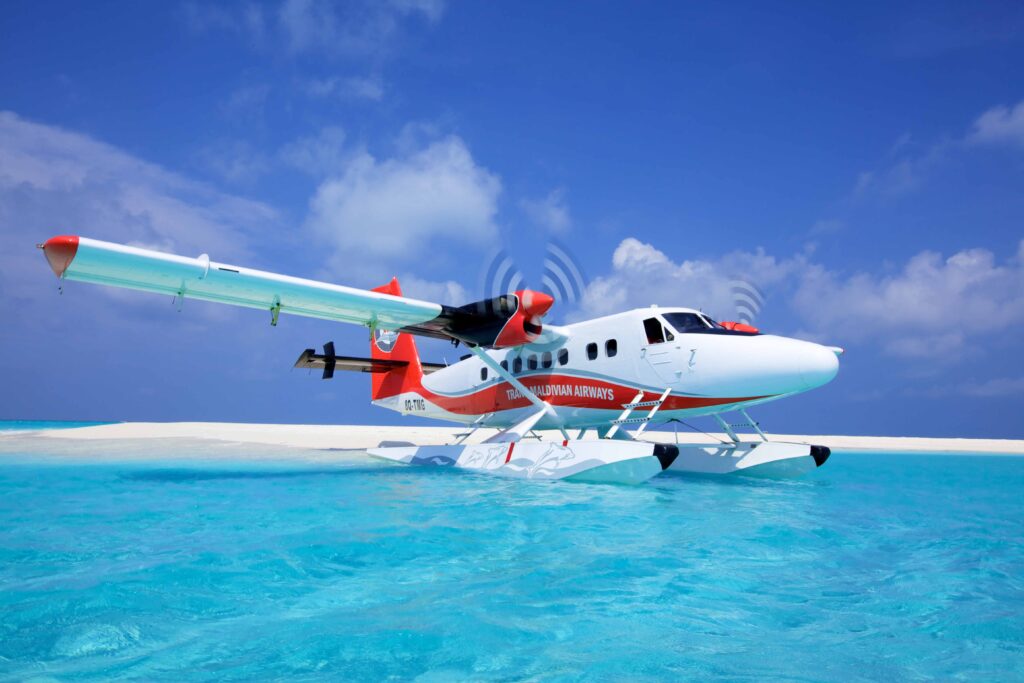
That feels rather fitting, given that Trans Maldivian's entire fleet is made up of Twin Otters, which were built in Canada.
These twin-engine turbine aircraft can be fitted with wheels, skis or floats, which makes them ideal for operating in just about any conditions, from the sub-zero Arctic temperatures of a Canadian winter to the tropical climate of places like the Caribbean.
"I find it far more interesting and challenging to land on water, because the water is constantly changing," says Farr.
"You can have a perfectly clear day, and everyone assumes that is the easiest time to land. But it is not, because the sky reflects off the water. You have to be very careful when landing on glassy water."
"During the southwest monsoon we get strong winds, and the waves can sometimes reach four or five feet high, sometimes more. I really enjoy adapting to that and having different ways of landing in different conditions."
Logistical challenges
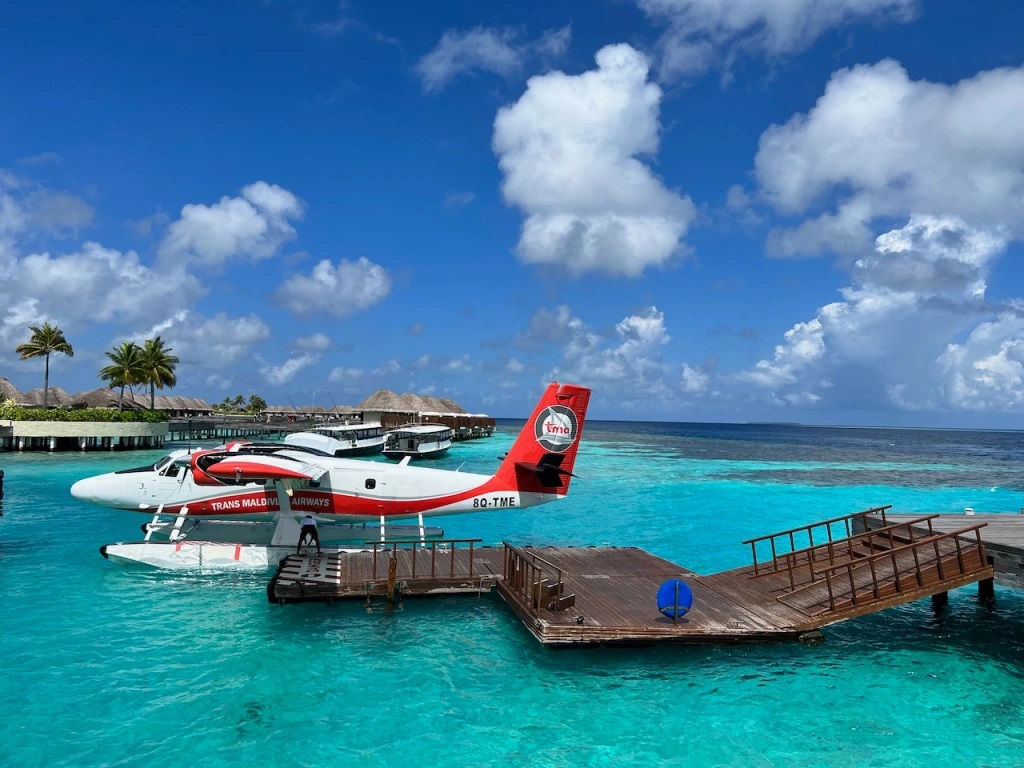
Unlike a regular commercial airline, the Trans Maldivian schedule shifts by the hour, depending on the needs of the resorts and on whether passengers are arriving for their holiday or rushing to catch an international flight home.
The weather adds another dimension.
"Sometimes, for example, the weather is really bad, and you have to circle around and around before you can reach the resort," says Farr. "You might land five minutes late, and that shifts the entire schedule."
Operations fit into a relatively short window, because the aircraft only fly during daylight hours under VFR, the visual flight rules. In short, the pilots have to be able to see where they are landing.
"We are limited to the hours between sunrise and sunset, and most of the time we fly from sunrise to sunset," Farr says.
Occasionally that means pilots get to spend the night at a luxury resort, if the last landing of the day runs too late. Another perk of the job.
But there is a flip side. Every day Farr's alarm goes off at 4 a.m., and by 5:20 a.m. he is already at Trans Maldivian headquarters.
After pre-flight preparation, he takes off at 6 a.m.
The rest of the day is spent flying across the Maldivian sky.
"On average, we probably do about five flights a day, covering 10 to 12 sectors, which means that over the course of a day we visit 10 to 12 different resorts," he explains, adding that it adds up to roughly five hours of flying a day.
Preparing for a flight includes working out the weight of the aircraft.
The maximum takeoff weight of a Twin Otter is 12,500 pounds, though not every aircraft weighs the same, Farr says.
So you take what is known as the aircraft's "basic empty weight," and then work out what the useful load can be. And that has to include fuel, passengers and baggage.
"When we get here in the morning, you inspect the aircraft, walk around it to make sure everything is working properly, nothing is broken and so on. Then a message comes through to your phone telling you where you are flying, how much fuel you need, how many passengers there are and the weight of the baggage. After that you have to calculate the center of gravity and the balance of the aircraft."
The airline operates two variants of the Twin Otter. That is because the De Havilland DHC-6 Twin Otter went out of production in the late eighties, but in the 2000s the rights to build it were acquired by the Canadian company Viking.
"But they completely updated the avionics," Farr says.
"If you look inside the cockpit, it feels like you are in a 737 or a large jet. It is a fully glass cockpit with computer screens, so everything besides the airframe is practically no different from the older twin Otters. But when you are sitting in the cockpit, it is nothing like the old ones. We have to go through special training to fly them. And most of us fly it now."
The life of a floatplane pilot
Farr says his father was a pilot, so he was drawn to aviation from a very early age. By the age of seven he already knew he wanted to fly floatplanes, having taken his first ride in one on his birthday.
"I still remember the feeling: seeing the water on the float, flying over the cottage and watching my mom wave at me," he recalls with a smile.
"That is when I knew I wanted to make this my career for life."
As for what brought him to the Maldives, Farr says it was a combination of factors, including the absence of snow.
"As a floatplane pilot in Canada, I always knew about the operation out here, so getting here somehow was always my dream," he says.
"Not long before I came out, I was working in the far north, and one winter the temperature dropped to -52 C (-61.6 F), and I said, 'There has to be a better way.' I love Canada, do not get me wrong. If they could do something about the winter, I might live there again."
Farr is not the only expat. The airline employs plenty of pilots from Canada, the US and Europe, along with a handful from the Caribbean, on top of the local Maldivian pilots. He says pilots are constantly reaching out to him with questions about how to sign on with the airline.
For a start, you have to be trained as a commercial pilot.
"The average first officer arrives here with maybe 1,000 hours, and then he or she works for two or three years until they build up the experience needed to move up to captain," says Farr.
The training, he says, is very, very thorough, and it includes courses on the aircraft's systems, safety and emergency situations.
"It is just like flying for a regular airline, only a lot more fun," he says.
A big part of that fun is interacting with the passengers. Most of them are heading off on holiday, which means they are usually in a good mood.
"I would say at least once a week, if not more often, someone tells me I have the best job in the world. And I feel like I do," he says.
"Everyone is always smiling and really happy. Sometimes people tell me, 'This is my first time flying on a seaplane,' and I try very hard to make it the best flight of their life."
And then, of course, there are the views.
"Every day we fly over the same areas, but the scenery changes: the water, the colors, the sand, the light," Farr says.
"The view from my office is the best in the world."